
Saturday, October 17, 2026



News and Views from the Global South

Can Planting Trees Be Harmful?
- Environmentalists warn that monoculture of tree plantations threatens the Uruguayan environment. But there are no studies available on the true impacts of commercial forestry, which now covers more than 600,000 hectares, or four percent of productive land in this South American country.
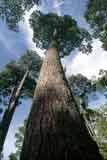
Pine is one of the preferred species for fast-growing tree crops. - Claudio Contreras.
Orderly rows of eucalyptus and pine trees are proliferating in Argentina, Brazil, Chile and Uruguay, representing 40 percent of the 10 million hectares of rapid-growth tree plantations worldwide.
Unlike other forestry plantations, these are intended only to produce “fast wood” at low cost — huge quantities of narrow tree trunks that serve as raw material for cellulose used to manufacture paper.
The Latin American forestry policies, encouraged by multilateral institutions and international cooperation agencies, “increasingly focus on promoting monoculture (of pines, eucalyptus or other species) rather than on protecting native forests,” Ricardo Carrere, coordinator of the World Rainforest Movement, WRM, told Tierramérica.
“The reason is that the forest is seen as a mine to be exploited,” he commented.
In Uruguay, Law 15.939 of 1987 led to “explosive growth of tree plantations between 1997 and 1998,” forestry agronomist Ariel Rodríguez Yáñez, co-author of that bill and former professor at the University of the Republic of Uruguay, told Tierramérica.
Subsidies, taxes that were never collected, soft credits and expenditures on road infrastructure total some 400 million dollars to promote the industry, according to WRM.
Fast-wood plantations now cover more than 600,000 hectares in Uruguay, or four percent of its productive land. The native temperate forests cover 810,000 hectares.
Rodríguez Yáñez, now working as an advisor to the forest product companies, says the policy was good, but has been unsuccessful because of the lack of industrialization. “We continue to be exporters of raw material, vulnerable to the fluctuations of the international market.”
Uruguay's forestry exports totaled 86.5 million dollars in 2002, with 43 million dollars representing raw wood, according to the national Forestry Directorate. The country's overall foreign sales that year reached 2.2 billion dollars.
The forestry industry involves some 1,500 producers, and U.S. and European transnationals predominate. The sector provides around 3,000 permanent jobs in this country of 3.4 million people, according to the 2000 agricultural census.
Seasonal work — planting, pruning and harvest — is not included in the statistics. Workers are hired through intermediaries and generally are not covered by Uruguayan labor legislation.
The initial boom hit the brakes due to a delay in subsidy payments, which is five years behind. After the devaluation of the Uruguayan peso in 2002, even the subsidies failed to be attractive.
But the pines and eucalyptus are still there. The expectations for industrialization are focused on plans of Spanish and Finnish companies to set up two cellulose factories in western Uruguay — plans that have come under fire for their potential threat to the environment.
According to the forestry law, forests are areas “in which trees predominate, regardless of size, exploited or not, and which are in conditions to produce wood or other forestry products or to exercise influence in the conservation of soils, the watershed or climate, or which provide shelter or other benefits of national interest.”
But the only thing in common between forests and plantations are the trees, argue environmentalists.
Forests contain a diversity of trees and bushes of different ages, other related species and provide shelter, food and reproductive conditions for a variety of animal life. This biological diversity interacts with the soil, the water, the solar energy and climate, ensuring regeneration and conservation.
In contrast, monoculture plantations involve one or a handful of species planted in plots and all are the same age. They require the intensive use of agro-chemicals and very few native species are able to grow in those areas.
But does that make tree plantations harmful to the environment? In Uruguay, there is no way of knowing for sure. Legislation for evaluating environmental impacts excludes the forestry industry — as if it were assumed that planting trees could never be detrimental.
Environmental groups are demanding independent environmental impact studies, and argue that the big plantations of pines and eucalyptus lead to soil erosion and alter the natural water cycle, in addition to threatening native forest and grassland ecosystems.
“For better or worse, forestation modifies the structural conditions of the soil due to the root system of the trees,” acknowledged Rodríguez Yáñez.
Uruguay is promoting commercial tree plantations in areas where there is lower output of the country's emblematic products: beef and wool. In practice, this has meant plantations taking over natural grasslands — Uruguay's most extensive ecosystem and most diverse in plant life — and in areas where there used to be natural forests or remnants of them.
“Our greatest biodiversity of plants is not in the forests, where there are some 200 species of trees and bushes,” said WRM's Carrere. “There are thousands of plant species in our prairies that could be hurt” by commercial forestry.
The forestry law prohibits logging of native forests but does allow the felling of isolated trees if they stand in the way of a plantation.
In other regions of the world, the loss of biodiversity has been established as being related to monoculture tree plantations.
At the end of 2001, Indonesia had 1.4 million hectares of tree plantations, half on land that was previously natural forest, according to the study “Fast-Wood Forestry: Myths and Realities”, published in 2003 by four international institutions.
The report states that rapid-growth tree plantations are expanding by one million hectares a year.
The groups responsible for the study were the Center for International Forestry Research, financed by multilateral agencies, governments and corporations; the World Conservation Union (IUCN); the World Wildlife Fund; and Forest Trends, an advisory group for the forestry industry.
Authors Christian Cossalter and Charlie Pye-Smith are looking for a midway point between the arguments of environmentalists and of industry, but acknowledge that commercial forestry has caused social and environmental problems “in some situations.”
They suggest that governments eliminate or drastically reduce subsidies for monoculture tree plantations.
 Print
|
Print
|




