
Thursday, October 22, 2026



News and Views from the Global South
UN Peacebuilding Week: Military Expenditure Soars as Funding for Civilian Protection and Prevention Collapses
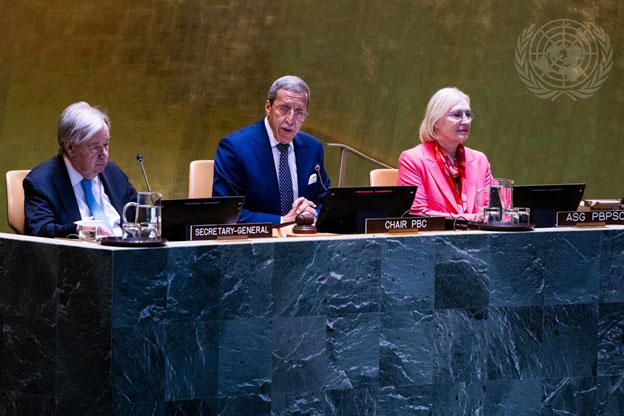
The UN Peacebuilding Commission Celebrates 20 Years of UN Peacebuilding Architecture. Credit: UN Photo/Eskinder Debebe
- From June 22 to 26, the United Nations (UN) commemorated its first annual Peacebuilding Week, marking the 20th anniversary of the UN Peacebuilding Commission’s inaugural session. Featuring discussions among world leaders, policymakers, civil society, and advocates, the event explored how collaboration among governments, international organizations, and the private sector can enhance the visibility and effectiveness of peacebuilding efforts worldwide.
The goals of the Peacebuilding Week are particularly critical today, as increasing geopolitical tensions fracture international cooperation and severe financing shortfalls deplete resources, hindering relief efforts for civilians trapped in conflict. Despite a historic surge in active armed conflicts worldwide recorded over the past two years, peacebuilding and relief funding suffered a severe 40 percent decline between 2024 and 2025, leaving millions of people around the globe in a state of extreme insecurity.
“Peace does not occur automatically. It is built through persistent diplomacy, collective action and political will,” said Annalena Baerbock, President of the UN General Assembly. “Wars that never happen because of peacebuilding, conflict-prevention or sustainable-development efforts rarely make headlines. Yet, like everything else, peacebuilding is only possible when properly resourced.”
On June 26, the Peacebuilding Impact Hub—part of the Peacebuilding and Peace Support Office (PBPSO) within the UN Departments of Political and Peacebuilding Affairs and Peace Operations (DPPA-DPO)—launched its inaugural Peacebuilding Overview, titled Investing in Peace When the World Pays for War. This report analyzes data gathered from governments, civil society, scholars, and UN field operations across numerous, diverse contexts.
By addressing the root causes of conflict and encouraging the implementation of digital technologies—alongside active participation from youth and the private sector—the report aims to forge new paths for peacebuilding that are resilient, inclusive, and globally supported. Aiming to identify structural gaps in data sharing that prevent vital information from being shared internationally and from being fully utilized by policymakers and the public, the report was launched alongside a side event titled Building Peace in a Changing World.
At the event, Paul Fargues, one of the report’s authors and a Political Affairs Officer for the UN Department for Political and Peacebuilding Affairs (DPPA), told reporters that the world is currently at a “crossroads, where conflict is on the rise, good governance is declining, and civic space is shrinking.” He noted that this is compounded by severe budget cuts and disproportionate investment in military expenditure rather than civilian protection and prevention efforts, making humanitarian relief operations increasingly difficult.
According to the report, over the last two decades, the world has invested only one dollar in peacebuilding efforts for every 100 dollars spent on military expenditure. Fargues added that the world’s most vulnerable populations are projected to suffer the most, particularly in dire contexts where aid constitutes more than 60 percent of all external funding and acts as a vital lifeline. Additionally, the DDPA found that roughly two-thirds of the countries whose economies are most dependent on UN aid are also the ones most adversely affected by the funding cuts.
Fargues argued that some of the central obstacles in advancing peacebuilding efforts today are the persistent structural gaps in the dissemination of evidence and data, which is critically underdeveloped when compared to the development and humanitarian sectors.
“Peacebuilding has no underlying framework to create shared data practices, to generate insights at the global level to enhance evidence-based decision-making, or simply to communicate its value to broader non-technical audiences,” Fargues said. “Peacebuilders and those who support them must do a better job at measuring, proving, and communicating this. Given the incredibly challenging contexts, producing more robust data and evidence of impact is a bare minimum.”
Katherina Ahrendts, the Director-General for Global Order, United Nations and Humanitarian Assistance of the Federal Foreign Office of Germany, stated that although the case for investing in protection and prevention efforts is clear, political and financial contributions lag significantly behind. According to figures from the International Monetary Fund (IMF), for every dollar invested in preventive macroeconomic policies, up to 103 dollars could be generated in returns. DPPA also estimated that with adequate investment in prevention and protection measures, humanitarian needs could be reduced by approximately USD 3.6 billion annually.
Despite these potential gains, the economic case for peacebuilding efforts has not sufficiently influenced global investment priorities.“We are indeed at a critical moment when violent conflict is increasing while budgets are under strain and multilateralism as a whole is increasingly challenged,” said Ahrendts. “From a domestic policy standpoint, we need a much stronger business case, more compelling narratives, and better evidence. We need to showcase that peacebuilding is a smart, strategic, and cost-effective instrument that prevents much higher costs later on.”
“This means framing peacebuilding not only as a moral imperative, but as a matter of security, stability, mutual interests and sound investments. In particular, we need to make clear that peacebuilding and investment are an integral component of an effective security strategy,” she added.
Ana Escobar, the UN Representative for Peace Direct, an organization that empowers local peacebuilding efforts and supports community-driven approaches, remarked that peacebuilding must be grounded in a community-based approach and tailored to match the specific needs of vulnerable communities. Peace Direct defines meaningful impact as seeing communities become safer and more resilient long after external support has ceased.
Rather than implementing a pre-established peacebuilding agenda, Peace Direct works with local peacebuilders and community leaders to define what success looks like to them and identify the changes that they want to see. “That means asking different questions,” Escobar said. “Are communities resolving disputes without violence, and how do we measure that? Do women, youth, and marginalized groups have greater influence in decision-making? Is trust increasing between communities and institutions?”
“Peacebuilding is most effective when power, resources, and evidence flow in the same direction, towards the communities that live with conflict every day…. For local peacebuilders, prevention means that children go to school instead of joining armed groups, farmers return to their lands, markets reopen, women move safely, families remain together. Those are the returns communities measure every day,” added Escobar.
Dr. Cedric De Coning, a Senior Researcher in the Peace, Conflict and Development Research Group at the Norwegian Institute of International Affairs (NUPI), underscored the importance of adaptive peacebuilding. This approach calls for the continuous monitoring of data and updating of peacebuilding measures, acknowledging that a community’s dynamics are constantly shifting. Rather than framing peacebuilding as a rigid structure being “built”, Dr. De Coning argues that it is more of a continuous process that is “nurtured”.
“What adaptive peacebuilding says is that we cannot know that beforehand; it has to emerge from people affected by conflict or people in societies struggling to achieve peace themselves,” said Dr. De Coning.
“As peacebuilders, we have to accompany these societies, and we have to learn together with them constantly and adapt our understanding of what it is that we can support. But we should be careful not to measure peace as something that only makes sense for donor-funded projects…. Peace is something much broader, and we need to measure that broader social transformation: how societies are experiencing peace, how they are living the things they look at, is what we need to look at rather than measuring projects to please donors.”
IPS UN Bureau Report


 Print
|
Print
|




