
Tuesday, October 20, 2026



News and Views from the Global South
Opinion
People Who Choose to End Their Lives

Decisions about ending one’s life are often complex, reflecting a combination of medical, psychological, social, and personal considerations. Credit: Shutterstock
- People who choose to end their lives through voluntary assisted dying typically face terminal, incurable, or debilitating conditions that cause severe physical or psychological suffering.
Research on requests for medical assistance in dying and euthanasia shows that most individuals seeking these options have advanced, irreversible illnesses or incurable, debilitating conditions that cause severe suffering or diminish their autonomy, dignity, or the ability to engage in meaningful activities.
Eligibility requirements for medical assistance in dying vary by jurisdiction. Where access is restricted to terminally ill patients, individuals generally must have a prognosis of six months or less to live.
Other jurisdictions permit access under different eligibility criteria. Applicants generally must demonstrate decision-making capacity and make a voluntary, informed request. Independent medical assessments are generally required, and many jurisdictions impose waiting periods or other safeguards.
Amyotrophic lateral sclerosis (ALS), cancer, and other serious illnesses are frequently associated with requests for voluntary assisted dying. Other requests involve advanced cardiovascular and lung diseases, as well as neurodegenerative conditions, including Alzheimer’s disease and other forms of dementia.
Cancer, particularly when advanced and no longer responsive to treatment, can also involve severe pain, weakness, loss of function, and other debilitating symptoms. Other requests for voluntary assisted dying include terminal illnesses such as advanced cardiovascular and lung diseases and neurodegenerative conditions, such as Alzheimer’s disease and other forms of dementia.
Severe physical pain or psychological distress that cannot be adequately relieved through standard medical or palliative care may lead some people to consider ending their lives. However, the reasons for requesting voluntary assisted dying generally extend beyond physical pain alone.
Loss of autonomy, including the inability to engage in meaningful activities, care for oneself, or maintain personal dignity, may strongly influence these decisions. Some individuals also fear increasing dependence on family members or caregivers, losing control over basic aspects of daily life, or experiencing further deterioration in their quality of life.
Decisions about ending one’s life are often complex, reflecting a combination of medical, psychological, social, and personal considerations. For some individuals, the prospect of prolonged deterioration or increasing dependence may be as important as the symptoms of the underlying illness.
Consequently, requests for voluntary assisted dying generally require careful assessment of an individual’s medical condition, decision-making capacity, wishes, and available alternatives, including palliative and hospice care.
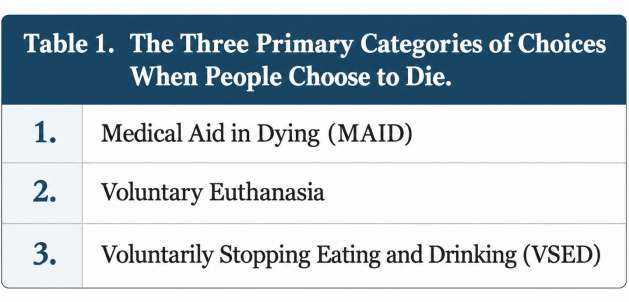
When people actively choose the timing and manner of their death, their choices generally fall into three primary categories, each governed by different legal frameworks, medical protocols, and procedures.
These categories differ principally in who administers the life-ending medication, whether the person must take the medication themselves, and whether the choice involves voluntarily forgoing food and fluids rather than receiving life-ending medication (Table 1).
Source: Compassion & Choices.
The first category is medical aid in dying (MAID), also known as physician-assisted dying or, in some jurisdictions, death with dignity. MAID allows a mentally capable, terminally ill adult who meets specific legal requirements to request and self-administer prescribed medication intended to end their life. In many U.S. jurisdictions where MAID is legal, eligibility generally requires a terminal illness with a prognosis of six months or less, although specific requirements vary by jurisdiction.
The emphasis on self-administration is an important distinction between MAID and voluntary euthanasia. Under MAID, the individual—not a physician or other health professional—takes the medication, retaining control over the timing of the final act. Depending on the jurisdiction, safeguards may include repeated requests, confirmation of the diagnosis and prognosis, assessment of decision-making capacity, and other measures to ensure the decision is voluntary and informed.
MAID is generally intended for people who meet specific legal eligibility requirements. It is not a general option for anyone experiencing suffering or wishing to die. Each jurisdiction determines who qualifies, what medical assessments are required, how requests must be documented, and what waiting periods and other safeguards apply.
The second category is voluntary euthanasia. Unlike MAID, which involves self-administration, voluntary euthanasia occurs when a healthcare professional administers medication intended to end the patient’s life at the individual’s explicit and competent request, typically to relieve otherwise intolerable suffering. It is legally permitted in several countries and jurisdictions, although eligibility requirements, procedures, and safeguards vary considerably.
The third category is voluntarily stopping eating and drinking (VSED). For people who do not qualify for MAID or live where MAID or voluntary euthanasia is unavailable, VSED may be another end-of-life option. It involves a voluntary decision to stop consuming food and fluids, eventually resulting in death. Medical and palliative care may be provided to relieve discomfort during the process.
Voluntary assisted dying is legally permitted in a growing number of countries. In 2026, some form of the practice is legal in approximately 16 countries. Estimates indicate that more than 30,000 people die each year through voluntary assisted dying in jurisdictions where the practice is permitted.
Nearly 5% of the world’s population, or more than 400 million people, live in countries or areas where some form of voluntary assisted dying is legal. These jurisdictions include Australia, Austria, Belgium, Canada, Colombia, Ecuador, France, Germany, Luxembourg, the Netherlands, New Zealand, Portugal, Spain, Switzerland, and Uruguay.
In the United States, Illinois and New York recently joined 11 other states and the District of Columbia in permitting medical aid in dying (MAID) under specified conditions. Nearly one-third of the U.S. population lives in a state where the practice is permitted.
About 60% of U.S. adults consider MAID acceptable or do not view it as a moral issue. Opinions differ by political party, however. About 75% of Democrats compared with 50% of Republicans consider the practice morally acceptable.
Across many regions, including North America, Europe, and Australia, international opinion polls generally find majority support for voluntary assisted dying. A cross-sectional survey of physicians in 17 countries also found nuanced but generally supportive views of physician-assisted death when strict safeguards are in place.
Methods of administering medication also vary across jurisdictions. In Switzerland, individuals self-administer the medication, usually by swallowing a liquid. In Québec, Canada, physicians or nurse practitioners administer it, usually intravenously. In Australia, both self-administration and practitioner administration are permitted.
The laws governing voluntary assisted dying differ considerably across countries and jurisdictions. Nevertheless, the medical conditions and personal circumstances associated with requests for assisted dying tend to show similar patterns across regions and over time.
People with ALS, for example, have been found to have the highest rate of voluntary assisted dying, often several times those of cancer patients. Cancer patients, in turn, are more likely to access voluntary assisted dying than people with other illnesses, such as lung or heart disease. However, cancer remains the most common diagnosis among assisted dying cases, largely because it affects far more people than these other conditions.
Voluntary assisted dying accounts for a relatively small share of all deaths in countries where it is permitted, generally 1% or less in countries such as Germany, Spain, and Switzerland. In other countries, the proportions are considerably higher. Around 2023, assisted dying accounted for 5.4% of deaths in the Netherlands, 4.7% in Canada, and 3.6% in Belgium.
The number of voluntary assisted deaths has increased substantially in some countries. In the Netherlands, for example, the number has reportedly increased threefold since 2002. In Canada, the number initially increased rapidly before growth slowed; assisted dying now accounts for nearly 5% of all deaths.
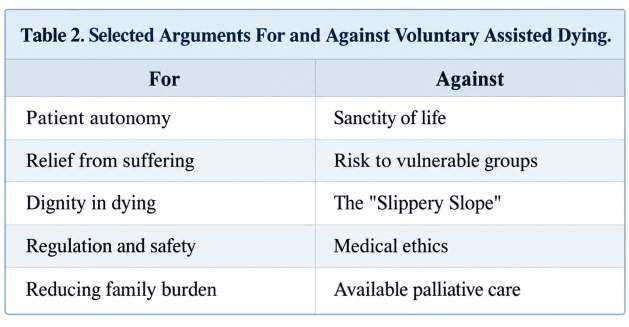
Despite becoming legally permitted in an increasing number of countries, voluntary assisted dying remains controversial. The debate centers on a fundamental tension between respecting personal autonomy and relieving suffering, on the one hand, and protecting human life, on the other (Table 2).
Source: British Medical Association (BMA).
Arguments in favor of voluntary assisted dying emphasize patient autonomy, relief from suffering, dignity at the end of life, regulatory safeguards, and reduced burdens on families. Arguments against it stress the sanctity of life, risks to vulnerable people, the potential for a “slippery slope”, concerns about medical ethics, and the importance of palliative care.
In sum, voluntary assisted dying is legally permitted in a growing number of countries and jurisdictions, and its use has increased substantially in many of them. Nevertheless, voluntary assisted dying remains a sensitive, controversial, and deeply personal issue, even where it is legally permitted.
Joseph Chamie is a consulting demographer, a former director of the United Nations Population Division, and author of numerous publications on population issues.
 Print
|




