
Saturday, October 24, 2026



News and Views from the Global South
Opinion
Beyond Commemoration: Why Conflict-Related Sexual Violence Demands Urgent Global Attention
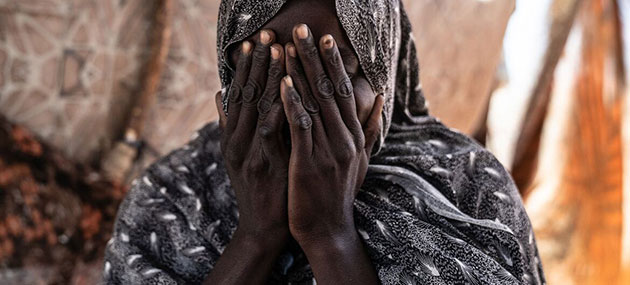
Clarke A survivor of sexual violence covers her face with her hands in a camp for displaced people in Tawila, North Darfur. Credit: UNOCHA/Giles
- Three years ago, during a mission to the Central African Republic from United Nations Headquarters, I met a woman whose story has remained with me ever since. She had survived rape during the conflict. Yet what stayed with her most was not only the violence she had suffered, but the stigma that followed it. When she returned home, her family refused to take her back. In a society where survivors of sexual violence are too often burdened with shame that rightfully belongs to perpetrators, she found herself isolated and struggling to rebuild her life. In that moment, it became painfully clear that for survivors, the violence does not end when the assault ends, it continues through stigma, exclusion, and the resulting silence for most.
Conflict-related sexual violence (CRSV) does not end when the act itself ends. Its consequences ripple through families, communities, and generations and that is precisely why more needs to be done to not just address it but prevent it from happening in the first place.
As the world marked the International Day for the Elimination of Sexual Violence in Conflict on 19 June, (The day marks the adoption of Security Council Resolution 1820 (2008), which condemned sexual violence in conflict and recognized its impact on peace and security), I found myself reflecting on the many survivors whose stories I have encountered throughout my career. I witnessed firsthand the devastating and enduring impact of these crimes, sometimes documenting and analysing the many cases sent to us by colleagues on the field and sometimes while interacting with the survivors first hand. At a moment when wars dominate global headlines, from Gaza and Ukraine to Sudan and Democratic Republic of Congo, ignoring CRSV means ignoring one of war’s most enduring and devastating consequences.
Today, the issue is more urgent than ever. Civilians continue to bear the heaviest burden of conflict, and among the most devastating consequences of conflict is sexual violence. According to the United Nations Secretary-General’s 2026 Report on Conflict-Related Sexual Violence, nearly 9,800 cases were verified globally in 2025, more than double the number documented the previous year. Yet even these alarming figures represent only a fraction of the actual scale of violations, given the barriers to reporting, including stigma, insecurity, fear of retaliation, and limited access to services. “The figures contained in this report should be understood not as the full picture, but as an indication of a much broader pattern of violations that remain largely unseen and underreported.” said Special Representative to the Secretary General on Sexual Violence in Conflict, Pramila Patten.
From Sudan and South Sudan to Haiti, Ukraine, and Myanmar, recent UN reporting shows that conflict-related sexual violence continues to affect communities across the globe, reminding us that it remains one of the most enduring and devastating consequences of armed conflict.
CRSV is not an inevitable consequence of war; it is often a deliberate act used to terrorize communities, assert power, and deepen divisions. Its impact extends well beyond the immediate violation. For many survivors, the trauma is compounded by stigma, rejection from family members, exclusion from community life, loss of livelihoods, interrupted education, and limited access to justice and support services. The consequences can endure long after the conflict itself has faded from public attention.
In South Sudan, I documented stories of women and adolescent girls who had survived gang rape while collecting firewood, water or travelling to markets. I listened to survivors who feared reporting violations because they worried about being ostracized by their communities and feared retaliation by their attackers who ranged from soldiers to armed militia. I encountered families struggling to support children born out of rape while facing stigma and economic hardship.
Although women and girls bear the overwhelming burden of conflict-related sexual violence, my work also exposed me to the experiences of men and boys who had endured similar violations. Many carried their trauma in silence, reluctant to come forward because of stigma, fear, and societal expectations surrounding masculinity. As a result, their experiences are frequently overlooked, even as they grapple with profound physical and psychological consequences.
In conflict zones such as South Sudan, local civil society organisations continue to play a critical role in supporting survivors despite significant resource and safety constraints. These organisations often serve as the first and sometimes only point of contact for survivors seeking assistance. They provide psychosocial support, referrals to healthcare, legal aid, community awareness programmes, and safe spaces for healing. Yet the scale of need far exceeds available resources.
As Rev. John Ngbapia Bakiri, Executive Director of Rural Development Action Aid (RDAA), explains:
“The biggest challenge we face in dealing with Survivors of CRSV in South Sudan is the limited scope and resources of the intervention relative to the scale of need. Many CRSV Survivors remain unreached, several highly affected communities excluded, and the specific needs of children born out of rape are not fully integrated into the response. These children continue to face stigma, protection risks, and limited access to essential services, compounding the vulnerability of survivor households.”
Addressing conflict-related sexual violence therefore requires moving beyond emergency response and looking at prevention with a survivor centred approach. It requires sustained investment in healthcare, psychosocial support, education, livelihoods, legal assistance, awareness building and social reintegration. It requires supporting local organisations that remain embedded within communities long after international attention has shifted elsewhere. It also involves very importantly engaging with the government including the implementation of national action plans, criminalization of conflict-related sexual violence in domestic legislation, and meaningful accountability for perpetrators regardless of rank or affiliation.
Despite decades of advocacy and normative progress, accountability remains elusive in many contexts. Survivors continue to face significant barriers in accessing justice and perpetrators often operating with impunity is common. With peace processes and political negotiations frequently overlooking the experiences and priorities of survivors, funding for survivor-centred services remains inadequate despite growing needs. At a time when violence and instability are rising across the world, we can no longer afford to relegate conflict-related sexual violence to the margins of policy and peacebuilding efforts. Its consequences are profound and enduring, leaving scars not only on survivors but also on the communities and societies struggling to rebuild in its aftermath.
The International Day for the Elimination of Sexual Violence in Conflict offers an important moment for reflection. But remembrance alone is not enough. What survivors deserve is justice, protection, meaningful support, and genuine participation in shaping the policies and responses that affect them with a seat at the decision making table. Their stories are not simply testimonies of suffering, they are calls to action.
Mariya Salim is co-founder of Zariya. She is a Human Rights activist and an international SGBV expert currently based in Delhi India. She has served as a Women Protection Adviser with the United Nations Mission in South Sudan (UNMISS), and was part of the United Nations team working on Conflict-Related Sexual Violence at UN Headquarters in New York.
IPS UN Bureau


 Print
|
Print
|




