Sunday, September 13, 2026



News and Views from the Global South
POLITICS: ‘UNAMID In Boxing Ring With Hands Bound’
Haider Rizvi
- Calls for an increased U.N. peacekeeping presence are growing as warring parties in Sudan’s troubled region of Darfur remain mired in a vicious cycle of violence that has taken about half a million lives in the past four years.
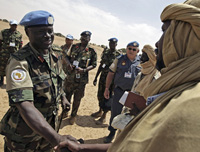
General Martin Luther Agwai, shakes hands with the Commander of the Sudan Liberation Army (SLA) Unity faction in El Hosh, Sudan. Credit: UN Photo/Albany Associates
Agwai explained that when he accepted his current job as commander of the U.N. Peacekeeping Mission in Darfur (UNAMID) a little over a year ago, he was expected to lead an international force comprising no less than 26,000 troops.
"People want us to do the job of 26,000 [troops]," he said at a news conference at U.N. headquarters, "That is not possible." However, Agwai added that he was optimistic about the U.N. forces’ ability to restore peace and end violence in Darfur.
"We will do whatever, the best we can," he said, amid hopes that more countries would be willing to contribute their troops by the end of this year. The general said it was likely to have about 80 percent of the proposed 26,000 troops on the ground by the end of this year.
By next year, most of the additional troops are expected to come from several African nations – namely Burkina Faso, Gambia, Ghana, Kenya, Malawi, Mali, Nigeria, Senegal and South Africa.
In recent months, both Secretary General Ban Ki-moon and former Under-Secretary- General for Peacekeeping Operations Jean-Marie Guehenno have raised concerns about the lack of proper equipment and manpower for the peacekeeping mission in Darfur.
The mission is still in need of more than 17,000 troops. But there have been few offers of men and material, with the exception of four helicopters from Ethiopia. Most recently, some troop contributions have come from Egypt and Ethiopia.
The government of Sudan – which has deep suspicions about the intentions of Western countries – insists on an African force and has already rejected troops from Norway and Sweden and expressed reservations over military units from Thailand and Nepal.
UNAMID – which has an annual budget of about 1.5 billion dollars – is tasked with acting under chapter VII of the U.N. Charter to implement the 2006 Darfur Peace Agreement between the government and the rebels fighting for control of the region.
Observers say the peacekeeping mission in Darfur, which officially came into force in Dec. 2007, has remained crippled because of the lack of helicopters and other logistical equipment. The mission requires at least 24 helicopters.
U.N. estimates suggest that more than 2 million people have been uprooted from their homes in the Darfur region since the conflict began between the indigenous rebel groups and the Janjaweed militia groups some four years ago.
The peacekeeping force under Agwai’s command is mandated to protect civilians from armed attacks and to ensure the security of aid workers and its own personnel and facilities.
Chapter VII of the U.N. Charter empowers the 15-member Security Council to take action, including military action, "with respect to threats to the peace, breaches of the peace of the parties and acts of aggression."
Despite its agreement on the need for peacekeeping operations under Chapter VII, the world community remains divided over how to deal with Khartoum. The U.S. and its allies still want to impose sanctions against Sudan, but both Russia and China think sanctions would be counter productive.
For their part, most African nations have not only voiced their opposition to the imposition of possible sanctions against Sudan, but have also criticised the move to try Sudanese President Omar Al-Bashir as a war criminal in the Hague-based International Criminal Court (ICC).
By contrast, in the West, human rights groups welcomed the ICC prosecutor’s recent request to indict Al-Bashir, thinking that it would set an example for the abusers of international human rights laws. There is considerable evidence that Khartoum is still backing the Janjaweed militia attacks in Darfur.
But Agwai thinks differently. "No one side can clean this mess," he said in response to a question about ICC prosecutor’s request to indict Al-Bashir. For some, it has become "convenient" to criticise the government of Sudan, according to Al-Bashir.
Agwai told IPS that he was not entirely pleased with the international media coverage of what has been and is happening on the ground in Darfur. "Sometimes, they exaggerate the facts," he said.
 Print
|
Print
|