Languages
Saturday, November 28, 2026



News and Views from the Global South
Africa
POLITICS-IVORY COAST: Coup Threat Elicits Varying Responses
A mixed reaction has greeted this weekend's threat by a former head of the Ivorian army to depose President Laurent Gbagbo. General Mathias Doue made the announcement in a letter printed by various Ivorian publications on Friday, and during an interview with Radio France Internationale, Saturday.DEVELOPMENT-AFRICA: A Small Step From Barnyard to Pond
Africa must urgently boost investments in aquaculture to fight hunger, as natural fish stocks on the continent and elsewhere decline, scientists say.POLITICS-SUDAN: John Garang’s Successor Faces Formidable Challenges
The death of Sudanese vice president and former rebel leader, John Garang, on July 30, has cast doubt upon the strength of a January peace agreement that ended 21 years of civil war between north and south Sudan.RIGHTS-SOUTH AFRICA: Not Quite the Welcome Mat
They are trends that show little sign of abating: the influx of refugees and economic migrants to South Africa, and the extent to which these persons become the target of xenophobia.WESTERN SAHARA: After POW Release, It Is the International Community’s Turn to Act
The Polisario Front released Thursday the last Moroccan prisoners of war that it was holding, which means it is now time for the United Nations, the European Union and the United States to press for a definitive solution to the situation in the Western Sahara, a representative of the independence movement told IPS in Spain.GUINEA-BISSAU: Low-Cost Treatment in Cholera Epidemic Could Save Many Lives
Guinea Bissau is about to run out of intravenous fluids and equipment essential to the low-cost life-saving treatment for cholera, which has claimed 112 lives in this tiny West African nation since June. An additional 6,420 patients are still at risk.POLITICS-SOUTHERN AFRICA: Room for Improvement in SADC, Say Activists
Southern African leaders came under pressure from civil society this week to tackle a host of issues ranging from drought and poor governance to gender inequalities and AIDS.POLITICS-KENYA: Referendum Set to Become Constitutional Battleground
The seemingly endless wrangle about Kenya's proposed constitution has continued in recent days, with non-governmental groups expressing concern over the terms of a referendum on the draft that is scheduled to take place in November.RIGHTS-RWANDA: A Life Spanning Continents, Genocide – And an Orphanage
Petite, soft-spoken and all of 93 years old, Rosamond Carr might not - at first glance - appear a likely candidate for heading up an orphanage in an especially poor and strife-torn corner of Africa.RIGHTS-UGANDA: Newspapers to Some, Scavengers to Others
Concern is growing over the prospects for press freedom in Uganda - this after claims by President Yoweri Museveni that the media were compromising security.RIGHTS-ZIMBABWE: Whither Civil Society?
As Zimbabwe has slipped deeper into political and economic turmoil over the past five years, the role of civil society in helping the country to address its problems has come under increasing scrutiny.SOUTHERN AFRICA: Fences Not the Only Barrier for Cross-Border Park
The Pafuri-Banyini pan in South Africa's north-eastern Kruger National Park teems with game. Elephant bulls amble among clumps of marula trees and impala leap gracefully across the grassland, where buffalo graze.HEALTH-NAMIBIA: "If I Could Only Warn Women Not to Get Married…"
"When my father died my uncle and his wife came and took all our stuff. They even took away our television," said an eleven-year-old orphan in Namibia, describing a tradition that allows relatives to take land, livestock, furniture and even clothes from bereaved families.DEVELOPMENT: Africa Falters in Food Security Goals
Sub-Saharan Africa is the only region in the developing world where the shortage of food has "substantially worsened" over the last three decades, a new study warns.HEALTH-MOZAMBIQUE: Preventing History From Repeating Itself
For children in Mozambique who are orphaned by AIDS, burying parents may simply signal the start of their battle with the pandemic. All too often, these orphans also find themselves amongst those most at risk of contracting HIV.POLITICS: African Veto Demand Risks Security Council Reform
The 53-nation African Union (AU), the largest single regional group at the United Nations, is exercising its political clout by refusing to back down on its demand for two permanent seats in the U.N. Security Council - but with hard-to-get veto powers.DEVELOPMENT-SOUTHERN AFRICA: “We Are Raising the Alarm Now”
Images of skeletal children in Niger, wasted away by malnutrition, have featured prominently in the media over recent weeks. Amidst efforts to alleviate this suffering, however, there are fears that the crisis in Niger may undermine donor willingness to tackle problems elsewhere on the continent – notably in Southern Africa.CULTURE-SWAZILAND: Sugar Daddies – The Bitter Truth
"People who don’t know me see this stylishly-dressed young woman driving a nice car, and they think, ‘Isn’t she lucky? She has a rich man as a lover to give her things’," says Angela Shabalala as she manoeuvres her blue BMW sedan onto a highway leading to the Swazi capital, Mbabane.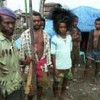
INDIGENOUS PEOPLES DAY: With Violent Greetings
Indonesian soldiers cut the face and body of Petto Wenda with a razor and a knife before pouring petrol on his head and setting him on fire. Petto was attacked when the soldiers overran Pyramid village of the Lani tribe in the Papuan highlands in July. He is not expected to survive.POLITICS-US: A Holy Trinity of Church, Boardroom and GOP?
U.S. Pres. George W. Bush continues to seek broader support from the African American community - most recently with a pledge to persuade corporate foundations to give more money to faith-based charities.FINANCE: Emigrants Boost Zimbabwe’s Parallel Economy
It is enough to distress any new emigrant. Sending money back home is, for many Zimbabweans working in neighbouring South Africa, a frustrating, complicated and costly exercise.« Previous Page — Next Page » *#*

The Week with IPS

NEXT STOP - SDGs
Tracking global progress towards a sustainable world
