Languages
Friday, November 6, 2026



News and Views from the Global South
Other Voices
News and Views from our Content Partners
Trump Trumps: Will He Dump Liberal America?
And so, the American voters have picked the unknown devil (instead of the known devil) to lead them for the next four years. In their somewhat skewed election process, the defeated candidate got more popular votes than the winner who to the much over-rated ‘most powerful job in the world’ – the President of the United States of America.
Why Can’t We Stop the Stalking?
Unwanted attention is something that a woman has had to experience at some point of time in their lives. It's not something new and it doesn't look like this tendency to pursue someone incessantly, abusing them with words or behaviour, and 'claiming' them for their own will disappear from our civilisation anytime soon. When girls are told by their elders and the society in general that boys will be boys, and they should do everything in their power to avoid their advances, the general reaction is to submit to these demands, to 'cover up', and not be out alone after a 'respectable time'. But what does a girl/woman do when the stalker attacks her in the middle of the day, in the midst of thousands of people, within an environment that she considers safe and secure?
An American Brexit?
It was beyond the imagination, even of the many diehard 'Trumpians' who, reportedly, were invoking a miracle for a Trump win. Donald Trump has proved the pundits wrong. He won by a big margin on electoral votes while most pollsters had given it to his opponent and many outside the US were hoping for a Clinton victory. For him, the road to 270 was tortuous with many permutations and combinations and lots of 'ifs' and 'buts'. He belied all statistics to get to it. It is remarkable too that he has pulled it off despite the fact that several top ranking Republicans had deserted him and several among them did not even vote for him.
Waterfall Days
Pakistan's transition from water-rich to water-stressed didn’t come without fair warning. At the turn of the ’90s, experts predicted that freshwater resources in the country would dwindle substantially and become scarce by 2005. The predicted ‘waterfall’ was confirmed by the Pakistan Council of Research in Water Resources (PCRWR), which further added that acute water shortage would follow by 2025 if the current situation was allowed to prevail.G77 Expresses “Deep Concern” over ODA and FDI Declines in Africa
The Group of 77 has expressed “deep concern” that both Official Development Assistance (ODA) and Foreign Direct Investment (FDI), which remain two of the major sources of development financing for Africa, have continued to decline over the years.G77 Underlines Importance of ICTs in UN’s Post-2015 Development Agenda
With half of the world’s population-- or more than 3.5 billion people-- still offline, mostly in developing countries, the Group of 77 (G77) has underlined the key role to be played by information and communications technologies (ICTs) in advancing the UN’s post-2015 development agenda.
Thai University Accepts Rice as Tuition Fees
A private university in Thailand has decided to accept rice as payment for its tuition fees.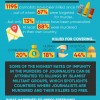
Isn’t It Time We Stop Shooting the Messenger?
Recently, a video of two television journalists being attacked by staff of a popular private hospital in Dhaka has been doing the rounds of social media. The reporters were covering an allegation of sexual harassment against a female patient by a staff of the hospital, and were apparently interviewing someone in the management when a group of hospital employees stormed into the room, questioning the presence of the reporters in the hospital, forcefully demanding that the cameraman shut off his camera, before finally resorting to manhandling them. When they protested that they were journalists who were only doing their job and didn't have any intention to defame the hospital, one of the employees thundered, “Faizlami paisen? Kisher journalist?” [Are you kidding? What journalist?] Reporter Ahmed Saleheen and cameraman Shafiqul Islam, both from Shomoy TV, further claimed that they were verbally abused by the hospital staff; in fact, Shafiqul was also confined in a room for a while where they allegedly beat him up.
Value of Education
Provincial governments have been trying to get every child enrolled in school. Public education systems, across all provinces, have gone through a plethora of reforms in the last couple of decades to achieve higher enrolments. Teacher salaries have been increased, more infrastructure facilities have been provided, there is more monitoring of teachers, teacher recruitment has been made more transparent, and a lot more has been spent on teacher training. Enrolment drives are conducted almost every year. But we have not been able to achieve universal enrolment as yet. This has been a puzzle for governments: why are the last 10-15 per cent of out-of-school children, in the relevant cohorts, so hard to bring into the system?
Foreign Policy article on Bangladesh: A Most Unfortunate Conclusion
It’s absurd! It's preposterous to suggest that around 40 percent of Bangladeshis favour suicide terrorism. Yet this is what some American think tanks and “expert analysts” have recently come up with in their reports, to the detriment of Bangladesh's reputation. Muslims in Bangladesh – around 90 percent of the population – are peaceful, liberal, devotional, and even syncretistic, unlike their counterparts in the Middle East, Africa, Afghanistan, and Pakistan.Religious Leaders Call for Peaceful, Integrated World
Abu Dhabi: Religious leaders from the Muslim Council of Elders — an independent international body that aims to promote peace in Muslim societies — and the Anglican Church on Wednesday called for setting up a peaceful and integrated world.
South-South Cooperation a Key to SDGs Success, Says G77
The Global South-South Development Expo 2016 (GSSD), which took place in Dubai, was one of the major international events showcasing some of the achievements and best practices of both South-South and Triangular Cooperation.
Hungarian Revolts
Early last month, there was a glimmer of hope in Hungary. Implored to vote in a referendum intended to effectively sanctify the nation’s brutal hostility to refugees from the Middle East, a majority of the eligible electorate opted to disengage from the process, rendering it invalid.UAE Has Enabled Religious Minorities to Meet, Teach, Worship and Express Themselves: Archbishop of Canterbury
The UAE has taken practical steps to enable religious minorities to meet, teach, worship and express themselves, the Archbishop of Canterbury said in his opening keynote address on Wednesday at a dialogue on integration, religious freedom and flourishing societies organised by the Muslim Council of Elders and with Christian leaders from the Anglican Communion.
Acknowledging the Ugly Truth
This happens every month, every week, everyday. Again and again and again. Brutality in the form of torture, sexual abuse, rape and murder has become epidemic in our society. Some cases get coverage in the media and spark reaction among citizens for a while, but most remain unreported and unknown. The ones which hit the headline in the media indicate the scale and depth of the dark side of our society.« Previous Page — Next Page »





The Week with IPS

NEXT STOP - SDGs
Tracking global progress towards a sustainable world
Tracking global progress towards a sustainable world
