Languages
Monday, September 21, 2026



News and Views from the Global South
Other Voices
News and Views from our Content Partners

WETEX 2018: one of the largest specialised exhibitions in the world
Dubai Electricity and Water Authority (DEWA), the organiser of the 20th Water, Energy, Technology and Environment Exhibition (WETEX) 2018, has announced that it will be one of the largest specialised exhibitions in the world.
Mohammed bin Rashid Space Centre announces final candidates for UAE Astronaut Programme
The Mohammed bin Rashid Space Centre has announced that 18 candidates are currently undergoing the final stage of the interviews leading up to choosing the first Emirati astronaut corps of the UAE Astronaut Programme, launched by His Highness Sheikh Mohammed bin Rashid Al Maktoum, Vice President and Prime Minister of the UAE and Ruler of Dubai, and His Highness Sheikh Mohamed bin Zayed Al Nahyan, Crown Prince of Abu Dhabi and Deputy Supreme Commander of the UAE Armed Forces, to train and prepare the first Emirati astronaut corps to be sent to space for various scientific missions The final 18 out of 39 candidates previously passed the initial interviewing process which was conducted by qualified specialists from MBRSC.
Arab Group at Human Rights Council says international community came long way in combating racism
The international community has come a long way in combating racism, discrimination, xenophobia, extremism and religious intolerance, according to the Arab Group at the Human Rights Council.
UN Migration Agency Presents Recommendations to Incoming EU Council Presidency, Austria
IOM, the UN Migration Agency, has put forward three recommendations to the incoming Austrian Presidency of the Council of the European Union that are based on our view that better migration governance - national, regional and global – benefits the entire migration spectrum: migrants, their home countries and the countries of destination, and requires political courage, evidence-based vision, and a human-centred approach.
OFID, Habitat for Humanity International sign agreement to boost living conditions in Monrovia
The OPEC Fund for International Development, OFID, has signed a US$420,000 grant agreement with Habitat for Humanity International to support a project aimed at improving living conditions for slum dwellers on Peace Island, Greater Monrovia, Liberia.
Dubai set to serve as regional digital financial inclusion hub for Middle East, Africa and South Asia
The UAE is ideally positioned to serve as the ‘beating heart’ of a regional innovation hub; according to a new report published by Oliver Wyman in collaboration with Dubai International Financial Centre (DIFC), the leading international financial hub in the Middle East, Africa and South Asia (MEASA) region.
Over 200 Migrants Drown in Three Days in Mediterranean — Death Toll for 2018 Passes 1,000
This weekend, some 204 migrants have died at sea off Libya, pushing the total number of migrant drownings in the entire Mediterranean so far this year to over 1,000 people.
Economic crisis management
Do forgive the people of this country if they cannot make sense of our present economic predicament. On one hand, they are told repeatedly (and correctly) that the economy has started reaping the benefits of CPEC — the ‘game changer’ — in the form of significantly reduced load-shedding, an upturn in investment and a not unimpressive recovery in economic growth. At the same time, they are told that the economy is in dire straits!
Democratic regression: The “English” turn
Gideon Rose made an astute observation in editing the May/June 2018 Foreign Affairs cover story on the current “democratic regression”. “We have seen this movie before,” he quoted a Latin friend of his on the concurrent predicament, “just never in English.” That may be the missing element behind this “regression”: populism may be a popular explanation, since it brings to the fore many of the disturbing developments within mature democratic countries; stalled economic growth in these same countries also finds immense currency as a democracy detractor; historically-bent scholars never miss the beat to push the cliché that what goes up (for example, whatever led Francis Fukuyama to proclaim an “end of history” in the early 1990s), must eventually not only come down, but also begin climbing again. And so the story goes.
UAE delegation discusses sustainability technologies, best practices in agriculture with Dutch officials
A UAE delegation, led by Dr. Thani bin Ahmed Al-Zeyoudi, Minister of Climate Change and Environment, has concluded a three-day official visit to the Netherlands.
António Manuel de Carvalho Ferreira Vitorino elected as new Director General of UN Migration Agency
On Friday 29 June 2018, the member states of the IOM, the United Nations Migration Agency, elected Portugal’s António Manuel de Carvalho Ferreira Vitorino as the International Organization for Migration’s next Director General.
Our prisons are hellholes
One of the most nightmarish experiences that any Filipino or foreigner can experience in this country (if they survive) is to spend time in our prisons. Thus, every kind of maneuver is made by those who manage to avoid incarceration — be it suddenly getting sick after years of carrying on healthily and checking into a hospital with a convenient serious diagnosis of illness from a compliant doctor, to effectively running away from the law and becoming a fugitive. Other variations of escaping the brutish conditions that our prisons have been allowed to come to, is to ask a judge to order confinement at the NBI or the PNP temporary incarceration places where the public is on view and vice versa. Then perhaps the conditions are less obviously dreadful, the bullies or other evil denizens that prisons have within their bowels are on public view, a minority, and therefore controllable.
Director of the Oxford Centre for Islamic Studies: “Let us be wary of the abuse of human rights to legitimize the attainment of political and other objectives through coercion”
On 25 June 2018, the Geneva Centre for Human Rights Advancement and Global Dialogue organized a World Conference on the theme of “Religions, Creeds and Value Systems: Joining Forces to Enhance Equal Citizenship Rights” at the United Nations Office at Geneva in collaboration with the International Catholic Migration Commission, the World Council of Churches, the Arab Thought Forum, the World Council of Religious Leaders, Bridges to Common Ground and the European Centre for Peace and Development.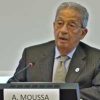
HE Amr Moussa: “It is our common responsibility to harness the collective energy of religions, creeds and value systems”
On 25 June 2018, the Geneva Centre for Human Rights Advancement and Global Dialogue organized a World Conference on the theme of “Religions, Creeds and Value Systems: Joining Forces to Enhance Equal Citizenship Rights” at the United Nations Office at Geneva in collaboration with the International Catholic Migration Commission, the Arab Thought Forum, the World Council of Churches, the World Council of Religious Leaders, Bridges to Common Ground and the European Centre for Peace and Development.
Global migration and urban expansion: an interview with Ambassador William L. Swing
Migration is one of the major defining factors of our time. Today, one billion people – one out of seven people in the world – are migrants, including over 250 million people living outside their home country and an estimated 750 million domestic migrants.« Previous Page — Next Page »


The Week with IPS

NEXT STOP - SDGs
Tracking global progress towards a sustainable world
Tracking global progress towards a sustainable world
