
Tuesday, November 10, 2026



News and Views from the Global South

Logging and Fire Lay Siege to Guatemalan Forests
- Conservationists say they are faced with an environmental tragedy, as 95,000 hectares of Guatemalan forests are lost each year.
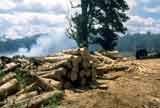
Chainsaws in actio - Sergio Dorantes
Forest fires, farm activity and illegal logging threaten the future of the forests, say activists.
Attempts to force compliance with environmental laws tend to be repelled with bullets, and more than one official has been murdered while investigating the illegal lumber trade.
According to the National Forests Institute (INAB), Guatemala loses 55,000 hectares of forest each year. But consultant Edwin Garzona, of the Environmental and Social Legal Action Center (CALAS), estimates that the total area deforested annually could reach 95,000 hectares.
“We know that officially 80,000 hectares are deforested each year, but international aid organizations put the total at 95,000. If we compromise and accept an average of 85,000 hectares and note that the annual average for reforestation is 7,000 hectares, we still have a tragedy on our hands,” Garzona said in an interview with Tierramérica.
“That projection would be correct if we didn't engage in reforestation and conservation initiatives of the total forest mass,” responded INAB director Luis Barrera.
The Mayan Biosphere Reserve and the national Laguna del Tigre park are two of the victims of lumber and drugs trafficking because clandestine runways are cut out of the forests.
In the heart of the Mayan forest, the biosphere reserve, located in the northern department of El Petén, covers nearly two million hectares.
The broader Mayan forest extends through the territories of Guatemala, Belize and Mexico, and is the second most important tropical jungle in the Americas, after South America’s Amazon jungle..
Laguna del Tigre, also in El Petén and covering 48,000 hectares, was included in 1990 on the list of wetlands of international importance, under the Ramsar Convention on Wetlands.
Despite legal protections, the trees that escape logging are threatened by fire. So far this year, 577 fires have devastated more than 20,000 hectares of forested areas, half in El Petén.
But even with this gloomy panorama, the INAB director says, “we can still recuperate the country's forests.”
Guatemala this year launched a forest inventory, which tallied 3.8 million hectares of jungle. The effort, with a budget of 13.9 million dollars for this year, includes management and conservation plans and forestry incentives that will reforest 40,000 hectares in five years, says Barrera.
On Jun. 9, the Guatemalan congress declared the reforestation campaigns “of national urgency and social interest,” and called on state institutions to enact them immediately. The efforts should focus “on areas where environmental degradation is most evident,” says the declaration.
But true forest recovery requires in-depth solutions, argues CALAS activist Garzona.
“The leading cause of deforestation is the advance of the agricultural frontier as farmers carve out new cropland,” he said, urging instead projects for diversification and sustainable use of the land.
The lack of clear policies and non-compliance with environmental laws have generated a state of total impunity, aggravated by the lack of funds for institutions to go after the perpetrators of ecological crimes, said Garzona.
The head of the Prosecutor's Office for Crimes against the Environment, Héctor Flores, and his staff had to fight off six armed attacks between 2000 and 2002 in their efforts to halt illegal logging in El Petén.
In that period, two INAB officials were murdered in the Caribbean coast city of Izabal while investigating lumber trafficking operations.
INAB's Barrera says the reforestation programs must be accompanied by projects that link local communities to the preservation of the forests around them.
 Print
|




