
Tuesday, November 10, 2026



News and Views from the Global South

The Well
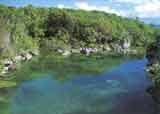
- Natural wells are sacred to today’s Maya as they were to their ancestors. Tradition holds that the water in these wells were “virgin or pure” because they never came in contact with light.
-
These natural wells were the sites of grand ceremonies, and those that were used for rituals were never used to supply water.
Mayan civilization endured for some 3,400 years from the establishment of the first villages. It stretched from southeast Mexico – the states of Yucatan, Campeche, Quintana Roo and parts of Tabasco and Chiapas – to Guatemala, Belize and the western portions of Honduras and El Salvador.
According to the city hall of Merida, capital of the state of Yucatan, there are four kinds of wells: there were pitcher-shaped wells, wells with vertical walls, wells that were watering holes and others that were caverns.
They were produced by rainwater wearing away rock and creating numerous channels and a network of underground rivers that carved out chambers called caves when dry and wells or cenotes when flooded.
According to La Venta, a site for explorers, the Yucatan peninsula is a limestone plateau with no water aboveground. This region, however, is rich in underground water and access to this invisible world of water is provided by the wells, connected to the deepest tunnels.
Exploration of these sacred wells is not only an extraordinary adventure in clean, warm water, but also basic to archaeological research.
The growing interest in Mayan history has resulted in a move to study these wells, says Mexico’s National Institute for Anthropology and History (INAH) pointing to expeditions mounted by the Carnegie Institute in Washington in the 1930s to study the wells’ biodiversity. Those expeditions identified some 306 species of animals associated with the wells.
To explain how underwater archaeology is done, INAH notes that materials that have been submerged for a long time require special procedures for their conservation, for example accumulated salts must be eliminated and drying must be done carefully.
The search for archaeological evidence in lagoons and natural wells is done with the help of archaeologists and restorers who are experts in both high altitude and cave diving.
Diving in mysterious caves or in the open sea one can find articles of jade, gold, obsidian, resins, woods, ceramics or conch that perhaps belonged to Mayan maidens delivered as offerings to the gods.
The website of the Autonomous University of Yucatan (UADY) emphasizes that the people who are doing this work are not treasure hunters, they are engaged in the discipline of underwater archaeology to add to the store of knowledge about the country’s underwater cultural heritage.
In 2001 the United Nations Educational, Scientific and Cultural Organization (UNESCO) adopted the Convention to Protect Underwater Cultural Heritage.
A text from the Foundation for the Advancement of Mesoamerican Studies Mesoamerica shows an analysis of objects recovered from the wells and another from the same institution a series of photographs of pieces rescued from those wells.
Desertification
Desertification and drought leave in their wake severe economic, environmental and socio-political troubles around the world. Every year, six million hectares of productive land disappear and millions of dollars in income are lost due to land degradation and declining agricultural yields.
The United Nations Environment Program (UNEP) says that after a great deal of study and debate experts defined desertification as a phenomenon of land degradation in arid, semi-arid and sub-humid dry areas arising from the negative effects of human activities.
Although this serious problem dates back centuries, it took on global importance when in the early 1970s hundreds of thousands of people died as a result of the severe drought that hit sub-Saharan Africa. The International Conference to Combat Desertification was held in Nairobi, Kenya, in 1977.
The United Nations Convention to Combat Desertification entered into force in 1996 after more than 50 countries ratified it. The Convention's objectives are to fight desertification and to curb the effects of drought through effective measures at all levels.
In 1994 the UN General Assembly designated Jun. 17 as World Day to Combat Desertification and Drought. The date marks the anniversary of the Convention.
According to the UN Food and Agriculture Organization (FAO), arid lands cover nearly 30 percent of the planet's land surface and are inhabited by around 900 million people.
The FAO cites various factors that contribute to desertification: climate fluctuations, poor use of land, inappropriate farming methods, increased demographic density, economic pressures and changes in land ownership structures.
The impacts of desertification are felt on all continents. In Latin America and the Caribbean, which cover 20.18 million square km, more than 25 percent of the territory is arid land. Of that total, 70 percent shows signs of advanced stages of desertification.
 Print
|




