
Thursday, October 22, 2026



News and Views from the Global South

Guantánamo's Two-Faced Climate
- The fight against desertification is bearing fruit in the semiarid region of the Cuban province of Guantánamo.
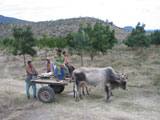
Water is carried by ox-carts to the neem tree farm. - Baldrich
“Baracoa has the best of it. The tourists stay there,” says a young man who is trying to sell hand-made shoes along a street in the provincial capital Guantánamo City, 929 km from Havana.
Baracoa, on the province's northeast shores, was founded in 1511 by the Spanish Conquistadors, led by Diego Velázquez. It is known for its virgin forests that are bursting with native plants and animals, crystalline waters and beautiful beaches.
The Sagua-Nipe-Baracoa mountains mark the climate difference between the north and south sides. While the province's north is Cuba's wettest region, with more than three meters of rainfall per year, the south is the driest, with less than a half-meter.
The lack of rain, say experts, has aggravated erosion and desertification in this semiarid region, which extends across 1,752 square km and includes a strip along the province's southern coast.
Desertification is a gradual process of the soil's loss of productive capacity, and of the thinning of an area's plant coverage, whether from human activities or climate variations. The phenomenon affects 14 percent of Cuba's agricultural land, or more than 1.5 million hectares.
Despite these problems, the young salesman — talkative, but hesitant to give his name — believes people are better off in the countryside than in the city. “The farmers earn more and eat well,” but he doesn't imagine himself working the land, he admits.
In the city's outskirts, at a place called Los Coquitos de Jaibo, more than 100 men and women have indeed opted for farm work, and have doubled their food production after learning techniques to improve the soils.
The land is at the northern limit of the semiarid zone and, although its soils are given an “acceptable” grade, a great deal of organic material must be used in order to get good results, Oscar Borges, an expert in ecological land management, told Tierramérica.
The farm provides vegetables for some 50,000 people in the surrounding area, as well as for a retirement home, a few daycare centers and a psychiatric hospital, among other institutions.
Until the mid-1990s, it was fallow, unproductive land. “The vegetable fields created new jobs, including for women, and produced foods that we didn't have before,” says Yamilé Romero, a primary school teacher and local resident.
A few kilometers away, in the middle of the semiarid region, a two-hectare area that was once covered with marabú (Leptoptilus crumenifer), a spiny plant that invades abandoned lands, is now a rice field.
“We applied agro-ecological techniques for managing saline soils, and now we harvest some 60 quintales (2,760 kg) of rice, apt for human consumption. I keep 10 quintales (460 kg) for my family, and the rest I sell” to the Enrique Campos Credit and Services Cooperative, says Humberto Aguilar.
For the past four years Aguilar has not had to buy his quota of rice, the staple of every Cuban dinner table, found in the list of subsidized and rationed foods available for all of the island nation's 11.2 million people.
The cooperative, which coordinates 56 small, privately-run farms, also doubled its output of vegetables, grains and root crops, thanks to the use of appropriate technologies for the local soils, affected by salinity, erosion and poor drainage. Among the municipalities hit hardest by lack of rain is San Antonio del Sur, home to more than 26,000 people. “Around here it's been raining very little, and I have to irrigate with water that reaches me by gravity from the neighboring community,” said Roberto Hinojosa, head of a state-run farm for reforesting the area.
He is entrusted with nearly 30 hectares, of which 11 are already growing fruit and lumber species of trees that are resistant to the conditions of the area, dubbed Bate Bate, for the Spanish verb “batir”, the beating of the ocean waves that are visible on the other side of the road.
Among the tree species are the neem (Azadirachta indica A. Juss), the physic nut (Jatropha curcas), the guayacán (Guaiacum officinale) and the guayaba (Psidium guajava L.).
“This farm is integrated because it also includes raising a small flock of sheep,” says Hinojosa. Five or six years ago, this area was covered by a dry, yellowing pasture. Today, the green of the young trees is beginning to change this country landscape.
“It's a lot of work, but it's worth it,” adds Hinojosa, who used to work at a sugarmill. Electricity in his home comes from photovoltaic panels, a technology that is already serving some 28,000 “Guantanameros”.
Also in San Antonio, in the Baitiquirí community a neem tree plantation is three years old and is irrigated every two or three months. The leaves and seeds of this lumber species have pest repellent properties.
“Even the children help out,” says Teodosio Hernández, the technician in charge of this forestry project, which also includes the future production of bio-insecticide, with financing from the United Nations Development Program and the Global Environment Facility.
Except for some fertile areas like oases in the desert, producing fruit in this region requires patient effort, in which scientists and farmers work side by side against desertification and drought.
The methods include planting drought-resistant forest species whose biomass also contribute to rehabilitation and conservation of soils, rotating the types of crops planted, applying organic fertilizers and bio-stimulators, made from sugarcane to boost crop yields and quality.
Desertification has been stopped in more than 67,990 hectares, Nicomedes Cobas, the local head of the government's Center for Applied Technologies for Sustainable Development, told Tierramérica. That is the equivalent of 39 percent of Guantánamo's semiarid region.
 Print
|
Print
|




