
Saturday, October 17, 2026



News and Views from the Global South

How to Atone for Beef's Sins
- Cattle consume many kilos of feed for each kilo of meat they produce and they are an enormous source of greenhouse gases in Argentina, Brazil and Uruguay.
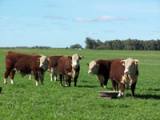
South American cattle bear brunt of blame for food and environmental troubles. - Courtesy of Sociedad de Criadores de Hereford del Uruguay
Because of its cattle, Brazil is among the world's leading emitters of greenhouse-effect gases. The livestock industry has encroached on the Amazon and is a leading cause of deforestation. According to the first national inventory, in 1994, logging represented 75 percent of Brazil's greenhouse gases.
The destruction of forests, which has accelerated since the 1980s, coincides with the expansion of cattle raising. From 1994 to 2006, the national herd grew from 158 million to 205 million head, and 82 percent of that increase took place in the Amazon region, according to the study “The Kingdom of Cattle” by the environmental group Friends of the Earth-Brazilian Amazon, released in January.
Cattle in the Amazon — 73.7 million head in 2006 — occupied 74 percent of the total deforested area.
But the original cause of deforestation is not cattle raising, but rather the lack of stimuli for sustainable production in the Amazon, said Mario Menezes, assistant director of Friends of the Earth and co-author of the study. Without agricultural regulation, state control and development policies, “the expansion is unregulated,” he told Tierramérica.
Most Amazon land is public, but the government does little to monitor it. Many ranchers occupy areas illegally, and have to spend little to eliminate the forests, says Paulo Barreto, a researcher with the Institute of Man and the Environment in the Amazon.
Meanwhile, recuperating degraded pasture costs two and a half times more, Barreto said.
With productivity at little more than one head per hectare, Brazilian cattle hunger for cheap land. Deforesting the land — which carries little risk of penalty — then becomes a logical route.
In the Amazon, furthermore, cattle have found “sun, heat and water year round,” which means cheaper beef, “competitive despite the distance” to the industrial centers, Assuero Veronez, head of the environment committee of the Agriculture and Livestock Confederation of Brazil, told Tierramérica.
To attribute three-quarters of Brazil's greenhouse gas emissions to deforestation is a mistake, Veronez believes, because the calculation includes all of the area's biomass, neglecting that before the “quemadas” (burning to clear forest), the useful lumber is removed and what burns is just 30 to 40 percent of the original biomass.
Tito Díaz, an animal health and protection officer with the United Nations Food and Agriculture Organization (FAO) in Latin America, also underscored that “pastures fix carbon in their roots (at a volume) that is quite considerable and is not taken into account.”
But now “everything is banned” because of environmental issues, which leads to a “stranglehold on the Amazon economy,” Veronez complains.
And the pressure grows stronger. Brazil's Consumer Defense Institute (IDEC) launched a campaign in March, “Change Consumption, Don't Change the Climate”, urging the public and supermarkets to track beef origins and reject any that comes from cattle that have contributed to deforestation.
According to Lisa Gunn, IDEC information manager, beef “is not sustainable” because it comes from the conversion of a much greater quantity of food and plant protein into meat, and requires too much land. But it is only possible to change habits gradually, she says, which is why the institute is calling for reducing consumption of beef instead of eliminating beef from the diet altogether.
In pasture-fed cattle operations like those of South America, one kilogram of beef is produced with 18 to 20 kilos of grasses. For feedlot cattle, where the diet is based on grain, six to eight kilos are needed to produce one kilo of meat, according to Francisco Santini, veterinarian at Argentina's National Institute of Agricultural Technology.
Cattle that are raised confined in feedlots require less space, but they also cause deforestation because they are fed soybeans, of which Brazil and Argentina are major producers. This effect is evident in the increase in deforested area in the Amazon each time there is a rise in the international price for soybeans.
Brazil's greenhouse gas emissions tally must also include the methane released from the intestinal fermentation of cattle and the nitrous oxide in the manure. These gases represent a much smaller volume of the total greenhouse gas emissions, but, respectively, they have 21 and 300 times the greenhouse effect that carbon dioxide from the forest fires does.
In Argentina, cattle ranching has transferred 11 million hectares to crop farming in the last 14 years, while maintaining a herd of 54 million head. Methane emissions have declined with the increase in grain feed, said Santini. But the most recent data available indicate that agriculture generates 44 percent of the country's greenhouse gas emissions, with an increased share from cattle-origin methane.
In Uruguay, which has 10 million head of cattle — three times the human population — in addition to 15.2 million sheep, agriculture generates 91 percent of the country's methane emissions and is the country's second leading source of greenhouse gases.
A 2006 FAO report estimated that livestock generated 18 percent of the world's greenhouse gases, surpassing transportation as an emissions source. The calculation included the effects of deforestation, food production and its chemical inputs (pesticides and fertilizers), gases produced by the animals, meat processing and agricultural transport.
Across most of Latin America forests have been lost to livestock and soybean production, but Chile and Uruguay have increased their tree-covered areas, which indicates that livestock can expand “without putting an end to forests,” Díaz, the FAO expert, told Tierramérica.
The region has the advantage of feeding its herds with grasses and forage, which don't compete with human food, given the high prices of grains that Europe and the United States utilize in their heavily subsidized cattle industries, he said.
But, not to miss this opportunity, Latin America must promote “sustainable cattle-raising systems” and recover degraded pastures, Díaz added.
Sustainability is being pursued in Acre, a state in northwest Brazil, by integrating agriculture, pasture and forestry, which improves the productivity of small, medium and large properties. The yield reaches three head of cattle per hectare, three times the national average, reports Judson Valentim, head of the local center of the government's agricultural research agency, Embrapa.
Valentim admits that livestock production leads to deforestation as a result of cheap land, but says this can be corrected with higher productivity and with measures like the ban (beginning July 1) on loans to farmers or ranchers who are involved in illegal logging.
Brazilian cattle raising could be made sustainable with more productive technologies, with ranching limited to appropriate areas, and leaving aside land that is better suited to growing crops, he says.
But Barreto and Veronez agree that this would require policies that compensate for what has been invested in recovering degraded or more costly land, paying farmers and ranchers for environmental services, and changing the economic logic that currently favors deforestation.
 Print
|
Print
|




