Friday, September 25, 2026



News and Views from the Global South

Women Create Food and Jobs in Argentine Wetlands
- Tierramérica explored the effort behind preparing artisanal dishes made from a declining catch of fish, an effort towards sustainability taken up by the women of river communities in northeast Argentina.
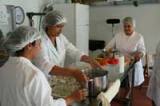
Preparing artisanal fish products. - Fundación Proteger
Lucero works as part of an added-value initiative for small-scale fishing operations in the wetlands of the Paraná, a river that has many branches in Argentina’s far northeast, creating a delicate series of ecosystems that are rich in biodiversity.
The program, promoted by the Proteger (Protect) Foundation, based in the province of Santa Fe, trains women in the region’s fishing communities.
“The plan consists of courses in different fishing communities and, later, where there is greater interest and possibilities for development, it means giving them the possibility of working in this area,” Julieta Peteán, wetlands and fisheries coordinator for Proteger, told Tierramérica.
For taking the courses and for producing the fish preserves two times a week, the women receive 250 pesos per month (85 dollars) from a fund administered by the Proteger Foundation, with support from the Inter-American Foundation, which provides grants for sustainable and participative projects in Latin America.
The economic support will continue until December. By then, Proteger expects to have a negotiation plan ready that will allow them to distribute the products in various markets. “Those involved will receive a percentage of the sales, leading towards making the effort self-sustaining,” added Peteán.
Before this project, some women worked at home raising their children, while the men would go to the “ranchada”, a camp the fishermen set up on one of the islands of the Paraná, where they stay two to three weeks at a time while they ply the river’s waters for fish.
Lucero, daughter of a fisherman, did work outside the home – a lot. The fisherman “would go to the island – about 45 minutes by boat from Alto Verde, on one of the branches of the Paraná – and I would go with the motorboat, to bring them food, tools and fuel, and then I’d bring back the fish to sell,” she tells Tierramérica.
But four years ago, the catch began to decline. “Before I would come back with1,000 or 2,000 kilos, but lately there were times when I came back with 50 kilos and my head down. Also, my mother would tell me it was not a job for a woman,” says Lucero. Many of the fishermen took jobs as bricklayers or farmhands.
Fishing is threatened by the big hydroelectric dams on the upper Paraná, affect the zones where fish reproduce and grow. Another big factor is the intensive exploitation of fish stocks begun a decade ago by big companies that sell the fish to foreign markets, and which has seen a sharp increase in the last five years.
The most-caught fish is the sábalo, or American shad (Alosa sapidissima), a key species in the food chain because it feeds the boga, dorado, surubí, patí and other fish sought by the commercial fishing industry. According to Proteger’s data, fish exports from the Paraná grew from just over 3,000 tons in 1993 to nearly 40,000 tons in 2004.
With this panorama, the Foundation gave up part of its headquarters to launch the pilot program for training women in river communities. Here, in Santa Fe, capital of the province of the same name, the experience has advanced further and various food products are being produced, including smoked fish, pickled fish and fish paste.
“We prepare escabeche (pickled fish) and preserves of the amarillo, patí, moncholo, mandubé, boga, armado and sábalo”, says Nelson Peteán, food engineer in charge of training and supervision of processing in Santa Fe.
“We make use of all the meat and create as much as 300 percent added value,” he tells Tierramérica.
The fishing community of Puerto Reconquista, along another arm of the Paraná in northern Santa Fe, is working to replicate the experience. The women are working on obtaining a sales permit from the food safety authorities, while production of the fish preserves takes place at the home of one of them, Mónica Farías.
Married to a fisherman, Farías has worked for 12 years as a volunteer at a community kitchen for children of the local port. Now she will also have a job that produces income, alongside her mother, an aunt, and other women in the community.
The municipal government offered a space in the port where they could set up a modest shop to process the fish and tan the skins, which will be used in crafts. It will be the first site certified to operate as a fish processing plant.
Puerto Reconquista is located in a 492,000-hectare area of rivers, lakes and grasslands, declared an international wetlands site in 2001 under the Ramsar Convention, and known as Jaaukanigás (“people of water” in an indigenous language).
The Ramsar Convention was adopted in 1971 in the Iranian city of that name with the intention to conserve biodiversity and promote the rational use of wetland ecosystems.
On the Paraná River’s islands there are several monkey species, caiman and birds, and the freshwater is estimated to hold some 300 different fish species.
The Proteger Foundation training also reached Puerto Antequera, in the northern province of Chaco, where women are getting ready to produce the fish preserves. It is in the heart of another Ramsar site, the Humedales Chaco, declared in 2004, covering 508,000 hectares.
The initiative to support artisanal fishing in wetlands of the Paraná was one of the three chosen by the Ramsar Convention to provide additional backing, along with similar efforts in Nepal and Thailand, Ramsar official Natalie Rizzotti told Tierramérica.
“The idea is that the communities themselves take responsibility for the resources, which is why it is important to have community participation, education and added value,” said Rizzotti after visiting the project sites.
The initiative also has the support of the Dutch committee of the World Conservation Union (IUCN), an international conservation body made up of governments, non-governmental groups and experts, which will present the Paraná project at the next global conference, in Barcelona in October.
 Print
|
Print
|