
Friday, October 2, 2026



News and Views from the Global South
SRI LANKA: War May Cost Trade Benefits From EU
Feizal Samath
- By refusing to allow the European Union to probe implementation of international labour and human rights covenants, on the grounds of sovereignty infringement, the Sri Lankan government may be jeopardising trade concessions and risking jobs in this country.
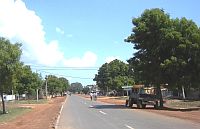
Calm before the storm in the besieged Tamil rebel stronghold of Kilinochchi. Credit: IPS Correspondents
In no uncertain terms, International Trade Minister Prof. G. L. Peiris told reporters on Monday that the EU’s request for a probe was an infringement of Sri Lanka's sovereignty, self respect and dignity. He said Brussels has been informed of this course of action through Sri Lanka's envoy there.
The government also announced a relief package worth 150 million US dollars to the garments sector and other industries that may be affected if trade concessions for a new three-year term starting January 2009 are not approved. The duty-free concessions (GSP+ benefits) which end in December, provide garments and other exporters a huge advantage in the European market against Chinese and Indian goods.
Sri Lanka has applied for fresh concessions in a new term starting 2009 but chances of success are bleak given the latest clash over the GSP+, analysts said.
The U.S., Britain, Germany and many western nations have raised concerns over a major humanitarian crisis in the northern Wanni region where the military says it is close to capturing the town of Kilinochchi, the last bastion of the Tamil rebels.
The situation worsened last month when all international humanitarian agencies were ordered to leave the area. Only government supplies through local level officials are going through for thousands of people who have been displaced.
Political analysts believe the international community is pushing the human rights line vis-à-vis GSP+ concessions because the government has generally 'given a cold shoulder' to international concern over human rights issues. It is also the first time the EU wants to investigate these issues and this may be connected to the cry for 'more accountability' from the government, the analysts said.
"This could be a bargaining chip against the need for some openness on the humanitarian crisis and now that this is gone – heaven knows what will happen next," one analyst said.
Peiris said the government will not allow the EU to conduct investigations on issues like the recruitment of child soldiers and human rights in order to review the grant of this facility.
The Sri Lankan army does not recruit anyone below 18 years, but the government could lose face as a former rebel group that it supports has been repeatedly accused of child recruitment by the United Nations Children’s Fund (UNICEF) and international rights groups.
Rohan Masakorala, deputy secretary general of the Joint Apparel Association Forum (JAAF), the garment industry apex body, said the government’s rescue package would help to ease the fears of many buyers.
"Buyers have been worried as to how to price the goods not sure whether concessions were coming or not, and thus export orders have been slow," he said. Garments form Sri Lanka's biggest export item with sales to Europe accounting for 50 percent of exports worldwide.
Some 65 percent of exports to the EU under GSP benefits come through garments while the balance 35 percent is made up of variety of small-scale products like fish, ceramics, plants, footwear, processed foods and rubber products.
With trade concessions and foreign aid from the West being linked to human rights, the Rajapakse administration has been leaning heavily on countries like Iran and China for financial support which comes with no strings attached.
Trade unions have said the absence of EU trade concessions could impact thousands of garment workers and their families.
Neil Kearney, general secretary of the Brussels-based International Textiles Garments and Leather Workers' Federation (ITGLWF), while visiting Colombo last month, told IPS that the EU position over a new agreement over GSP+ is subject to rules and regulations governing human rights and worker rights. "The EU will want to assess how far Sri Lanka has progressed in this field," he said.
He said it was unfortunate that 'statements' (at that time) by some Sri Lankan ministers, that the country would not accept a EU mission to study these aspects, and that Sri Lanka prefers to lose the concessions rather than allow such a mission, complicated matters.
"I find this extremely shortsighted as a halt to these concessions would affect thousands of workers and their dependants. Workers in the transport, logistics and support services in the industry will be affected," Kearney said, adding that Sri Lanka has a 10 percent price advantage over other suppliers because of the GSP+ benefits.
Anton Marcus, general secretary of the Free Trade Zones and General Services Employees' Union, said that if Sri Lanka loses the GSP+ the impact will be on the workers and their families.
"Many factories will close down," he said. JAAF officials say they are hopeful the rescue package of 150 million dollars will act as a buffer against any fallout on industries that benefit from the EU concessions.
While the modalities of the rescue package are to be worked out next week, it is unlikely to contain a grant or subsidy. Industry sources said it is likely to contain a credit-line and some advances to cushion the costs to industries if the GSP+ concessions end by December.
Among issues that workers have been campaigning for, and which would have formed part of the EU investigations, are the right to form unions and the need for what is called a 'living wage'.
Kearney says globally it is accepted by buyers and the International Labour Organisation (ILO) that wages must meet the basic needs of the workers and make up what is called a 'living wage'. "The legal minimum wage here is 6,000 rupees (about 600 dollars) plus per month while the living wage is double that," he told IPS.
 Print
|
Print
|



Pictures for this story
This story includes downloadable print-quality images -- Copyright IPS, to be used exclusively with this story.


