
Sunday, October 11, 2026



News and Views from the Global South

When the City Makes You Sick
- A scientific study in Brazil shows that breathing urban air filled with particulates sharply increases the risk of cardiovascular disease.
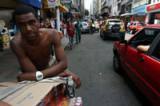
Living in polluted cities is harmful to health, especially for the poor - Alejandro Arigón/IPS
The new structure of LDL (low density lipoprotein) facilitates the accumulation of fat in the arteries, in other words, arteriosclerosis. This process ultimately restricts blood flow and can damage vital organs like the heart and brain.
The study that verified this risk is the doctoral thesis of biomedical scientist Sandra Castro Soares, of the University of São Paulo's medical school. The research was conducted using mice, as usual, but for the first time they were placed in the real environment, breathing the same air as humans, near a busy avenue in this overpopulated city in southern Brazil.
One group of mice was exposed to the air pollution of the streets, which comes mainly from vehicle exhaust, during their first four months of life – equivalent to 40 human years. Another group of mice was kept in chambers with filtered air.
The first group ended the period with symptoms like thickened arterial walls, altered LDL, and antibodies to fight that change. All are indicators of a higher risk of heart attack.
The problem lies with the microparticulates that “cross the nasal and pulmonary barriers, entering the blood system,” Soares explained in an interview with Tierramérica.
“They don't change the quantity of fat, but rather its quality” of adhering to the artery walls, she said. The change attracts more antibodies, which in turn attract more LDL, in a vicious circle that aggravates the problem.
In the last few decades, São Paulo has reduced the quantity of contaminating particulates in its atmosphere by half.
But the research revealed that even with the improvement, which meets the standard recommended by the World Health Organization of less than 50 micrograms of particulate per cubic meter, the air is not clean enough, said Lucía García, who advises Soares in the air pollution lab at the University.
The particulates are oxidants, and oxidized LDL intensifies arteriosclerosis, increasing vascular health risks for those who live in the world's big cities. Exercising, such as running, in polluted areas can be very bad for your health, García said.
In fact, there are many recent studies in São Paulo that reveal numerous and varied effects of urban pollution: more girls are born than boys, there are more premature births or birth weight is below normal, male infertility is on the rise, and deaths from respiratory illnesses are increasing. Childhood cancer and hypothyroidism are other possible consequences.
A low birth weight is not just a matter of size, it means “a less mature fetus,” with organs that are not fully developed, which can lead to future health problems or premature death, according to physician Paulo Saldiva, who coordinates the University of São Paulo's (USP) air pollution lab.
USP is today “among the five universities in the world producing most knowledge” about the relation between health and environment, says Saldiva proudly, though he laments that the findings have had little influence on Brazilian public policy.
Air pollution as a serious public health matter has so far failed to mobilize the health authorities, who are more concerned about fighting infectious diseases like H1N1 influenza, HIV/AIDS, and dengue, he said.
Furthermore, environmental officials and activists pay little attention to the relationship between the environment and human health, he added.
In contrast, the tobacco industry is apparently content with the conclusions about the effects of urban air pollution, because they can use them to tone down the health effects of smoking, like lung cancer. But, in any case, “cigarettes are worse for your health than the polluted air,” stressed the researcher.
The problem is that while tobacco affects only those who decide to smoke or live with smokers, nobody escapes from air pollution, Saldiva said. “The poorest are the most exposed” to the risks because they travel for hours on buses on congested streets to get to their jobs, while the wealthy have their own enclosed cars with air conditioning.
Social inequalities coincide with environmental injustices, given that the poorest of the poor live in unsuitable areas, vulnerable to floods and landslides, with little water and more pollution, said Saldiva.
The situation is getting worse in São Paulo, where thousands of cars are added each day to the six million vehicles circulating the metropolitan area's streets. This slows transit and forces people to breath the polluted air for longer periods, increasing the risk of contracting one of the pollution related diseases, he said.
The USP air pollution lab research is concentrated now on studying the effects on people who spend a lot of time in the more polluted areas of São Paulo, such as traffic controllers at the busiest intersections.
Particulate matter and “perhaps ozone” are the elements of greatest concern in terms of urban health, said Saldiva.
 Print
|
Print
|




