Tuesday, October 20, 2026



News and Views from the Global South
U.N. Chiefs Vulnerable to Manipulation by Big Powers
- Since the creation of the United Nations over 65 years ago, successive secretaries-general have won re-election for a second five-year term mostly by currying favour with the five veto-wielding permanent members of the Security Council: the United States, Britain, France, China and Russia.
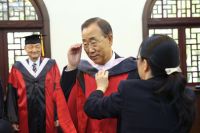
Secretary-General Ban Ki-moon receives an honorary degree from Nanjing University during his recent trip to China. Credit: UN Photo/Mark Garten
So, when Secretary-General Ban Ki-moon refused to publicly urge China to release the imprisoned Nobel Peace Prize winner Liu Xiaobo last week, he was accused of playing up to the Chinese, who could veto a second five-year term – if Ban displeases Beijing and if he seeks re-election.
But Ban, whose five-year term ends in December next year, maintains he did “discuss” human rights issues in his private talks with Chinese leaders – “where diplomatic discourse has sometimes to be conducted in confidence”.
When Boutros Boutros-Ghali of Egypt failed to win a second term in late 1996, he lost the post of secretary-general because he irritated a single member state: the United States.
Despite the fact that the overwhelming majority in the Security Council voted for him – he garnered 14 out of 15 votes – he was drummed out of office when the United States cast its veto against him.
Jayantha Dhanapala, a former U.N. Under- Secretary-General for Disarmament Affairs who ran unsuccessfully for the post of secretary-general four years ago, expressed his own thoughts on "one of the world's most impossible jobs".
In an op-ed piece he wrote years ago, Dhanapala said there is the procedure for the election on which many views have been expressed. He wrote:
"Should it be more transparent and should not the General Assembly have more control? Should the candidates present manicured manifestos and engage in a U.S. Presidential campaign style extravaganza or should they be shrinking violets waiting coyly in the wings till the call comes?
All pertinent questions.
Those disillusioned by the sullied reputation of the U.N. seek a Superman as the next secretary-general.
The media speculates wildly about past Presidents and current Prime Ministers forgetting that those elected on national mandates are more likely to be Generals than Secretaries.
The U.N. system has already had many such square pegs in round holes. Perhaps what the U.N. needs today is what it has always needed - a secretary-general who is a tried and tested diplomat with versatility and gravitas derived from experience, a flexible and modest temperament and the limitless patience of a consensus builder.
We need someone who will be more of a steady moral compass than a flamboyant political weathercock.
History has proved that the U.N. Charter's Article 100 requirement for impartiality is more achievable with the citizens of smaller countries with the least amount of accompanied national baggage of territorial and other disputes in their international relations.
We need a strong manager who will delegate and yet be finally the person where the buck stops. And yes - even if it is an oxymoron - we need a practical idealist."
And how could one ensure that the U.N. chief is independent, forthright and willing to speak his mind – without worrying about re-election for a second five-year term?
Shashi Tharoor, a former U.N. Under-Secretary-General for Public Communication and who unsuccessfully ran for the post of secretary-general four years ago, was a strong advocate of a one-term, seven-year tenure for the U.N.’s chief administrative officer. So is Phyllis Bennis, director of the New Internationalism Project at the Institute for Policy Studies, who told IPS that if a second term was not an option, one could imagine at least a hypothetical scenario of a U.N. chief taking seriously the caution outlined in the Charter: that the secretary-general shall not seek or receive instructions from any government.
“One imagines that the drafters of the Charter would also have been concerned about a secretary-general making decisions with one or more eyes turned towards the possibility of a second term,” said Bennis, who has authored several books, including the just-released “Ending the US War in Afghanistan: A Primer”.
A former Arab diplomat told IPS that virtually all recent secretaries general who ran for a second term refused to publicly criticise Israeli human rights violations fearing they would antagonise the United States.
“Ban Ki-moon is no exception,” he said. “Since he is politically cautious on issues such as human rights violations by China or high-handedness by Israel, it is obvious he is planning to run for a second term.”
Barbara Crossette, a former U.N. bureau chief for the New York Times, told IPS there is an argument to be made for a non-renewable seven-year term for the secretary general.
“With the need to be looking over one’s shoulder through a first term in the hopes of insuring a second, it can be that it is not until that second term that a secretary-general can be more courageous and outspoken (as Kofi Annan was on the U.S.-led war in Iraq),” she said.
Boutros Boutros-Ghali paid the price for not pulling punches in his first term. But the United States refused to endorse him for a second five-year term, she added.
“A single term might make a secretary-general more forceful from the start,” said Crossette.
The downside, of course, is that seven years is a long time if the wrong person has been elected to the job, she added.
Bennis told IPS the position of U.N. secretary-general has always been highly politicised but more publicly so in the last quarter century or so.
The appointment must reflect that year’s particular alliances and enmities, the nuanced balance of forces among the rest of the U.N.’s 192 member states.
But most importantly, she pointed out, the person selected must be acceptable to all five permanent members of the Security Council.
“That generally means someone deemed politically bland enough not to challenge U.S. interests first and foremost, China’s second, and those of the other three veto-wielding permanent members,” Bennis said.
It means someone willing to get along with Washington, whether by actual agreement or by decision not to seriously challenge U.S. positions, Bennis said.
Faulting Ban Ki-moon for not publicly criticising the Chinese, a New York Times editorial last week said the United States “should think hard about whether it wants to support Ban’s re-election”.
Bennis said Kofi Annan was already in his second term in September 2004 when he finally acknowledged, more than 18 months after the U.S.-led invasion of Iraq, that the war was illegal and a violation of the U.N. Charter.
“There is little doubt that U.S. and UK pressure had prevented Annan from making that statement much earlier, particularly during the tense months leading up to the invasion, when such an unequivocal assessment would have further strengthened the UN’s opposition to the looming war,” she noted.
She said Ban Ki-Moon was seen as “Washington’s man” when he was first appointed, not least at his first press conference when, answering a question about the execution of Iraqi President Saddam Hussein, he rejected the United Nations historic unequivocal opposition to the death penalty.There were rumours after U.S. President Barack Obama came into office that Ban was really more Bush’s man than Washington’s man, but his consistent support for government accountability in Darfur, along with his refusal to support serious efforts towards holding Israel accountable for war crimes in Gaza, paralleled longstanding U.S. positions during both administrations, she added.
 Print
|