
Monday, October 26, 2026



News and Views from the Global South
Gender
Afghan Men Quietly Resist Taliban Ban on Girls’ Education
The author is an Afghanistan-based female journalist, trained with Finnish support before the Taliban take-over. Her identity is withheld for security reasons
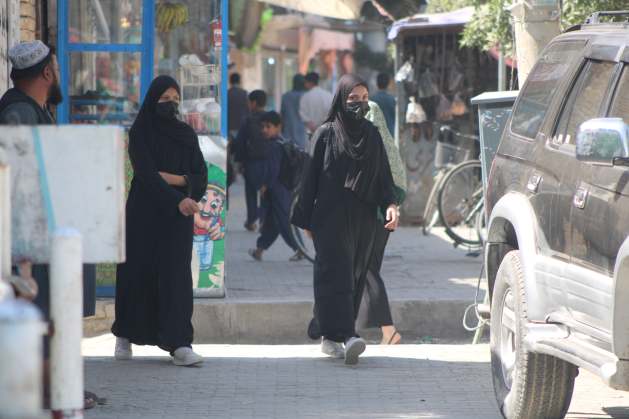
Since the Taliban seized power in August 2021, girls have been banned from schooling beyond the primary level and women’s employment has been severely restricted. Credit: Learning Together.
- Many wonder why men in Afghanistan do not protest when women’s rights are trampled upon. In reality, many are rebelling behind the scenes, for instance, by helping their daughters get an education.
“The only thing I can leave my daughter is an education”, says Yaser.
Every day before leaving for work, he checks whether the internet is working. He does this not for himself, but for his 18-year-old daughter, Mariam. Mariam has been unable to attend school for five years, but she can still study online, provided the internet connection holds.
Mariam shares this plight with two million other girls. When the Taliban seized power in August 2021, it became the only country in the world to ban girls from schooling beyond the primary level and severely restrict women’s employment. Afghan women have never been as invisible as they are now.
Both within Afghanistan and internationally, many have wondered why men have not protested, even though their daughters have been deprived of educational opportunities. Why have they remained silent? But the question can also be framed differently: Have men been doing something else instead of staying all quiet?
To find answers, I spoke with fathers, uncles, teachers, and principals in Kabul, Herat, Mazar-e-Sharif, and several other provinces. I realized that what appears from the outside to be silence and acceptance of the situation is actually a form of quiet resistance.
Fear is a major reason why men remain silent.
“If I protest publicly, the Taliban will come to my home at night, beat me up, and take me away. What would happen to my wife and daughters then? But I can ensure my daughters are able to study online. That way, I won’t have to be ashamed of myself one day for having done nothing.”
Yaser tells the story of a man who criticized the closure of girls’ schools on Facebook.
“Two days later, the Taliban came and took him away. His family was beaten, too. The man wasn’t released until months later. I am terrified of that happening and don’t want the same thing to happen to my own family.”
Reports from human rights organizations corroborate Yaser’s account. The Taliban have detained and issued warnings to journalists and activists who have criticized the regime. They have been threatened with harsher measures if the criticism does not stop.
Ahmad, a Kabul resident, is the father of two daughters. He lost his job when the Taliban came to power and now takes on odd jobs whenever he can find them. Putting food on the table for his family is a daily struggle.
When I ask why he has never protested on behalf of his daughters, his answer is brief: “My wife and children would starve if I protested and got arrested. But I can send my daughter to a neighbor’s house to study. Before the Taliban took power, our neighbor was a university professor. Now, she teaches girls in her home.”
“It might not be a substitute for school, but it’s better than nothing”, says Ahmad
Ahmad falls silent for a moment before continuing his train of thought: “People have protested before. Women have marched in the streets but what did that change? Many of them are still paying a heavy price for it.”
Other men I have interviewed have reached the same conclusion. Instead of protesting, they have begun supporting their daughters’ studies at home. There are valid grounds for their fears, too.
For instance, in Herat, the Taliban detained university lecturer Qadoos Khatib and civil society activist Fayaz Ghori for posting videos and messages on social media advocating for girls’ education. Both emphasized that Afghanistan cannot develop without educating women.
Another case also came up repeatedly in my interviews.
University professor and former journalist Ismail Mashal refused to remain silent about the ban on girls’ education. He tore up his university diplomas during a live television broadcast and later distributed thousands of books to girls and women on the streets of Kabul.
The Taliban detained and brutally beat him. The books were confiscated.
For many of the men I interviewed, these events were not merely news stories, but reminders of what can happen if one speaks out. Many are looking for other ways to help their daughters.
Amir, 45, from Mazar-e-Sharif, never had the chance to go to school himself. He cannot read or write and has been working since childhood.
“My daughter means the world to me. I don’t want her to miss out on an education, the way I did”, says Amir.
Amir knew that some girls were studying online, but he couldn’t afford a mobile phone or an internet connection. So, he borrowed money from relatives to pay for them. Now, he works in a shop during the day and puts in extra hours at a tailor’s shop in the evenings to pay off his debt.
“If I don’t do everything I can for my daughter’s education today, what will she have for tomorrow?”
Amir owns no home and has no savings.
“The only thing I can leave my daughter is an education.”
It is not just about the girls; it is about the future of Afghanistan.
Farid, 38, does not have a daughter of his own, but every Friday he helps his 16-year-old niece with her studies at her home. Farid brings her books and downloads learning materials from the internet.
His niece’s dream was to become a doctor, and Farid does not want to let that dream die.
Farid believes that supporting girls is not solely the duty of fathers. It should be a shared responsibility for everyone.
Of the people I interviewed, the one who took the greatest risk was the principal of a private school. She wants to remain anonymous.
She refused to comply when the order came to stop educating girls after the sixth grade. Instead, she kept the girls officially registered as sixth graders for another two years and continued teaching them.
She knew she would lose everything if she were caught. When I asked if she was afraid, she smiled.
“Of course I was afraid. I have often had nightmares about it. But I couldn’t do otherwise when I saw the girls crying because their schooling was coming to an end.”
There are also those who believe girls do not need much education.
“Girls will get married eventually anyway. Basic literacy is enough for them,” said one man who did not wish to give his name. However, he was in the minority among the men I interviewed.
Most wanted educational opportunities for girls. They have not been able to change government policy, but they have found other ways to help their daughters continue their studies.
 Print
|
Print
|




