
Wednesday, October 7, 2026



News and Views from the Global South
Renewed Hostilities In Yemen Inflame Displacement and Regional Risks
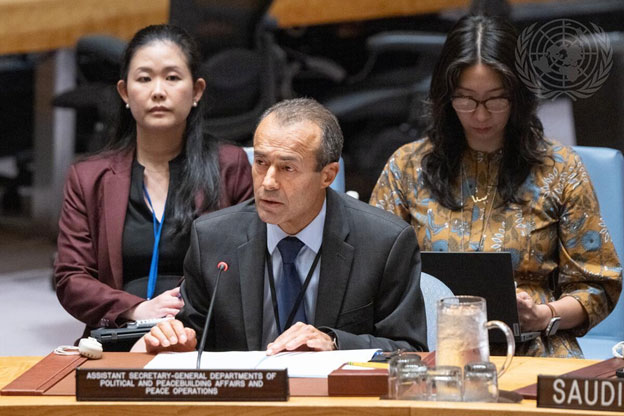
Khaled Khiari, Assistant Secretary-General for Middle East, Europe, the Americas, Asia and the Pacific, Departments of Political and Peacebuilding Affairs and Peace Operations, briefs the Security Council meeting on the situation in the Middle East (Yemen). Credit: UN Photo/Eskinder Debebe
- In recent days, the humanitarian situation in Yemen has deteriorated sharply following a new escalation of hostilities between the Iran-backed Houthi rebels and the Saudi-backed Presidential Leadership Council (PLC). This follows four years of relative stability, marking the most severe resurgence of violence since the collapse of the United Nations (UN)-mediated ceasefire in October 2022.
Described by the UN as a “new, more dangerous phase of the war,” new hostilities have resulted in persistent disruptions to telecommunications and restrictions on movement, which have left humanitarian aid operations increasingly strained. Although insecurity has largely been concentrated in Yemen’s southwest, civilians across the country face rampant insecurity and increasingly limited access to essential services such as shelter, food, clean water, healthcare, and protection.
On September 3, Houthi forces launched a major offensive in the Taiz governorate, aiming to sever critical connecting roads to the strategic port city, Mokha–a key trade hub in the region. This prompted counter-offensives and cross-border missile exchanges from Saudi-backed forces. By September 10, the Houthis had expanded their operations along Yemen’s Red Sea coast, capturing Mokha as well as key surrounding areas along the Bab al-Mandeb Strait.
As of September 14, the Office of the United Nations High Commissioner for Human Rights (OHCHR) has verified at least 40 civilian casualties recorded since September 3, including 8 deaths and 32 injuries. Women and children account for half of those killed and more than half of those injured. Due to rampant access constraints and ongoing insecurity, these initial figures are expected to rise as response efforts continue.
The same day, the United Nations Refugee Agency (UNHCR) announced that over 100,000 civilians, or at least 18,000 households, have been newly displaced due to renewed violence. The International Organization for Migration (IOM) noted that the Taiz governorate was the hardest-hit by new displacement, with nearly 56,000 displaced from this region alone. An additional 19,000 civilians were displaced from Lahj, more than 8,000 from Al Hodeidah, and over 2,500 in Aden.
“Families are arriving with nothing: no shelter, no food, no way to know if it’s safe to go back,” said Abdusattor Esoev, IOM Yemen’s Chief of Mission. “Many of these are people who have already been displaced once, twice, even four times before. Every time fighting flares up, they lose whatever little they had managed to rebuild. We are particularly concerned by reports that some families may be unable to leave frontline areas safely because of continuing hostilities and insecurity along access routes.”
Additionally, IOM notes that entire villages have been emptied across three districts in Taiz– Maqbanah, Jabal Habashi, and Al Ma’afer–with recorded upward trends in Aden, Al Hodeidah, and Abyan. The agency stated that the recorded number of displaced families increases “by the hour,” noting that basic services across Yemen’s overcrowded displacement shelters have grown increasingly strained.
Renewed violence has also driven massive levels of cross-border movements, with UNHCR recording over 2,400 people crossing from Yemen to Djibouti by sea, with the vast majority arriving through Obock, Khor Angar, Moulhoule, and Godoria. These voyages are extremely dangerous, with overcrowded vessels, fuel shortages, and rough waters leading to frequent fatalities and missing passengers. More than 60 percent of these migrants are women, children, and elderly persons.
“People are arriving after a difficult sea journey, many exhausted, distressed and carrying what little they could take with them,” said Sandrine Desamours, UNHCR Representative in Djibouti. “The response is already under pressure. We urgently need more support before more families arrive and needs outpace our capacity to assist them. Djiboutian families and the Yemeni refugee community are opening their doors and sharing what little they have, but the humanitarian response, already facing a dire funding crisis, is being stretched fast.”
Hans Grundberg, UN Special Envoy for Yemen, warned the Security Council on September 10 that the new escalation of hostilities could plunge the country into a state of prolonged war that spills far beyond its borders. Grundberg stressed that Yemen risks being dragged into another broader regional conflict with “global repercussions,” raising significant concern across the humanitarian community.
With Houthi rebels maintaining a strong presence along all key routes connecting to the Red Sea coast–one of the world’s most critical maritime chokepoints–the global energy trade could face severe disruptions, further inflaming regional tensions. As the Houthis exert control over the Bab al-Mandeb Strait while Iran disrupts shipping through the Strait of Hormuz, Iran effectively consolidates massive economic and political leverage over the global energy market.
The UN Security Council held an emergency session on September 15 to address the situation in Yemen. Mauricio Gaona the Permanent Representative of Colombia to the UN, warned that the disruption of the Straits of Hormuz and Bab al-Mandeb jeopardize roughly one-third of global oil trade.
“We are facing an international, or potentially an international, conflict that will be felt first in the developing world and then in the developed world. We will believe that the effects of not acting are greater than the conflict we do face today,” said Gaona.
Vasily Nebenzya, the Permanent Representative of the Russian Federation to the UN, stressed that destabilization in the Red Sea and the Bab al-Mandeb Strait compromises free, safe navigation and sustainable shipping. He noted that this directly threatens humanitarian cargo shipments—which many countries in protracted crises are critically dependent on—raising concerns that conditions could rapidly deteriorate if aid deliveries are cut off.
Khaled Khiari, the UN Assistant Secretary-General (ASG) for Middle East, Europe, the Americas, Asia and the Pacific, Departments of Political and Peacebuilding Affairs and Peace Operations, reiterated concerns for the security of the Red Sea and the international maritime corridors. He added that what is needed in this time is “sustained engagement that reduces tensions prevents further escalation and safeguards freedom of navigation”.
“The parties in Yemen should prioritize dialogue and engage constructively with United Nations-led efforts toward a negotiated political solution,” said Khiari.
IPS UN Bureau Report



 Print
|
Print
|




