Sunday, August 23, 2026



News and Views from the Global South

Global Warming Fuels Chinese Inflation
- A persistent drought threatens the harvest of grains in China, driving up food prices.
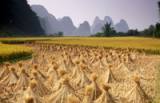
Harvested rice paddies in Yangshuo, southern China. - Photo Stock
Efforts to combat price hikes though by increasing grain supply are hampered by climate change, which has posed a severe threat to this year’s harvest.
“We’re facing a grave situation,” the country’s top planner, Ma Kai, said of the annual harvest last week, warning that global warming is taking its toll on China’s already shrinking farming land and its sacrosanct policy of food security.
More than 11 million hectares of arable land have been hit by drought this year, 2.14 million more than the average for the past few years, Ma Kai said while making a report to a working meeting of the National People’s Congress, China’s Parliament.
China, which has a fifth of the world’s population — 1.3 billion people using seven percent of the world’s farmland –, is used to scarcity of resources and has managed to have a succession of bumper harvests in recent years.
Yet government officials now fear that the combined effects of climate change and inflation pressures could destabilize public mood ahead of the 17th Communist Party Congress — a five-yearly meeting, designed to chart the party’s policy and seal the legacy of its current leaders.
Drought is already affecting 22 of China’s 31 provinces. Meteorological experts say that global warming would exacerbate things as a one-degree rise in temperature could aggravate ground water evaporation by seven percent.
Zheng Guogan, head of the State Meteorological Administration forecasts global warming will cut China’s annual grain harvest by up to 10 percent. That would mean about 50 million tons less grain in the current tight supply situation and a potential for further inflation.
“Given the tightened food supply in the international market, a decline in domestic grain production could lead to more price hikes,” Song Tingmin, vice-president of the China National Association of Grain told the China Daily.
A surge in food prices saw China’s consumer price index (CPI) rise to a 10-year high of 5.6 percent in July, far above the government’s upper target of 3 percent for the whole year. Economists say the August inflation rose even higher on the back of soaring pork costs.
The social dimensions of such leaps in inflation are not lost on a government, which remembers that 1989 pro-democracy movement that saw thousands of students, workers and intellectuals out in street protests was triggered by public anger over inflation.
In the past China would have tackled inflation woes by increasing imports of commodities but this strategy is seen as no longer viable because of rising prices of grain abroad. Citing the need to “stabilize inflation expectations”, Beijing reacted by ordering the central bank to raise interest rates for the fourth time this year.
In recent months Chinese leaders have also made publicized efforts to raise farm output and curb price hikes. Premier Wen Jiabao who has warned that continuous price rises pose a threat to social stability made a high-profile tour of pig farms and farmer markets earlier this year, attempting to reassure the public that Beijing was acting to solve the inflation problem.
To counter the threat of diminished farm output, the government has offered subsidies to pig breeders and started weighing options of growing more drought-resistant crops like potatoes. In August Beijing ordered local governments to check food producers, wholesalers and retailers for price fixing and gouging.
In the latest sign of unease over the price hikes, this week the Ministry of Education ordered universities to provide subsidies for hard-up students and ensure the stability of food prices in student canteens.
“We hope that university students will have correct understanding of fluctuations in food prices,” ministry spokesman Wang Xuming was quoted as saying Tuesday, sounding yet another poignant reminder that 1989 protests started in university campuses.
China observers speculate that runaway inflation has been the cause for last week’s removal of China’s finance minister, Jin Renqing. Ostensibly, Jin was just one of several government officials reshuffled in the run up to the party congress on Oct. 15 and reports of his sexual misconduct and various mistresses were somehow accidentally leaked to the press.
But, says one Beijing-based foreign diplomat, “I do believe his (Jin’s) alleged dalliances have to do more with inflation than with sex”.
Reigning in inflation is perceived as important by the current Chinese leadership of President Hu Jintao and premier Wen Jiabao. Both have made equalizing of robust but uneven economic growth and helping the poor and downtrodden their political priorities.
When the Communist party conclave convenes on Oct. 15, Hu Jintao, who is also party chief, would seek to cement his political legacy of promoting a “harmonious society” and “fair and just polices”, by finally naming a successor designate.
 Print
|
Print
|