Tuesday, September 1, 2026



News and Views from the Global South

Amazon Ghost Highway Revived
- The decision of the Brazilian government to rebuild a highway nearly 900 kilometers long in the middle of the Amazon jungle has reopened a heated environmental debate.
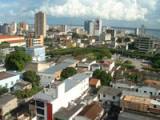
Manaos, an Amazon city on the controversial BR-319 highway. - Wikipedia
The officials defend the economic integration of the central Amazon and south-central Brazil, with many benefits for the local population. The environmentalists warn that the highway will lead to more deforestation and new waves of migration towards the northern city of Manaos, which is already suffocated by urban problems and increasing agrarian conflicts. The controversy grew with the proposal to replace the highway with a railway, for which an economic viability study has already been conducted, and would mean much less deforestation, according to Virgilio Viana, who proposed the alternative as secretary of environment and sustainable development of the northwestern state of Amazonas, a post he left Mar. 3 to head the Sustainable Amazon Foundation.
The 885-km highway unites Porto Velho, capital of Rondônia state, which borders Bolivia, and Manaos, capital of Amazonas, the Brazilian state with most preserved forest.
The rebuilding and paving of the highway should be complete in 2011, says the Ministry of Transport, whose chief, Alfredo Nascimento, was mayor of Manaos from 1997 to 2004. The estimated cost is 700 million reais (about 400 million dollars).
The railway, in contrast, would cost three times more, but would avoid emissions of gases responsible for climate change by reducing deforestation, which would allow Brazil to obtain abundant credits in the international carbon market, Viana told Tierramérica.
The deforestation forecast to result from the rebuilt highway would reach 168,000 square km by 2050, an area comparable to the size of neighboring Uruguay, according to a study by a Brazilian team led by Britaldo Soares, of the Federal University of Minas Gerais.
Furthermore, a railroad would mean much less fuel consumed, which would further reduce greenhouse gas emissions, adds Mariano Cenamo, executive secretary of the Manaos Institute of Conservation and Sustainable Development. Trains have been ignored in Brazil for decades, but they should serve as the axis for Amazonian exports and for South American integration, he said.
But the rail alternative “will not materialize”, Rondônia's Governor Ivo Cassol stated in a phone interview with Tierramérica. It is a good mode of transport, but not for this case, where the aim is to improve the living standards of the local population and allow the production of small farmers to reach the Manaos market, he said.
The ones most opposed to rebuilding BR-319 are the water transport companies, who don't want competition in a region crisscrossed by many large rivers. But the rivers are for large shipments like soybeans for export. “That doesn't work for bananas, lettuce and other horticultural products,” because it takes nine days to reach Manaos, said Cassol.
Rondônia, a state that makes its living from farming and livestock, has to expand its access to markets and industrialize its raw materials. “The 10,000 units of leather produced daily could generate 70,000 jobs in the shoe industry,” said the governor.
The population of Rondônia has grown considerably since the 1970s, absorbing the recent arrivals from the south in agricultural projects promoted by the Brazilian government. The environmental result was dramatic: today it is one of the most deforested Amazon states. It is home to 1.5 million people, with 370,000 living in the capital.
Manaos, with its 1.7 million inhabitants, many drawn by its industrial free zone, represents a big market, especially for vegetables, of which little are produced nearby. Meanwhile, its industrial sector is interested in opening a new transport option for its products to the country's central-western region.
Cassol played down the environmental damages potentially caused by the highway. “It will be easier to preserve” the jungle, he said, because the road would allow better access and lower the costs of monitoring and enforcing protections.
Furthermore, it is not about building a new highway, but rather re-establishing conditions that existed in the 1970s. “I shipped banana from Rondônia to Manaos with my truck starting in 1977. I left at 6:00am and arrived at around 5:00pm,” recalls the governor.
What is needed is to “establish the rules of the game” to prevent environmental harm, says Cassol, himself a migrant from southern Brazil who became an agribusinessman and owner of small hydroelectric dams.
And also that “the United States, Europe and international bodies not only make their demagogical speeches” in defense of preserving the Amazon, but also “contribute resources to compensate the landowners who preserve their forests, as is done in Costa Rica,” he added.
But the environmentalists predict the repetition of deforestation caused by other highways in the eastern Amazon. The devastation would expand because new lateral roads would be built along the principal route, as branches expand out from a tree trunk, argue environmental groups and researchers.
“We question the choice of the highway” without considering alternatives for transport in the Amazon, including multi-mode forms, activist Mario Menezes, assistant director of Friends of the Earth – Brazilian Amazon, told Tierramérica.
The government is paving another highway, BR-163, to the east of BR-319, which unites the central-west with the port of Santarém, which is reached from Manaos by the Amazon River itself, notes Menezes. The route also links Manaos to the country's south-central region without new threats to the forest.
However, “the connection between Manaos and Porto Velho is inevitable,” given the decision of President Luiz Inácio Lula da Silva to include BR-319 in his Accelerated Growth Program as a priority project for national infrastructure, which is why the railroad should be defended as a viable and more environmentally friendly alternative, said Cenamo.
Work on recuperating the old highway has already begun on the stretches that remained passable, near Manaos as well as Porto Velho. But the nearly 600 km in need of repair in the midsection requires authorization from the Brazilian Institute of Environment, following environmental impact studies. The debate will continue.
 Print
|
Print
|