Saturday, August 15, 2026



News and Views from the Global South

Caution and Enthusiasm for Fish Farming
- Industrial production of fish and shellfish is growing more than eight percent a year worldwide. But not all countries with extensive coastlines can take advantage of this boom, which is not without its ecological risks.
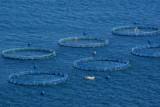
Fish farms out at sea - Photo Stock
According to the United Nations Food and Agriculture Organization (FAO), 45 percent of the fish consumed in the world comes from fish farms. Today that means 48 million tons, but by 2030 that volume would have to be doubled because of the decline in commercial fishing and the increasing demand of a growing population.
In Mexico, aquiculture dates back to the pre-Hispanic era. Historians say that several species were raised in ponds and that the Maya controlled fish reproduction in natural pools known as “cenotes”.
Currently, fish farms in Brazil, Colombia, Chile, Ecuador, Mexico and Peru produce volumes that are seen with admiration by Argentine producers. But in Argentina, the continent's southernmost country, the climate and topographic conditions are not conducive to developing large-scale fish farming.
Environmentalists here point out that the social and environmental harm that can arise from aquiculture do not justify its industrial promotion, and recommend instead fomenting responsible fishing in seas and rivers that still have a rich biodiversity.
With an output of 710,000 tons annually, Chile is the region's leading aquiculture producer and one of the top 10 in the world, alongside China and India. It is also the world's second leading producer of farmed salmon and trout (both of the Salmonidae family), after Norway. But the sector is not without its risks.
In 2007, the outbreak of infectious anemia in salmon closed down many fish farms in Chile. One thousand jobs in a sector of 55,000 were lost, according to the government, though the unions say the layoffs affected 3,000 workers.
Argentina has its potential, “but it is not Chile or Brazil,” Laura Luchini, national director of aquiculture, told Tierramérica.
“Some provincial governments are promoting this sector, but our job is to make sure people keep their feet on the ground,” she said.
On Chile's long, southern Pacific coast, there are many fjords, making it “very favorable for this activity,” said Luchini.
In contrast, Argentina's southern Atlantic coastline does not have any fjords, which provide protection, except in Tierra del Fuego, the country's southern-most province, where mussels are farmed.
Fish farming in this country is being developed on a small scale, with trout, Patagonian flounder and mussels. Output is no more than 3,000 tons per year; an insignificant volume when compared to fishing, which produces between 850,000 and 1.1 million tons of fish and mollusks.
“Nor can our country compare to Brazil, which has tropical waters,” said Luchini. The South American giant produces 250,000 tons annually of fish and shrimp in freshwater and on its Atlantic coast, in an inlet near the southeastern city of Florianópolis.
The aquiculture official believes that the enthusiasm of the Argentine producers, who see enormous potential in fish farming, is a response to the pace of the sector's growth worldwide. “While fishing production has slowed and beef production grows at a rate of 2.5 percent, aquiculture is growing 8.5 percent annually for the last eight years,” she said.
Aquiculture has become a booming activity because of the higher global demand for food and because of the possibility of establishing “traceability”, knowing the history, location and path of a product along the entire supply chain.
By 2045, the FAO estimates that fishing and fish farm production will become homologous. The producers in Argentina believe that with credits, subsidies and better technology they will be able to make the most of the opportunity to do good business, said Luchini.
But there are no magic solutions. Claudio Baigún, a biologist who is an expert in freshwater fish resources, agrees that the expectations of the producers do not take into account Argentina's limitations.
“They take Chile or Brazil as a guide, but Argentina is different. There are projects to raise pacú (Piaractus mesopotamicus) in Rosario (in the eastern province of Santa Fe). But while in Bolivia or Brazil, with their warm waters, the species matures in eight months, in Argentina it takes 18,” Baigún told Tierramérica.
“Argentina is at the limit in South America for raising warm water species,” he added. In any case, he warned that aquiculture is not a panacea. There are fish diseases, high costs of energy and food, and also the risks associated with the lack of genetic variation among the fish raised in pools.
“We want to believe that fish farming will resolve everything, but we have to preserve what we have, promote responsible management of the fish stocks and not believe that aquiculture is a life-preserver that's going to save us,” said Baigún, a researcher at the Technological Institute of Chascomús.
From the environmental perspective, Jorge Cappato, director of the Proteger (Protect) Foundation, maintains that it is essential to differentiate between community and industrial aquiculture, because the latter could have greater negative social and ecological impacts. The foundation works to preserve biodiversity and promote sustainable fishing.
In a conversation with Tierramérica, Cappato remarked that “the chemical products used in fish farming — antibiotics, pesticides, fertilizers — have (negative) effects on the water.”
“Local communities like artisanal fisherfolk lose access to the resources and run the risk of being turned into fish farmers,” he added.
Colombia produces 70,000 tons of farmed fish per year, according to 2006 data from the Colombian Agriculture Institute. With the disappearance of the “bocachico” (Prochilodus magdalenae), the principal freshwater fish species, the small-scale fishermen were turned into fish farmers, Cappato said.
“They earn less, are poorer and have worse nutrition,” said the Argentine foundation director, who visited the fish-raising ponds along the Sinú River, in the northern Colombian department of Córdoba.
Cappato also mentioned the case of Ecuador, where the intensive production of lobster has been promoted in coastal areas of mangrove forests. The companies “destroyed 60 percent of the mangroves, left jobless the women who caught shrimp, and when a virus appeared they left, leaving behind empty concrete tanks.
The destruction of mangrove forests is also a problem in Mexico, which in 2007 produced 261,000 tons of farmed seafood, with shrimp in first place.
The shrimp industry is responsible for a large part of the disappearance of those ecosystems, according to the Mangrove Ecology Group. In 2007, according to an official inventory, there was a 27-percent decline of mangrove forests since 2000 along Mexico's Pacific, gulf and Caribbean coastlines.
 Print
|
Print
|