
Wednesday, October 14, 2026



News and Views from the Global South

Genetically Modified Maize Finds Its Way to Cuba's Fields
- With little fanfare, genetically modified maize produced by Cuba's genetic and biotechnology engineering center, CIGB, is being grown on test plots as part of a new project involving five of the Caribbean island's provinces.
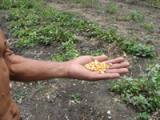
Corn kernels in the hands of a Cuban farmer. - Patricia Grogg/IPS
But the experimental cultivation of genetically modified (GM) maize, or corn, has sounded the alarm among academic experts linked to the farming sector.
The debate tends to be limited to scientific meetings and university classrooms, and not everyone in agriculture seems to be aware of the issue.
Nor is the heated international controversy very well known here about the risks that GM crops could pose for human health and biological diversity.
“I don't understand all that, but we have very good varieties here, like this one that I'm growing, which is called 'canilla'. I have little land (one-eighth of a hectare), but I can also grow lettuce, cabbage, some root vegetables, which is enough for me to eat and sell to my neighbors,” Leonida Sames, who lives in the outskirts of Havana, told Tierramérica.
Another Havana worker noted that “there is little information” about GM crops and admitted that he had not read an article in the Cuban government-run press that announced the beginning of “field trials” this year with a new grain that is resistant to the fall armyworm (Spodoptera frugiperda), the leading corn pest.
Genetic modification also aims to achieve tolerance for a herbicide in order to achieve greater yields, according to statements to the press by Raúl Armas, expert in plant biotechnology and project coordinator at the CIGB bureau in Sancti Spiritus province. The final objective is to obtains seeds that allow expanded production for human and animal consumption, as long as the appropriate authorities approve them. In this first phase, a total of 60 hectares of the GM variety will be planted in Cuba, reported the state-run newspaper Juventud Rebelde. Without ignoring the fact that Cuba needs to increase and adapt its deficient food production to adverse climate conditions, the application of this technology is being refuted particularly by sectors that support organic farming and recuperation and improvement of native variety through ecological techniques.
In its defense, CIGB scientists have said that their research does not seek profits for the institution, but rather that the technology be used in a rational way, and as a complement to conventional genetics and other important techniques that are being developed here with good results.
“In the release of transgenics in Cuba I see a great threat to the overall agro-ecological matrix of a strategic importance (not situation-specific) to our agrarian policy,” Eduardo Freyre, professor at the Agrarian University of Havana, told Tierramérica.
However, he wanted to clarify that his objections “are not intended to discredit” what his country is doing in this area, and said there is a “high value” to the CIGB researchers' work and efforts to provide “exceptional guarantees of biosafety.”
But about the potential threats to health, he fears that, perhaps not in the short term, but in the middle in long terms, GM foods could cause allergies, toxicity, immunological problems, cancer, infertility and even endocrine alterations, said Freyre.
“Not to mention the possibility of transgenic contamination, which endangers wild species and non-GM crops,” added Freyre, author of a prize-winning essay on the matter in the Cuban theoretical journal, “Temas”, to be published in an upcoming edition.
In his opinion, this technology “is made to fit the interests of the multinational corporations and the market.” And taking into account its potential risks, it would be better for Cuba to concentrate on agro-ecological alternatives already under way, even if not sufficiently widespread.
Havana has been discreet on the matter even in negotiations taking place to agree on international standards of responsibility and compensation for potential harm to biodiversity caused by transborder movement of GM crops, covered in the 2000 Cartagena Protocol, ratified by Cuba in 2002.
Acknowledging that he is unaware of Cuba's position in those talks, Freyre noted that the negotiations have yet to produce results and the reticent among the participants include the United States and Argentina. “If they reach an agreement, it would be very good for Cuba and the region,” he said. For example, it would clear up doubts about maize imported from the United States.
The talks have been going on for five years. Cuba was one of the countries in the Latin American and Caribbean Group (GRULAC) that attended as “friends of the co-chairs” of the meeting held in February in Mexico to agree on the text of the standards.
Silvia Ribeiro, spokesperson in Latin America for the non-governmental ETC Action Group (Erosion, Technology and Concentration), based in Canada, attended the meeting as an observer. She lamented that GRULAC is the bloc that most clearly is trying to delay or undermine an obligatory policy for responsibility for harm caused by GM species.
“Cuba didn't speak much in the meeting, but by omission, it remains inside the positions of the bloc, which is serious,” the activist told Tierramérica. It is “lamentable” that after many years of “quite strict position on the issue of biosafety, now (Cuba) proposes to cultivate GM maize in open fields and to produce seeds.”
“I'm sure that in Cuba there is strong debate on this, and that organic farmers and many others, including academics, believe that this is a misstep, which places Cuba and its natural diversity and its seeds under unnecessary threats,” said Ribeiro from Mexico, consulted by e-mail.
The planting of genetically modified crops began in 1996, and the are cultivated worldwide now reaches 125 million hectares. The leaders are the United States, Argentina, Brazil, Canada and China. In early March, the Mexican government gave the green light for experimental cultivation of GM maize in that country.
 Print
|
Print
|




