Languages
Wednesday, October 21, 2026



News and Views from the Global South
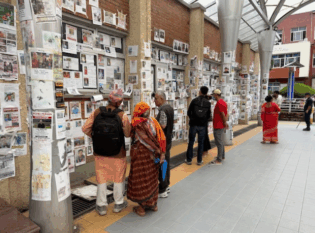
How Nepal is Learning To Cope With the Psychological Toll of Its Missing
Nearly three decades ago, in the final stretch of Nepal's civil war, Dr Brandon Kohrt sat with parents whose sons had been conscripted as child soldiers and never returned.
In Sikkim, Snow Leopards and Communities Share the High Mountains
The tea arrives before the conversation starts. Jayanta Mukhia sets two cups on the wooden table and pulls up a chair across from the couple who arrived that afternoon with trekking poles and rucksacks. They have come to walk the Goechala trail into the heart of Khangchendzonga National Park in India. They will leave in two days. Before they go, she has something to tell them.
Players Score Dignity in India’s First Transgender Football League
Pyari Hessa, 26, balances long shifts as a loco traffic controller at a steel company in Jamshedpur with evening football practice on the same turf where professionals train.
Vanishing Wisdom of the Sundarbans–How climate change erodes centuries of ecological knowledge
Bapi Mondal's morning routine in Bangalore is a world away from his ancestral village, Pakhiralay, in the Sundarbans, West Bengal. He wakes before dawn, navigates heavy traffic, and spends eight long hours molding plastic battery casings. It's not the life his honey-gathering forefathers knew, but factors like extreme storms, rising seas, and deadly soil salinity forced the 40-year-old to abandon centuries of family tradition and travel miles away to work in a concrete suburban factory.
Darjeeling’s Wake-Up Call: Expert at IUCN Congress Calls for Agile Climate Finance
As global conservation leaders gather in Abu Dhabi for the IUCN World Conservation Congress, communities in the hills of Darjeeling, thousands of kilometers away, are still counting their losses. In early October, heavy rains triggered deadly landslides that buried homes, blocked key roads, and left several people dead. The destruction has once again exposed how vulnerable India’s mountain regions are to extreme weather.
Nepal’s Gen Z protest: How Fake News Tried to Rewrite a Revolution
Claims that Ravi Laxmi Chitrakar, wife of former Nepali Prime Minister Jhala Nath Khanal, was burned alive in her home—fake. The reports of an angry mob destroying and vandalizing the Pashupatinath Temple—fake. Allegations that protesters were demanding a Hindu nation in Nepal—fake. As Kathmandu and other Nepali cities erupted in unrest last week, the fire of fake news spread just as fiercely across Nepal and into neighboring India and the rest of the world.
Four Times Rejected: Stateless Lotshampa Refugees Appeal to Nepal’s Supreme Court
Four Bhutanese Lotshampa refugees—Aasis Subedi, Santosh Darji, Roshan Tamang, and Ashok Gurung—filed an appeal in Nepal’s Supreme Court on July 27, challenging a government order that would deport them from Nepal.
U.S. Deported Bhutanese Refugees Cry–‘No Country To Call Home’
Sitting in his small hut in the Beldangi refugee camp in Jhapa district, Nepal, Narayan Kumar Subedi feels relieved that his son, Aasis Subedi, is safe. Aasis is one of four United States deportees who were the subject of Nepal's Supreme Court landmark ruling on April 24, which directed the government not to deport four Bhutanese refugees who entered Nepal in March of this year after being disowned by Bhutan. U.S. Immigration and Customs Enforcement (ICE) deported the four after they had lived in various parts of the United States for nearly a decade.
Chel Snakehead: A Fish That Time Forgot, Rediscovered
The Chel Snakehead fish, thought to be extinct, has made a dramatic comeback to the eastern Himalayan ecosystem after more than 85 years of absence near its source river in India.
The Giant Plastic Tap: How art fights plastic pollution
"The size of the faucet highlights the magnitude of the problem. It makes the problem impossible to ignore. We're used to throwing things 'away'—but when we're confronted with what happens when 'away' is not an option, I think it creates an emotional wake-up call," says Benjamin Von Wong.
At 76, India’s ‘Super Granny’ to Run Marathon in Australian Masters Event
Kmoin Wahlang, a 76-year-old woman, starts her running training every morning at 4 a.m. Dressed in track pants, a jacket, and running shoes, she sets out to navigate the hilly terrain of the small village of Shngimawlein in the southwest Khasi Hills district of Meghalaya, a state in northeastern India.
Mayurbhanj Kai Chutney: From Forests to Global Food Tables
On a scorching May morning, Gajendra Madhei, a farmer from Mamudiya village, arrives at the local bazaar in Udula, a town in Odisha's Mayurbhanj district. He displays freshly caught red weaver ants, known locally as kai pimpudi, in the bustling tribal market. Thanks to the recent recognition of Mayurbhanj's Kai chutney, or red weaver ant chutney, with a Geographical Indication (GI) tag awarded in January, his business of selling the raw ants has seen a significant surge in profitability.
Climate Crisis in Mountains: Borderless Struggle for Frontline Communities
For the last three years, Sambhunath Guragain has been waking up every morning to a view he doesn't want to see: discarded agricultural land where he and his family used to grow food, including rice, but the flood in 2021 changed everything. “We don’t have any crops now, but we are farmers,” Guragain said in November 2021, while looking towards a quietly flowing Melamchi river. This was six months after the massive flash flood in Helambu-Melamchi in Sindhupalchowk district in Nepal. After three years, the situation hasn’t changed.





The Week with IPS

NEXT STOP - SDGs
Tracking global progress towards a sustainable world
Tracking global progress towards a sustainable world
