
Friday, September 25, 2026



News and Views from the Global South
When UN Elections Were Once Tainted by Trade-Offs, Cheque Book Diplomacy & Luxury Cruises…
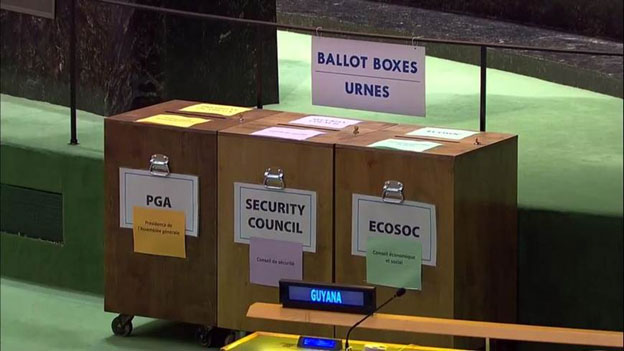
Voting by secret ballot. Credit: United Nations
- The year 2026 seems to be an eventful year at the United Nations –a new President of the General Assembly (PGA), who will officially preside over the 81st session in mid-September, plus the election and appointment of a new Secretary-General (SG) who will takeover in January 2027 after the conclusion of a 10-year tenure by the outgoing SG Antonio Guterres.
When UN member states competed in elections– or sought votes for membership in the Security Council or in various UN bodies– the voting in the 1960s and 70s was largely tainted by cheque-book diplomacy — while promises of increased aid to the world’s poorer nations came mostly with heavy strings attached.
In the 1950s and 60s, voting was by a show of hands, particularly in committee rooms. But in later years, a more sophisticated electronic board, high up in the General Assembly Hall, tallied the votes or in the case of elections to the Security Council or the International Court of Justice, the voting was by secret ballot.
In one of the hard-fought elections many moons ago, there were rumors that an oil-soaked Middle Eastern country was doling out high-end, Swiss-made wrist watches and also stocks in the former Arabian-American Oil Company, then one of the world’s largest oil companies, to UN diplomats as a trade-off for their votes.
So, when hands, both from right-handed and left-handed delegates, went up at voting time in the Committee room, the largest number of hands raised in favor of the oil-blessed candidate sported Swiss watches.
As anecdotes go, it symbolized the corruption that once prevailed in voting in inter-governmental organizations, including the United Nations — perhaps much like most national elections the world over.
Just ahead of a crucial election, one Western European country offered free Mediterranean luxury cruises in return for votes while another country dished out — openly in the General Assembly hall— boxes of gift-wrapped expensive Swiss chocolates.
Fathulla Jameel, a former UN Ambassador and later Foreign Minister of the Maldives told Inter Press Service of how his resource-poor island nation, categorized by the UN as a Small Island Developing State (SID), would appeal to richer nations to help fund some of country’s infrastructure projects.
At least one rich Asian country, a traditional donor, was the first to respond – and magnanimously too, he said. The project would be fully funded —free, gratis and for nothing. But there was a catch: “If there is a vote at the UN, and it is not of any national interest to your country”, said the donor country’s foreign ministry, “we would like to get your vote.”
Perhaps for life – the life of the island nation itself which was threatened with sea-level rise and in danger of being wiped off the face of the earth. The offer was a clever political payback. Development aid with no visible strings attached.
There was at least one instance when the president of the General Assembly, the highest policy making body at the United Nations, was elected, on the luck of a draw -– following a dead heat.
With the Asian group failing to field a single candidate, the politically-memorable battle took place ahead of the 36th session of the General Assembly back in 1981 when three Asian candidates contested the presidency: Ismat Kittani of Iraq, Tommy Koh of Singapore and Kwaja Mohammed Kaiser of Bangladesh (described as the “battle of three Ks”—Kittani, Koh and Kaiser).
On the first ballot, Kittani got 64 votes; Kaiser, 46; and Koh, 40. Still, Kittani was short of a required majority — of the total number of members voting. On a second ballot, Kittani and Kaiser tied with 73 votes each (with 146 members present, and voting).
In order to break the tie, the outgoing General Assembly President drew lots, as specified in Article 21 relating to the procedures in the election of the president (and as recorded in the Repertory of Practice of the General Assembly).
And the luck of the draw, based purely on chance, favored Kittani, in that unprecedented General Assembly election. But according to a joke circulating at that time, it was rumored that the winner was decided by the flip of a coin — but the tossed coin apparently had two heads and no tail.
In more recent years, however, the regional groups, including the Asian, African, Latin American and Caribbean and the Western and Other Groups (WEOG) have called for a virtual ceasefire as they took turns according to geographical rotation. The Groups would name their candidates who get elected without any opposition.
But the seriousness of the UN’s far-reaching mandate has been tempered by occasional moments of levity which have rocked the Glass House by the East River— with laughter. The UN is a rich source of anecdotes—both real and apocryphal– in which the General Assembly (UNGA), takes center stage, along with the Security Council (UNSC) as a political sidekick.
When UN ambassadors and delegates congregate in the cavernous General Assembly hall at voting time, they have one of three options: either vote for, against, or abstain.
The most intriguing, however, is a fourth option: to be suddenly struck with an urge to rush to the toilet. The frantic attempt to leave your seat vacant — and consequently be counted as “absent”– takes place whenever the issue is politically-sensitive.
When delegates are unable to vote with their conscience– don’t want to incur the wrath of mostly Western aid donors or are taken unawares with no specific instructions from their capitals– they flee their seats and head for the toilet
At a lunch for reporters in his town house bordering Park Avenue in Manhattan, (“this was once owned by Gucci, now it is Fulci”), Ambassador Francesco Paolo Fulci, an Italian envoy with a sharp sense of humor, described the fourth option as the “toilet factor” in UN voting.
And he jokingly suggested that the only way to resolve the problem is to install portable toilets in the back of the General Assembly hall so that delegates can still cast their votes while contemplating on their toilet seats. But for obvious reasons, there were no takers.
In most instances, the various regional groups and coalitions—including the Group of 77, the Latin American and Caribbean States, the African Union (AU) and the Western European and Others (WEOG)— take decisions behind closed doors ahead of voting and voted by consensus,
In the 1970s and 80s, the 116-member Non-Aligned Movement (NAM), founded in Belgrade in 1961, was one of the largest and most powerful political coalitions at the UN led by countries such as Yugoslavia, India, Egypt, Ghana, Indonesia, Zambia, Cuba and Sri Lanka.
As a general rule, all 116 countries vote in unison on General Assembly resolutions rarely breaking ranks. A Sri Lankan ambassador once recounted a message transmitted from his Foreign Ministry in Colombo – primarily directed at newly-arrived delegates which read— “If you are faced with an unscheduled surprise vote, and do not have any instructions from the Foreign Ministry, look to the right to see how Yugoslavia is voting and look to the left to see how India is voting. If both ambassadors are seen bolting from their seats, just follow them to the toilet”.
This article contains excerpts from a book on the United Nations titled “No Comment – and Don’t Quote Me on That” authored by Thalif Deen, Senior Editor at Inter Press Service news agency. A former member of the Sri Lanka delegation to the General Assembly sessions, he is a Fulbright scholar with a Master’s Degree in Journalism from Columbia University, New York, and twice (2012-2013) shared the gold medal for excellence in UN reporting awarded annually by the UN Correspondents Association (UNCA). The book is available on Amazon. The link to Amazon via the author’s website follows: https://www.rodericgrigson.com/no-comment-by-thalif-deen/
IPS UN Bureau Report


 Print
|
Print
|




