Tuesday, June 9, 2026



News and Views from the Global South
Q&A: ''Lee Myung-bak Has Mafia-like Capability''
Interview with Francis Daehoon Lee, chief of Asian Regional Exchange for New Alternatives
- One month before Lee Myung-bak officially takes over the South Korean presidency, liberals and progressives are apprehensive about the conservative credentials of the ‘CEO President’ and their impact on civil society.
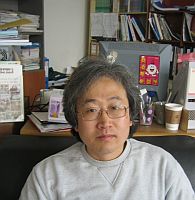
Francis Daehoon Lee of ARENA Credit: Alex Jong Lee
This former advisor to the U.N. Human Rights Sub-commission spoke with IPS correspondent Alex Jong Lee about Lee’s recent electoral landslide, the shortcomings of his liberal predecessor, and the future of progressive politics in this country.
IPS: Given that S. Korea’s last two presidents, Kim Dae-jung and Roh Moo-hyun, were both liberal, what are the implications of Lee Myung-bak, a conservative, being president for the next five years? FDL: After the generals left politics [post democratisation] in Korea, every president afterwards, more or less with varying degree of intellect and policy-orientation, were all pro-democracy, 'liberal', in a sense.
So the change of government affected civil society in a homogeneous direction. This is the first time that we have reverse impact by the change of government. And this person (Lee) has nothing to do with democracy. For the first time, we have somebody who has almost nothing to do with a desire for political change. He’s an economy guy.
IPS: What does this mean for Koreans? FDL: Depoliticisation. Economic agenda is likely to remain top on the list of the political agenda. And that will have an effect on depoliticisation. So an agenda of democracy, human rights, peace, justice, equal relationship with the U.S. will receive less attention. And what does "economy" mean? Economy means, especially, in this era, the rich get richer and the poor gets poorer. And in the Korean context, most economy-oriented politicians, they tend to squeeze the freedom of expression -freedom of assembly, freedom of demonstration – so we expect to have that squeeze again by the government.
IPS: Which you did not really have to experience in the past… FDL: In the past 10 years, we didn’t – unless someone threw us a Molotov cocktail. Otherwise, we had like 80 percent freedom of demonstration. I say 80 percent because we still cannot demonstrate in front of the U.S. Embassy.
IPS: During the elections, the media framed S. Korea’s incumbent president as an "incompetent president" whose "liberal bias" and lack of politically savvy led the country into economic recession. How much of Lee’s crushing victory was truly a referendum by the people against Roh? FDL: I think that the election was a loss by liberals and progressives in terms of failure to communicate with the common people and failure to frame the real issues of common people. Conservatives came in more pragmatically. They framed with false facts. They framed that the economy under Kim Dae-jung and Roh Moo-hyun was a failure and that was the main cause of all these difficulties. That’s not the case. That’s just bullshit.
(During Roh’s tenure) the national economic growth was quite sound from a national point of view, average 4.5. That’s high growth.
And from middle and upper class perspective, they gained more during Roh’s time. But what I’m talking about is common people – the increasing gap between rich and poor-who think about their monthly salaries every month. They have to be concerned about housing prices, private education, college entrance, medical costs. All of this increased a lot during Roh’s period due to his deliberately neo-liberal policies, market oriented policies. Roh was a liberal on politics. He was a neo-liberal on economics.
IPS: You would never have known that from the media though… FDL: Yes, conservative media is dominated by a few families. The liberal media could not counter that, just in terms of their leadership. The amount of readership on this side is so small. The amount of leadership (on their side) is large.
IPS: So on the whole, what is your opinion on Roh’s presidency? And is the backlash unreasonable? FDL: He did his job as an average student. He didn’t mess up the country. But he did a bad job in a good government, which emerged from much high expectations, especially from young liberal and progressive people. (In this case) he did a very lousy and disheartening job.
He failed on foreign policies. He was personally confused and he gave mixed messages. He didn’t do anything on the U.S., North Korea. He did swinging approaches. For three years, North Korea couldn’t trust this government. It was his lack of communication, inexperience, and confusing his personal commitment with political agenda. He got emotional too often in public scenes.
IPS: Coming back to Lee Myung-bak – he won the presidency at 48.7 percent of the vote by stressing only one political slogan, "Economy First!" Much of the popular media, in turn, highlighted his rags-to-riches story – rising from poverty to a becoming a successful CEO at Hyundai Engineering and Construction." He himself has promised to become Korea’s "CEO President." What are the implications of this and why has this message resonated so well with average Koreans? FDL: Well, that concerns the history of chaebols (family-owned conglomerates) in S. Korea. There’s no single chaebol, which stands by itself. So let’s imagine that you’re a [Korean] CEO of the 1970s. It’s not a CEO of a modern company that you analyse your sales and demands, and you make strategies for larger sales in the market. That’s not a CEO of the 1970s. A CEO in the 1970s is: drink a lot with government officials in the Finance Department. Get the money, channel the money, clean the money from the black market, and increase assets. Approach other companies, again through government channels and CIA. Then take up the company.
IPS: It is fast and dirty… FDL: Yeah. It’s like the mafia. That’s the kind of capability that Lee Myung-bak has. I cannot say that much, but that’s his background. And there’s a saying in the political circles that a president usually pursues the policy that he’s more familiar with. So we’re afraid that he will do a lot of construction, a lot of government corporate connections, collusion.
IPS: One of Lee Myung-bak’s central campaign promises is to revive the S. Korean economy, his "747 plan", seven percent annual growth in GDP, 40,000 US dollars per capita and making S. Korea the world’s 7th largest economy. Is his plan feasible? FDL: No. I don’t think the construction model works anymore for S. Korea, which has evolved way far from the bulldozer period of the 1970s. We need much more sophisticated economic coordination.
He will see backlashes very soon. This is an optimistic period and there are high expectations. So people will wait for a couple of years and if they don’t see (improvements), they will react, and ask, "Why?"
IPS: So you do not think he will make S. Korea richer and more prosperous? FDL: Not more than what Roh Moo-hyun has done, 4 or 5 percent growth. I think that’s the maximum and best level that he’ll be able to do.
 Print
|
Print
|