
Sunday, November 29, 2026



News and Views from the Global South
AFRICA: Civil Society Gains Strength at AU
Sarah McGregor
- The launch of the African Union’s official civil society council may strengthen the continent’s ability to address human rights violations and tackle poverty, activists say.
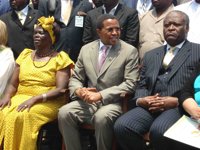
Activists hope ECOSOCC will allow civil society to "speak out of step, diplomatically speaking, and with a conscience." Credit: Sarah McGregor/IPS
However, some nations will not be fully represented as only about half of the African Union's member nations -25 – have agreed to take part in the council.
Participation of some non-governmental organizations may be prohibited by a rule they can accept no more than 50 percent foreign funding. The rationale is to prevent donors having undue influence on the council's work. Yet, many NGOs in Africa rely on outside sources for their budgets.
ECOSOCC's inaugural three-day meeting this week was mainly bogged down in bureaucratic minutiae – briefing participants on the mechanics of the new AU organ to help them come to grips with their new responsibilities.
The real work starts now, said ECOSOCC’s incoming presiding officer Akere Muna, president of the Pan African Lawyers Union and vice-chair of the corruption watchdog Transparency International.
"Civil society will be directly able to address the African heads of state, without the diplomatic shackles or formalities we often see in regional bodies," said Muna, a Cameroonian, in an interview.
"We have the ability to speak out of step, diplomatically speaking, and with a conscience."
The council will rely on the power of grassroots activism to help build a better future for the world’s poorest continent, said Nobel laureate Wangari Maathai, outgoing presiding office of the interim ECOSOCC. Membership of the council includes trade unions, non-governmental organizations, the diaspora, women’s groups, human rights campaigners, anti-poverty activists, the disabled and businesspeople.
The permanent council replaces an interim advisory body chosen in 2005 to chart the way forward, raise funds and organize elections for its successor. With that now in place, ECOSOCC is supposed have direct input into the policies and programming of the Africa Union and the opportunity to engage with heads of state as part of annual their summits, according to the website.
The first order of business for ECOSOCC is not yet clear.
In general, the body will try to push its own issues to the top of the AU agenda, issues such as investigating how foreign money may fund the weapons trade and fuel war on the continent, Muna said.
Maathai said she hopes the council will explore the expansion of mining and oil activities in Africa, working to secure more benefits for local citizens and protect against environmental destruction.
"On this continent there is powerful competition for a limited number of resources. We as Africans must demand that these are fairly distributed and that these activities don’t lead to environmental degradation," Maathai, a Kenyan, told reporters.
At the same time, the council will also shine a spotlight on the continent’s dire humanitarian situations including the economic meltdown in Zimbabwe and civil conflict in Sudan, said Maathai.
The AU has called for a power-sharing deal between Zimbabwean President Robert Mugabe’s ZANU-PF and the main opposition Movement for Democratic Change to end a post-election crisis that is further damaging the economy.
In Sudan, the AU has deployed troops in a bid to help resolve a five-year civil conflict in the western Darfur region in which 300,000 people have died and more than 2.2 million driven from their homes.
"Civil society needs to show the root causes of the problems – including Zimbabwe and Sudan. We are doing everything we can to be effective through this new channel to our political leaders," said Maathai.
African Union chairman Jakaya Kikwete said civil society activists were now equal partners in influencing daily decision-making at the AU. "The African Union has gone beyond the mere process of consultation that other institutions adhere to," Kikwete said in his address at the launch ECOSOCC in Dar es Salaam. "Africa has given the value of democratisation and inclusiveness, a more holistic and enduring meaning."
Action and not warm words are needed to confront the many challenge facing Africa, said Beatric Nyamoya, president of the Association of Female Lawyers of Burundi based in the capital Bujumbura.
"This is all very diplomatic and nice today but our members are very conscientious of the fact that we have our fight on our hands," said Nyamoya, who represents the central African nation on the council. "Our challenge will be to remain independent, which I do think is possible," she added.
Lee Habasonda, of the Transparency International chapter in Lusaka, Zambia and a member of ECOSOCC, said creation of the council was already a small victory for the fledgling civil society in Africa.
"In some ways you could say we’re making some small progress already because we’ve opened up this space to be partners," said Habasonda. "I’m going to use it as a platform to talk about corruption, poverty, and free and fair elections."
 Print
|



Pictures for this story
This story includes downloadable print-quality images -- Copyright IPS, to be used exclusively with this story.


