Languages
Tuesday, October 13, 2026



News and Views from the Global South
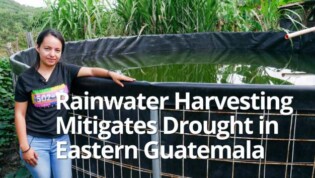
Rainwater Harvesting Mitigates Drought in Eastern Guatemala – VIDEO
Plagued by drought, farming families living within the boundaries of the Dry Corridor in eastern Guatemala have resorted to rainwater harvesting, an effective technique that has allowed them to cope.
Guatemalan Peasants Overcome Drought in the Dry Corridor
Water scarcity that relentlessly hits the rural communities in eastern Guatemala, located in the so-called Central American Dry Corridor, is a constant threat due to the challenges in producing food, year after year. But it is also an incentive to strive to overcome adversities.
Government Constructions Hit Water Recharge Area in El Salvador
Two construction projects pushed by the government of El Salvador, in a water recharge area adjacent to the country's capital, on the slopes of the San Salvador volcano, threaten to make the area more vulnerable and increase the risk of flooding in the city's poor neighborhoods downstream.
Biogas to Wipe Out Poultry Industry Pollution in El Salvador – VIDEO
 El Granjero, the second-largest egg producer in El Salvador, invested US$2.5 million in 2017 to build a biogas plant, proving that there is a solution to the thorny issue of environmental pollution caused by most poultry companies in the country.
Biogas, a Solution to Poultry Pollution in El Salvador
Still in its early stages and with few players, the poultry sector in El Salvador is taking small steps toward environmentally sustainable production by using its biological waste to generate biogas and, in turn, electricity –an equation that benefits the natural environment, communities, and the farms themselves.
Solar Energy Brings Water to Iconic Salvadoran Village of El Mozote
The worst massacre of civilians in Latin America occurred in the Salvadoran village of El Mozote, where environmental projects are beginning to emerge, slowly fostering awareness about protecting the natural resources of this deeply symbolic site, embedded in the country's historical memory.
In Central America’s Dry Corridor, Farmers Find Ways to Harvest Water and Food – VIDEO
In Central America’s Dry Corridor, climatic conditions hinder water and food production because rainfall in this ecoregion—from May to December—is less predictable than in the rest of the isthmus. 
Food Security and Water, a Priority for Border Towns in Central America
The hope of Salvadoran Cristian Castillo to harvest tomatoes in a municipality of the Central American Dry Corridor hung by a thread when his well, which he used to irrigate his crops, dried up. However, his enthusiasm returned when a regional project taught him how to harvest rainwater for when the rains begin in May.
Central American Countries Backtrack on Metal Mining Ban
Metal mining has a renewed momentum in Central America, encouraged by populist rulers who, in order to soften environmental damage, claim they can develop it in harmony with nature, which is hard to believe
Solar Project Causes Social and Environmental Conflict in Rural El Salvador
With machete in hand, Salvadoran farmer Damián Córdoba weeds the undergrowth covering the trunk of what was once a leafy tree to show the deforestation taking place on the Santa Adelaida farm, where a company seeks to install a solar park in western El Salvador.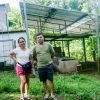
Rural Communities in El Salvador Get Their Water Supply from the Sun
Setting up a community water project with a solar-powered pumping system was an unlikely idea for the peasant families of a Salvadoran village who, despite their doubts, turned it into reality and now have drinking water in their homes.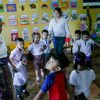
Working to Keep Náhuat, the Language of the Pipil People, from Vanishing in El Salvador
A group of children participating in an immersion program in Náhuat, the language of the Pipil people and the only remaining pre-Hispanic language in El Salvador, are the last hope that the language will not die out.
Biogas Is Key to Harmony Between Agribusiness and Environment in El Salvador – VIDEO
Faced with the recurring problem of environmental pollution caused by the poultry industry in rural communities in El Salvador, some companies are responding by producing biogas from organic waste from their chicken farms and processing plants, and using the gas to generate clean electricity.
Salvadoran Poultry Farms Produce Biogas, Easing Socio-environmental Conflicts
In a win-win relationship, a segment of El Salvador's agribusiness industry is taking steps to ease the tension of the historic socio-environmental conflict caused by poultry and pig farms, whose waste has caused concern and anger in nearby communities.
Higher Education in Central America: Poor Quality and Unaffordable for the Poor
Decades of civil wars and a lack of long-term public education policies, among other problems, have made higher education in Central America precarious and costly in general. In this region, made up of Belize, Costa Rica, El Salvador, Guatemala, Honduras, Nicaragua, and Panama, home to some 50 million inhabitants, the quality of education offered by public and private universities is poor, while costs are high even for those who can afford them.
Salvadoran Rural Communities Face Climate Injustice
For decades, poor fishing and farming communities in southern El Salvador have paid the price for the electricity generated by one of the country's five dams, as constant and sometimes extreme rains cause the reservoir to release water that ends up flooding the low-lying area where the families live.
Community Efforts Boost Wastewater Treatment in El Salvador – Video
Neither the central government nor most of El Salvador's 262 municipalities have had the capacity to install enough wastewater treatment plants to prevent it from being discharged directly into the environment. 
Increasing Wastewater Treatment Is Vital for Families and Ecosystems in El Salvador
Insufficient wastewater treatment systems in El Salvador have taken a toll on the environment and the health of the population for decades, but some municipalities are putting more attention on processing their liquid waste.
El Niño’s Impact on Central America’s Small Farmers Is Becoming More Intense
The effects of El Niño on agriculture in Central America are once again putting pressure on thousands of small farmer families who are feeling more vulnerable economically and in terms of food, as they lose their crops, due to climate change.
El Salvador Is Making Little Effort to Eradicate Illiteracy
El Salvador's efforts to improve the educational level in the country seem to be falling short, with rundown schools, especially in rural areas, and little progress in overcoming illiteracy.
Unregulated Agrochemicals Harm Health of Rural Residents in Central America
In his green cornfield, Salvadoran farmer Medardo Pérez set about filling the hand-held spray pump that hangs on his back, with the right mixture of water and paraquat, a potent herbicide, and began spraying the weeds.Next Page »





The Week with IPS

NEXT STOP - SDGs
Tracking global progress towards a sustainable world
Tracking global progress towards a sustainable world
