Languages
Saturday, November 7, 2026



News and Views from the Global South
ENVIRONMENT-VENEZUELA: The Fate of the Condor’s Flight
One no longer sees the giant condor soar over Venezuela's share of the Andes Mountains. This species, the largest of the flying birds, has shifted its range to neighbouring Colombia, and the few remaining birds that were part of a Venezuelan repopulation programme have perished.
The Fate of the Condor's Flight
The world's largest flying bird no longer soars over the Venezuelan mountains. But the condor is reappearing gradually in other Andean countries, thanks to programs for protecting the species and its habitat.ENERGY-LATIN AMERICA: Region’s Oil Powers Vie for Influence
Mexico and Venezuela, Latin America's biggest oil producers, have launched separate energy cooperation programmes with their smaller neighbours in Central America and the Caribbean, in a quiet geopolitical competition that contrasts with their alliance of the past quarter century.VENEZUELA: 16-Year Sentence for Opposition Union Leader
The leader of the Confederation of Venezuelan Workers (CTV), Carlos Ortega, was sentenced Tuesday to 15 years and 11 months in prison for instigating rebellion and carrying false documents.VENEZUELA: New Stage of Political Confrontation, with Monochrome Parliament
The unprecedented 100 percent victory by the ruling coalition in Sunday's legislative elections in Venezuela opens the door to a new stage in the political confrontation that has marked President Hugo Chávez's seven years in office.VENEZUELA: Violent Death a Young Man’s Burden
A few days before he passed away, Juancho confessed to IPS that he had chosen to die by the age of 25 if that was the price he had to pay to live among his people in Cartanal, a shantytown on the outskirts of the Venezuelan capital named for the houses made from cardboard ("carton" in Spanish) by its first settlers.TRADE: Andean Community Integration Feels Strain of Discrepancies
Trade agreements are one thing and integration is another, "so dissatisfaction with the former should not deter us from the latter," according to Allan Wagner, secretary-general of the Andean Community, who is trying to paper over the cracks in Latin America's oldest trade bloc.VENEZUELA: State-Financed Experiments in the Solidarity Economy
"I used to be a buhonera (street vendor), but I got tired of working in all weather conditions, rain or shine, so I joined the Venezuela Avanza (Venezuela Advances) cooperative. Here I earn less money and the heat in the warehouse is stifling, but we hope our working conditions will improve with time," Ana Ortiz, a mother of seven, told IPS as she sat at her sewing machine.HAITI: Petroleum Greases the Deforestation Process
In Haiti, the poorest country in the Americas, rising oil prices have forced households and small businesses that used natural gas or kerosene for cooking to instead use charcoal or firewood, a mortal blow to a country that has almost no trees left.VENEZUELA: Mural’s Demolition Draws Mixed Reviews
Instead of laying the cornerstone or cutting the ribbon at its inauguration, the mayor of La Guaira, Venezuela performed a rather unusual ceremonial act for the Chromatic Wall, a mural by world-renowned painter Carlos Cruz-Diez stretching two kilometres around the city's port: he struck the first hammer blow in its demolition.Petroleum Greases the Deforestation Process
High oil prices are driving up charcoal and firewood use in Haiti, where once-extensive forests now cover less than two percent of the territory.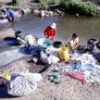
Big Commitment to Water
New commitments for clean water are being adopted by Latin America's environment ministers. Some 100 million people in the region don't have access to sanitation services.ENVIRONMENT-LATAM: Ministers Call for Integrated Management of Water
Latin American and Caribbean environment ministers meeting this week in the Venezuelan capital underlined the need for integrated management of water resources in order to extend water services to millions of families, while rejecting the decentralisation of political power when it comes to decision-making.EDUCATION: Venezuela Declares Itself Illiteracy-Free
Venezuela declared itself an "illiteracy-free territory" Friday, announcing that 1.482 million adults have learned to read and write in the past two years, and that less than two percent of the population of 26 million remains illiterate.AFRICA-VENEZUELA: Weaving New Alliances with Cultural Threads
Venezuela, the biggest oil producer in Latin America and the fifth biggest in the world, has launched an offensive to forge closer diplomatic ties with Africa, initially focusing on political and cultural questions while leaving the matter of energy cooperation to the future.VENEZUELA-US: First Latin American to Lead Big Leagues Team to Victory
Venezuela completely forgot Thursday about the ever-present political tension and even the national football team's sad failure to classify for the Germany 2006 World Cup, after Venezuelan manager Oswaldo "Ozzie" Guillén led the Chicago White Sox to their historic victory in North American baseball's World Series.VENEZUELA: Indigenous People Protest Coal Mining
Recent protests by indigenous people in Venezuela defending their land and the environment from coal mining show that not all is rosy in their relations with the government of Hugo Chávez, although they recognise that no president has ever done so much for the country's 35 native ethnic groups.VENEZUELA: Colombian Paramilitaries Convicted of Plot
A Venezuelan military court sentenced 27 Colombian paramilitaries to six years in prison Tuesday for participating in a failed plot to overthrow the government of Hugo Chávez in May 2004, while 73 others were acquitted, released from prison and deported.VENEZUELA: New Wave of Protests – By Government Supporters This Time
Despite its broad range of social programmes financed by windfall oil profits, the administration of President Hugo Chávez in Venezuela has been facing a new wave of protests. But this time they are led by supporters of the government.RELIGION: Venezuela to Expel U.S. Evangelical Group
Venezuela will expel the U.S. evangelical group New Tribes Mission, which has been active in indigenous communities along the southern border with Colombia and Brazil since 1946, President Hugo Chávez announced Wednesday.RIGHTS-VENEZUELA: Search for the “Disappeared” Off to a Late Start
In Venezuela, where the forced disappearance of leftists began perhaps even earlier than in the Southern Cone countries, the search for the truth and for the remains of the victims who were never found is just getting underway, much later than in countries like Argentina or Chile.« Previous Page — Next Page »





The Week with IPS

NEXT STOP - SDGs
Tracking global progress towards a sustainable world
Tracking global progress towards a sustainable world
