Languages
Sunday, October 25, 2026



News and Views from the Global South
Q&A: “We Can’t Continue to Pay Lip Service to Gender Equality”
During consultations of the 45-member U.N. Commission on the Status of Women (CSW) here, one of the lingering issues that is surfacing is the success - or failure - in the implementation of the 1995 Beijing Platform for Action on gender empowerment.RIGHTS: Women Still Battling Gender Bigotry Worldwide
Nearly 62 years after the Universal Declaration of Human Rights, which proclaimed "all human beings are born free and equal in dignity and rights," a few of the world's discriminatory laws against women are being progressively repealed in Asia, Europe, Africa and Latin America.DEVELOPMENT: World’s Longest Toilet Queue in the Making
The "world's longest toilet queue," scheduled for next month, may not be a celebrity-filled event worthy of a Hollywood spectacle - but it could still find a place in the Guinness Book of World Records.RIGHTS: U.N. to Focus on Global Epidemic of Gender Abuse
The statistics relating to the world's socially and economically-distressed women are staggering.RIGHTS: U.N. Goals on Education Under Widespread Attack
The relentless attacks on educational institutions in war zones - along with growing threats against academics, teachers and school-going children - have jeopardised one of the U.N.'s Millennium Development Goals (MDGs) - education for all by 2015.DEVELOPMENT: Crisis Could Open Doors for Change, Says UNCTAD
As the financial crisis continued to threaten world economies last year, the White House chief of staff Rahm Emanuel famously declared: "You never want a serious crisis to go to waste."RIGHTS: EU Faults U.N. for Slowdown in Gender Empowerment
Against the backdrop of continued widespread gender discrimination worldwide, the European Union (EU) has urged Secretary-General Ban Ki-moon to "urgently" speed up the creation of the proposed new U.N. agency for women.
RIGHTS: New U.N. Envoy to Crack Down on Sexual Violence
When the Security Council adopted resolution 1325 back in October 2000, it was a historic event: for the first time the U.N.'s most powerful political body dealt with a gender-related issue, explicitly linking women to peace and security.DEVELOPMENT: Asia to Lead Global Economic Recovery, Says U.N.
The United Nations is predicting that the world's developing nations will recover faster than industrial countries - even as they both try to struggle out of the post-2007 global financial crisis.POLITICS: U.N. Faulted for Toothless Sanctions in Civil Wars
The United Nations estimates that at least 40 percent of civil wars during the last 60 years have been fought either over natural resources - including diamonds, gold, timber, oil, gas, and cocoa - or sustained by revenues from rich minerals and commodities.
DEVELOPMENT: Yemen to Lead South in U.N. Negotiations
The republic of Yemen, categorised by the United Nations as one of the world's "least developed countries" (LDCs), will lead the largest single coalition of developing nations this year: the 130-member Group of 77 (G77).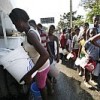
POLITICS: U.N. Defends Relief Efforts in Haiti
The United Nations, which has come under heavy fire for its relatively slow relief efforts in earthquake-devastated Haiti, hit back at the international news media for "sensational" reporting.CLIMATE CHANGE: Small Islands Await Haitian-Type Disaster
The devastation caused by the earthquake in Haiti last week has brought into sharp focus the threat of another natural disaster waiting to happen: a sea-level rise that could obliterate the world's small island states, triggering fears of mass migration.
POLITICS: U.N. Faces Its Own Major Tragedy in Haiti
The major earthquake that struck Haiti Tuesday, causing death and destruction in the capital of Port-au-Prince, may also turn out to be a veritable disaster for the United Nations, which has over 9,000 personnel, including peacekeepers, international staffers and local civilians, scattered throughout the country.POLITICS: Russia, China Sustain Military Toehold in Yemen
Russia has stolen a march over the United States in the multi-million-dollar arms market in cash-strapped Yemen, whose weapons purchases are being funded mostly by neighbouring Saudi Arabia.POLITICS: U.S. Arms Feed Yemen’s Gun Culture
When Yemen refused to vote in support of a U.S.-sponsored Security Council resolution against Iraq during the 1990-1991 Gulf War, a visibly angry U.S. delegate turned to the Yemeni diplomat and said: "That will be the last time you will ever vote against a U.S. resolution."RIGHTS: Gender Empowerment at U.N. Still Cloudy
When the United Nations commemorated the 30th anniversary of a major international treaty on women's rights last week, Secretary-General Ban Ki-moon boasted about the increasing number of women he has appointed to senior positions in the world body since he took office in January 2007.DEVELOPMENT: Chile to Join the “Rich Man’s Club”
The Paris-based Organisation for Economic Cooperation and Development (OECD) has invited Chile, a developing nation with a vibrant economy, to join what has long been described as "the rich man's club".
DEVELOPMENT: South-South Cooperation at 30-Year High
As the United Nations commemorated its sixth annual 'U.N. Day for South-South Cooperation' Friday, Secretary-General Ban Ki-moon singled out the growing new ties among developing countries that go far beyond trade and investments: education, science, agriculture, medicine, health services and information technologies.
CLIMATE CHANGE: Water Is the Missing Link in Copenhagen
When the World Meteorological Organisation (WMO) announced the grim news that 2009 is likely to rank in the top 10 warmest on record, the U.N. agency also stressed last week the widespread water-related calamities caused by global warming.POLITICS: Zimbabwe Blasted for Condoning “Sexual Terror”
Zimbabwe’s ruling political party has been accused of launching a "widespread and systematic campaign of rape and sexual terror" aimed at intimidating opponents and voters in the troubled African nation, according to a new report released here.« Previous Page — Next Page »





The Week with IPS

NEXT STOP - SDGs
Tracking global progress towards a sustainable world
Tracking global progress towards a sustainable world
