Languages
Wednesday, November 11, 2026



News and Views from the Global South
Active Citizens
RIGHTS-RUSSIA: Equal Opportunities For Women a Long Way Off
Women can look forward to a bunches of flowers and annual words of praise from the country's leaders but the fight for equal opportunities has not gone well in crisis- ridden Russia.HEALTH-EGYPT: Contaminated Blood Scare
It happened in Cairo this month - the worst nightmare of a hospital patient. A 70-year-old woman, given a blood transfusion, contracted the HIV virus that leads to AIDS because blood was contaminated.MEDIA-AFRICA: Gorillas in a Media Mix
Just ten days ago Ghanaian President Jerry Rawlings, at a farewell ceremony at the White House, lodged the usual complaint of visiting African leaders.POLITICS-INDIGENOUS: Inuits To Get Their Own Homeland
The huge new Canadian territory of Nunavut will be born April 1, creating the first major political entity in North America with an overwhelming aboriginal majority.ENVIRONMENT-FINANCE: Opposition to Bolivia-Brazil Pipeline
US Environmental groups don't want any government money going toward building a gas pipeline across tropical forest areas of Bolivia and Brazil and the headwaters of the Pantanal watershed - the world's largest wetlands.ECONOMY: Problems of Post-Soviet Integration
Former Soviet republics are heralding a new era of integration but they face a rocky road ahead before there can be any real economic union.DISARAMENT-ENVIRONMENT: Chemical Weapons Poisoning Arctic
The snowy wastes of the Arctic region have become the greatest victim of the once-mighty Soviet military- industrial complex.TECHNOLOGY-RUSSIA: Y2K Bug Raises Fear of Nuclear Breakdown
As the new millennium moves ever closer, there is growing concern in Russia that the country cannot cope with the so-called "Y2K bug" the fault in some computers that will not recognise the year 2000 but rather 1900.ECONOMY-RUSSIA: Russians Ponder Need For Bountiful U.S. Grain Aid
The prognosis for the coming winter is pessimistic. With a grain harvest of less than 50 million tonnes, the consumption of meat and dairy products is expected to go down in Russia while prices skyrocket.FINANCE: Russia/Kazakhstan Pipeline Diplomacy Heats Up
Last Tuesday, the Caspian Pipeline Consortium announced the start of the construction phase of a 2.2 billion dollar pipeline to carry Kazakh oil from the Tengiz field in the Caspian Basin to the Russian port of Novorossiik on the Black Sea.DEVELOPMENT-RUSSIA: Russian And Chinese Traders’ Border Struggle
Many of Russia's far eastern territories are now facing a disastrous situation with shortages of fuel, heating, electric power and food. Yet the region is rich in energy and natural resources.HEALTH-RUSSIA: Drug Resistant TB Runs Riot In Russian Jails
Russia's tuberculosis rates are almost one and a half times the level the World Health Organisation (WHO) considers as an epidemic, says the country's Chief Sanitary Physician Gennady Onishchenko.ECONOMY-RUSSIA: Nuclear Symbol Of Economic Hope Lights Electrostal
Since Russia's central bank gave up the ghost and let the rouble free-fall in value in mid- August, average wages across the country have fallen to about 60 dollars a month -- and very many live on much less.ECONOMY-RUSSIA: Gold May Be An Alternative Cure For Russian Woes
Economists grin at the very thought of minting gold coins here. Russia seems to be returning to the Middle Ages, just at the moment when the rest of the world is moving to plastic money and cashless transactions on the internet...DEVELOPMENT-RUSSIA: Chukotka Sits On Riches But Lives In Poverty
For the past two weeks, Anadyr, the capital of Chukotka in north-east Russia, has been facing daily power cuts, as its local authorities desperately hunt for cash to run life-sustaining basic services.POLITICS-TAJIKISTAN: Renegade Commander Strikes Again
Ex-Tajik army general Mahmoud Khodabardiyev, by launching a rebellion in Tajikistan's northern Leninabad region Wednesday, has hammered another nail in the coffin bearing the hopes for a lasting regional peace.RUSSIA: Retiring Army Officers’ Uncertain Future In Economic Crisis
With the Cold War era over, Russia is slashing the size of its military, and many retiring officers are retraining to prepare them for new careers.ENVIRONMENT-RUSSIA: Far East Regions Choked By Forest Fires
In a much less widely reported re-run of last autumn's Indonesian forest fires, which blanketed major Asian cities in a pall of acrid, choking smoke, a similar crisis is overtaking a corner of Russia's remote Far Eastern provinces.HEALTH-TAJIKISTAN: Malaria Back In Tajikistan, But Now More Virulent
In the wake of civil war and the collapse of the Soviet Union, malaria has returned to the central Asian republic of Tajikistan, according to a report in the current issue of the leading London-based health magazine, The Lancet.ECONOMY-RUSSIA: Russians Protest Over Unpaid Wages
Hundreds of thousands of Russians took to the streets Wednesday to protest against unpaid wages and called on President Boris Yeltsin to resign.ECONOMY-RUSSIA: Crisis Package Has Soviet Ring
Russia's newly formed government is considering a package of economic reforms reminiscent of Soviet- style central planning and citizens fear hard times, regardless of whether the new plans are implemented.« Previous Page — Next Page »





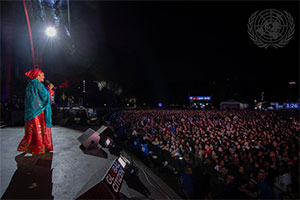 Global Citizen Festival in New York. Credit: UN Photo/Eskinder Debebe
Active citizens are committed to social change because they know that it is achievable. However, major political challenges face active citizens across the world. For example, in authoritarian regimes in Latin America where the hegemonic party has been in power for decades on end, protestors and human rights activists face enormous repression and struggle to materialize their advocacy into concrete results. The same can be said for Africans, where a shift towards elected government in recent decades has yet to translate into an effective voice in decision-making. Now, the Strengthening Citizen Demand for Good Governance, which uses evidence-based approaches – funded by DFID's Governance and Transparency Fund – seeks to raise their voices.
In 2025, the CIVICUS Monitor’s People Power Under Attack report revealed that civic freedoms are severely limited in 122 of 198 countries and territories, and only 7.2% of the global population now lives in countries where civic space is open. Through partnership with the Overseas Development Institute (ODI) and CIVICUS, IPS reporters across the continent will seek to define the extent and limits of state capability, government accountability and the responsiveness of leaders to the needs of citizens.

The Week with IPS

NEXT STOP - SDGs
Tracking global progress towards a sustainable world
Tracking global progress towards a sustainable world
