Languages
Wednesday, November 11, 2026



News and Views from the Global South
Active Citizens
RUSSIA-TECHNOLOGY: Space Research Goes for the Big Bucks
The winner of next month's runoff presidential election in Russia is expected to accelerate a space programme that is becoming increasingly commercial.RUSSIA-ELECTIONS: Kingmaker Lebed Closes in on Throne
Its horse-trading time in Russia.RUSSIA-ELECTIONS: Media Set for Key Role in Runoff
There were 11 candidates in the race for President of Russia that culminated in Sunday's vote: sometimes the media made it seem there was only one.RUSSIA-ELECTIONS: Gains, Pains of The Market Will Determine Vote
The mood of the Russian electorate ahead of Sunday's presidential election is largely determined by the gains and pains of the post-communist era.RUSSIA-ELECTIONS: ‘Others’ Also Run for President
Scanning the Russian media just three days ahead of the June 16 presidential ballot, it would seem that only two candidates are in the contest.RUSSIA: Brain Drain in Science Causes Considerable Strain
Russia is being robbed of some of its best brains as an increasing number of scientists and researchers yield to the lure of lucrative offers from disparate parts of the globe.RUSSIA-ENVIRONMENT: Russia Faces Worst Ever Forest Fires
More than 20 people have died so far this year in forest fires which have swept uncontrollably through vast areas of Russia, destroying tracts of valuable timber and wildlife habitat and leaving large areas of land open to erosion from the weather.RUSSIA-LATIN AMERICA: Primakov Trip Shows Strong Interest in Region
With a six-day visit last week to three strategically important Caribbean Basin nations, Russia's foreign minister Evgeny Primakov was on a mission of discovery in a region long ignored by Moscow.RUSSIA: Yeltsin Vows To Veto Land Code
President Boris Yeltsin and the Federation Council (parliamentary upper house) are both expected this week to veto a new Land Code which was adopted by the Duma (lower house) on May 22 by a vote of 288-18.BALTIC STATES: Growling Russian Bear Makes Baltics Nervous
As presidential elections draw close in Russia, the independent Baltic states have found themselves unwilling subjects of attention in the angry campaigning surrounding the vote.INFORMATION-VIETNAM: Hanoi Proceeds Warily Along Internet Highway
The take-off of the information superhighway in Vietnam is being delayed, say observers, by an increasingly cautious bureaucracy in the lead up to next month's eighth Congress of the country's Communist Party.CIS-RUSSIA: A Summit In The Shadow Of Elections
When the 12 members of the Commonwealth of Independent States (CIS) meet here this weekend for a summit, their deliberations will both be feeding into, and be influenced by, the presidential election campaign heating up in Russia.UKRAINE: Misuse of Chernobyl Funds is a Way of Life
Recent revelations about the embezzlement of large sums of money meant to help with the Chernobyl clean-up operation are just the tip of the iceberg, according to medical workers dealing with Chernobyl evacuees.ENVIRONMENT: Opposition to Toxic Waste Plant Plan Rejected /REPEAT/
Citizens of the Russian town of Sergei Posad are fighting a government plan to build a U.S. co-funded plant in their town to reprocess thousands of tonnes of heptyl -- a highly toxic chemical used as liquid rocket fuel.IRAN-CENTRAL ASIA: Teheran Leads Beneficiaries From New Rail Link
The inauguration Monday of a rail link between the Iranian border town of Sarakhs and Tejand, Turkmenistan, is a landmark in the evolving relations between Iran and the five Muslim-majority Central Asian republics.ENVIRONMENT: Opposition to Russian Toxic Waste Plant Plan Rejected
Citizens of the Russian town of Sergei Posad are fighting a government plan to build a U.S. co-funded plant in their town to reprocess thousands of tonnes of heptyl -- a highly toxic chemical used as liquid rocket fuel.for editing
Once treated like "enemies of the people," international human rights monitors are now receiving the red-carpet treatment from the authoritarian Uzbekistan government, Human Rights Watch/Helsinki reports.RUSSIA: A Nuclear Power Plant Ahead of the Rest
Amid ongoing debate about the future of Russia's troubled nuclear industry, experts point to the strides being made by one plant as setting the pattern for the rest.RUSSIA-ENERGY: Money Squeeze Cannot Halt Nuclear Power
Russia plans to continue pursuing its nuclear power programme despite the severe economic problems facing the country, according to a senior official.ENVIRONMENT: Moscow’s Secret Nuclear Waste Nightmare
There are literally hundreds of illegal nuclear waste dumps in and around the Russian capital, the result of years of careless shipping, corruption and often inexplicable thieving within the country's atomic industry.KAZAKHSTAN: ‘Jigsaw’ Deal On Giant Oil Pipeline Fits Into Place
Piece by piece, a cluster of governments and oil companies are filling in a vast jigsaw puzzle which will, if they succeed, usher in a new era for oil and gas development in the Caspian Sea region.« Previous Page — Next Page »





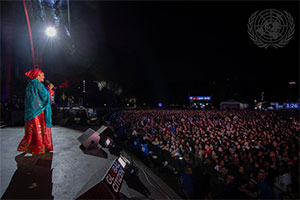 Global Citizen Festival in New York. Credit: UN Photo/Eskinder Debebe
Active citizens are committed to social change because they know that it is achievable. However, major political challenges face active citizens across the world. For example, in authoritarian regimes in Latin America where the hegemonic party has been in power for decades on end, protestors and human rights activists face enormous repression and struggle to materialize their advocacy into concrete results. The same can be said for Africans, where a shift towards elected government in recent decades has yet to translate into an effective voice in decision-making. Now, the Strengthening Citizen Demand for Good Governance, which uses evidence-based approaches – funded by DFID's Governance and Transparency Fund – seeks to raise their voices.
In 2025, the CIVICUS Monitor’s People Power Under Attack report revealed that civic freedoms are severely limited in 122 of 198 countries and territories, and only 7.2% of the global population now lives in countries where civic space is open. Through partnership with the Overseas Development Institute (ODI) and CIVICUS, IPS reporters across the continent will seek to define the extent and limits of state capability, government accountability and the responsiveness of leaders to the needs of citizens.

The Week with IPS

NEXT STOP - SDGs
Tracking global progress towards a sustainable world
Tracking global progress towards a sustainable world
