Languages
Thursday, November 19, 2026



News and Views from the Global South
Active Citizens
ECONOMY-RUSSIA: Duma Blasts Government As Crisis Deepens
The State Duma, lower house of the Russian parliament, held an emergency session Friday to discuss the country's current financial crisis, bombarding President Boris Yeltsin and his troubled government with ferocious condemnation.TAJIKISTAN: Peace Process Moves On As Taleban Advance In Afghanistan
On Monday Tajikistan's president, Imamali Rahmanov, strengthened his national unity administration by appointing six leaders of the Islamist-led United Tajik Opposition (UTO) as cabinet members. These UTO figures join their five colleagues, who were installed into office early this year.HEALTH-RUSSIA: HIV/AIDS Infections Rise In The Russian Army
The number of soldiers found to be infected with the HIV virus has quadrupled in the last year and a half in Moscow's military district alone, say army officials.COMMODITIES-UKRAINE/RUSSIA: Slugging It Out In Sugar Trade Standoff
Next week's massive import tax hikes on the sugar trade with Russia will do nothing to sweeten a bitter standoff between Russian processors and Ukrainian exporters, who will be exempted from Saturday's scheduled rises.COMMODITIES-RUSSIA: Price Wobbles Push Russian Aluminium Into Crisis
With world aluminium prices at their lowest for four years, Russia's aluminium industry is facing serious problems with some experts warning of a possible collapse.COMMODITIES-RUSSIA: Price Wobbles Push Russian Aluminium Into Crisis
With world aluminium prices at their lowest for four years, Russia's aluminium industry is facing serious problems with some experts warning of a possible collapse.LABOUR-RUSSIA: Unions Fail To Halt Angry Miners’ March To Violence
Zhenya Shumeiko, new deputy head of the Independent Miners' Union at the Severny mine here, bought his first suit when he started work. But he finds the black two- piece, black shirt and garish silver tie as ill-fitting as the job itself.POLITICS-AZERBAIJAN: Aliyev Seeks Closer Ties With The West
The political high point of Azeri President Haidar Aliyev's current five-day state visit to the United Kingdom was his meeting on Tuesday with British Prime Minister Tony Blair.ENVIRONMENT-RUSSIA: Radioactive Lake Threatens Arctic Disaster
Deep below the beds of Siberia's giant man- made Lake Karachai, a thick layer of highly radioactive salt in the underground water supply is leaching its way, slowly but surely, towards open rivers and ultimately the outside world.ECONOMY-RUSSIA: Duma Deputies Dispute IMF-Required Austerity Bill
Russian President Boris Yeltsin Wednesday berated, bribed and begged his parliamentarians, to get them to endorse a sweeping austerity plan and meet conditions set by the International Monetary Fund.DISARMAMENT-RUSSIA: Chemical Weapons Destruction Plan Crawls To Halt
Russia will miss its global treaty deadline and will fail to destroy its massive chemical weapons stocks by the year 2008, admits Stanislav Petrov, head of the country's chemical and biological defence forces.TRADE-KAZAKHSTAN/CHINA: Border Pact Removes Last Hurdle To New Ties
By signing an agreement on Saturday that resolves their long-running border dispute, Kazakhstan and China crossed the last hurdle to forging strong economic and diplomatic links.POLITICS-RUSSIA: Far-Right Sows Nationalist Grapes of Wrath
With billions of roubles owed millions of desperate workers across Russia, demands for money and jobs have swiftly developed into angry public protests against the federal government and its policies.RIGHTS: Russian Navy Journalist May Face Treason Charges Next Month
Military journalist Captain Grigory Pasko, well known for his investigations into secret nuclear dumping as a reporter for the Russian Navy newspaper Boyevaya Vakhta (Combat Vigil), could face charges of high treason next month.POLITICS-BALKANS/RUSSIA: Moscow More Cautious Of NATO Than Belgrade
With NATO fighter-bombers prowling his borders, Yugoslav president Slobodan Milosevic apparently thinks it prudent to consent to Russian mediation in the deepening standoff between Belgrade and the West over the Kosovo crisis.RIGHTS-TURKMENISTAN: Opposition Vows To Win Democratic Reforms
The European Union has promised to take 'appropriate measures' if the human rights situation worsens in Turkmenistan. But the country's democratic opposition doubt there is much chance of it improving, at least in the near future.LABOUR-RUSSIA: Russia Faces A Long Hot Summer Of Labour Unrest
Russia's angry public employees, led by the miners, plan to step up their campaign to force the state to pay billions of roubles in unpaid wages.ENVIRONMENT-RUSSIA: Massive Floods Devastate Siberian Republic
Over 50,000 people have been made homeless and 15 people have died in floods which are sweeping through Russia's Siberian republic of Yakutia.ENVIRONMENT-KIRGIZSTAN: Truck Crash Cyanide Spill’s Deadly Effects
Almost 700 people have been forced to seek medical treatment as the spillage from a May truck accident which tipped kilos of sodium cyanide into a river in Kirgizstan continues to poison unsuspecting locals. One woman has died.HEALTH-RUSSIA/UKRAINE: Dying Under Chernobyl’s Shadow
The problems of Chernobyl, the 1986 scene of the world's worst nuclear accident to date, did not end when engineers sealed up the shattered hulk of the plant's Reactor IV in a giant concrete and steel 'sarcophagus' casing.RIGHTS-UZBEKISTAN: Ever Deeper Embroiled In Islamist Row
More Islamists are going on trial in Uzbekistan, charged with involvement in last year's unrest in the south-eastern city of Namangan, as president Islam Karimov backs up a draconian new law on religious activism passed this month.« Previous Page — Next Page »


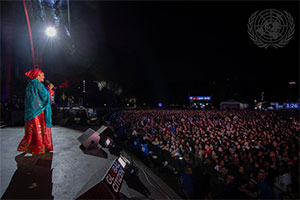 Global Citizen Festival in New York. Credit: UN Photo/Eskinder Debebe
Active citizens are committed to social change because they know that it is achievable. However, major political challenges face active citizens across the world. For example, in authoritarian regimes in Latin America where the hegemonic party has been in power for decades on end, protestors and human rights activists face enormous repression and struggle to materialize their advocacy into concrete results. The same can be said for Africans, where a shift towards elected government in recent decades has yet to translate into an effective voice in decision-making. Now, the Strengthening Citizen Demand for Good Governance, which uses evidence-based approaches – funded by DFID's Governance and Transparency Fund – seeks to raise their voices.
In 2025, the CIVICUS Monitor’s People Power Under Attack report revealed that civic freedoms are severely limited in 122 of 198 countries and territories, and only 7.2% of the global population now lives in countries where civic space is open. Through partnership with the Overseas Development Institute (ODI) and CIVICUS, IPS reporters across the continent will seek to define the extent and limits of state capability, government accountability and the responsiveness of leaders to the needs of citizens.

The Week with IPS

NEXT STOP - SDGs
Tracking global progress towards a sustainable world
Tracking global progress towards a sustainable world
