Languages
Friday, November 20, 2026



News and Views from the Global South
Labour
LABOUR-BRAZIL: Adjustment Measures Knock on Union Doors
Between 50 and 80 percent of Brazil's 16,000 unions could disappear if Congress approves a draft constitutional amendment submitted by President Fernando Henrique Cardoso.LABOUR-TANZANIA: Improved Skills Needed To Reduce Poverty
Tanzania's blacksmith, Musa Hamisi Nanhuyeu, used to produce five tiny hoes or "jembes" per day, before polishing up his skills.ECONOMY-BRAZIL: Pension Reform Finally Makes it Through Congress
A partial overhaul of Brazil's pensions system, finally approved by Congress under the pressure of the financial crisis, is considered an important first step in the fiscal adjustment considered indispensable for restoring investor confidence in Brazil.LABOUR-ZAMBIA: Miners Suspend Strike, But Tension Still Runs High
Tension is still running high in the northern Zambian mining town of Luanshya where two people were killed this week when police opened fire on striking miners, protesting poor working conditions.LABOUR-BRAZIL: Gov’t Attacks Unemployment, Overturns ‘Union Tax’
The Brazilian government adopted measures designed to offset the rise in unemployment expected next year as a consequence of the financial crisis, and to reform the statute governing trade unions.LABOUR-US: Breakthrough on Monitoring Sweatshops
Major U.S. clothing and footwear makers have reached an unprecedented accord with human-rights groups to create an independent association to monitor labour practices in their factories and those of their contractors abroad.LABOUR-WEST AFRICA: Banding Together Against Unemployment
Member states of the West African Economic and Monetary Union (UEMOA) have decided to work out a joint strategy to curb unemployment in their subregion.LABOUR-ZIMBABWE: Searching For Greener Pastures In South Africa
South Africa may not be the land of 'milk and honey', yet Zimbabweans still risk everything including their lives to go there and get a job.LABOUR-SOUTH AFRICA: New Jobs In The Pipeline
South Africa's long awaited 'Presidential Jobs Summit' did not turn out to be another of the talk shops that have become a characteristic of the country's democratic rhetoric.LABOUR-AMERICAS: Fighting to be Remembered in Integration Process
The labour movement in the Americas is fighting to end the neglect it has suffered in the continental integration process, according to union leaders.LABOUR-COLOMBIA: Civil Servants Lift 20-Day Strike
Public employees in Colombia lifted a 20- day strike Tuesday after reaching an agreement with the government which accords a higher raise to the 70 percent of civil servants who earn the lowest salaries.LABOUR: Flexibility Hurts Workers While Boosting Business
Labour flexibility brings heavy consequences for workers in the machinery, electrical and electronics industries, while boosting competitiveness and jobs, according to a new report by the International Labour Organisation (ILO).ECONOMY-PANAMA: Unions Demand Halt to Privatisation
Panama's unions have launched an all- out campaign to demand a stop to the privatisation of public enterprises started four years ago by President Ernesto Perez Balladares.LABOUR-US: RETURN OF THE SWEATSHOPS
The crackdown on immigrants entering the United States has had the unwelcome effect of returning exploitative conditions in the workplace reminescent of the last century.RIGHTS-ITALY: Benetton Implicated in Child Labour Scandal
A textile factory in Turkey subcontracted by Benetton, Italy's top chain of clothing stores, was accused of employing children as young as nine years old in sweatshop conditions.SOUTH AFRICA: The New Struggle Against ‘Apartheid Wage Gap’
South Africa is witnessing another struggle against apartheid with thousands of Black workers marching, picketing and demanding a living wage from their wealthy White employers.KENYA: A Major Showdown Looms Between Teachers And Government
A major showdown is looming in Kenya between teachers and the government after riot police used clubs to break up a demonstration to protest the government's failure to pay promised raises.LABOUR: Duty-Free Zones a ‘Paradise Lost’, Says ILO
Duty-free zones attract investment and generate jobs, but they also constitute enclaves of low wages and exploitative labour conditions, the International Labour Organisation (ILO) concluded after 20 years of research into the phenomenon.LABOUR: Jobs Take a Beating from Venezuela’s Economic Crisis
Workers trekked this week from Venezuela's provinces to the headquarters of the state-run oil company to protest a wave of dismissals by the sector, in an unprecedented act of desperation./REPEAT/LABOUR-THE BAHAMAS: Uneasy Truce Between Government and Trade Unions
Much has been said about the labour movement here in the last few months, but President of the National Congress of Trade Unions, Leroy Hanna seemed to have been talking for several persons when he argued that the growing militancy of trade unions over the past few months has signalled the end of the honeymoon between the movement and the government.LABOUR-THE BAHAMAS: Uneasy Truce Between Government and Trade Unions
Much has been said about the labour movement here in the last few months, but President of the National Congress of Trade Unions, Leroy Hanna seemed to have been talking for several persons when he argued that the growing militancy of trade unions over the past few months has signalled the end of the honeymoon between the movement and the government.« Previous Page — Next Page »


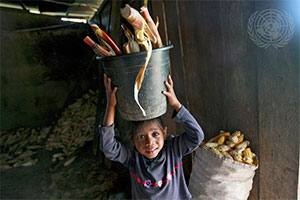 Timorese Girl with Fresh-Picked Corn. Credit: UN Photo/Martine Perret
A global common denominator is the need for a decent job. The economic realities of each country determine just how difficult it is to find one. Despite the labour movement's achievements, serious challenges persist: gender discrimination, child labour, worker migration, the digital divide and AI automation, evaporating pensions, unsafe workplaces, corporate pressure against union organising, negative impacts of trade agreements, and the precariousness of informal employment. The 2025 UN SDG Report identifies jobs and social protections as one of the six priority areas requiring urgent action, with progress either stalled or reversing in many developing nations.
In recent years, the fight to protect labour equality has taken on new dimensions with the rise of Environmental, Social and Governance standards. With the Social aspect aiming to promote equality and human rights, ESG principles have strengthened labour advocacy within corporate and governmental regulatory landscapes. In particular, ESG has become much more institutionalized in emerging economies such as Brazil and China. IPS follows the world’s workers as they confront these challenges - their setbacks and their successes.

The Week with IPS

NEXT STOP - SDGs
Tracking global progress towards a sustainable world
Tracking global progress towards a sustainable world
