
Monday, September 21, 2026



News and Views from the Global South
POLITICS-ZIMBABWE: A Campaign Tailor-Made for the Ruling Party
Moyiga Nduru
- A routine visit to a relative living in a rural area is, in most parts of Africa, a private family matter. Not so in Zimbabwe, says Tiseke Kasambala, a researcher with Human Rights Watch.
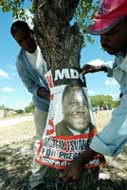
An MDC campaign poster goes up - but is it too little, too late? (Photo: AP) Credit: PictureNET Africa
The ruling Zimbabwe African National Union-Patriotic Front (ZANU-PF) draws most of its support from rural areas. As a result, says Human Rights Watch (HRW), ZANU-PF members and their allies do not hesitate to take action if they believe this support is being challenged.
“There is a woman whose uncle visited her from the city. After her uncle had left, ZANU-PF activists went and interrogated her about the…reasons for the visit. And she was made to go to the chief’s house for further interrogation,” Kasambala told journalists Monday.
“Many rural Zimbabweans are scared and don’t want to go through such an ordeal,” she added. Kasambala was speaking at the Johannesburg release of a new paper by HRW entitled ‘Not a Level Playing Field: Zimbabwe’s 2005 Parliamentary Elections’.
Kasambala and several HRW colleagues spent over three weeks in Zimbabwe in December 2004 and February 2005, during which they interviewed 135 representatives of the ruling party, opposition and civil society.
Their findings, recorded in the paper, were that opposition supporters and other Zimbabweans had been intimidated by ZANU-PF and government officials in the run up to parliamentary elections.
This continued a pattern of repression that had characterized the past five years in Zimbabwe.
The 2000 parliamentary poll and the 2002 presidential election were preceded by widespread violence, most of it directed against the opposition. While many observers agree the level of intimidation ahead of the Mar. 31 vote is lower, they believe this may reflect assurance of victory on the part of ZANU-PF, which now faces an opposition hamstrung by years of repression.
HRW condemns the Harare government’s use of restrictive laws such as the Public Order and Security Act, which undermines the opposition’s ability to campaign – and the Access to Information and Protection of Privacy Act. This law has been used to muzzle the independent press.
“In short…the playing field for the 2005 election has not been level,” says the HRW paper.
The group has also expressed concern about voter registration and education, and the arrangements for election monitoring, noting that “Major problems…that marred previous elections have not been remedied.”
These include the fact that too few inspection centres were available where the voters’ roll could be scrutinized.
This difficulty notwithstanding, a Harare-based organisation called the FreeZim Support Group has done an analysis of the roll which indicates that more than two million of its 5.6 million names are suspect. In addition, Zimbabwe’s substantial expatriate community will not be allowed to cast ballots.
Inasmuch as attention has focused on the Zimbabwean government’s actions ahead of Mar. 31, the Southern African Development Community (SADC) has also found itself coming under pressure in connection with the poll.
Last year, SADC – of which Zimbabwe is a member – drew up a set of electoral guidelines to ensure that polling in the region would be free and fair. Southern African countries are now obliged to ensure political tolerance ahead of elections, provide all parties with access to state media – and set up impartial electoral institutions, amongst other measures.
The Mugabe administration claims it is adhering to the SADC protocol. But, HRW begs to differ.
“(With) only days remaining before voters go to the polls,” says HRW, “it is clear that the government has not adequately met the benchmarks set by the SADC Principles and Guidelines Governing Democratic Elections.”
SADC observers are expected to comment on Zimbabwe’s election environment within the next 10 days. In light of this, HRW has called on the 13-member organisation to look beyond the relative calm that prevails in Zimbabwe at present when giving its verdict on polling preparations.
“They must also take into account the effects of the past five years of violence, recent reports of intimidation, continuing electoral irregularities and the use of restrictive legislation,” says HRW.
Michael Clough, HRW advocacy director for Africa, believes that political repression in Zimbabwe is proving an acid test for SADC.
“I think the credibility of SADC is on the line. And, I think South Africa’s commitment to spread democracy in the region is on the line,” he told journalists in Johannesburg last week.
HRW has also urged SADC states to ensure that campaigning in the final days before the parliamentary poll is allowed to proceed unhindered.
Zimbabwean president Robert Mugabe, who has been head of state since his country received independence from Britain in 1980, frequently accuses the opposition Movement for Democratic Change (MDC) of being a front for Western interests. (The MDC is Zimbabwe’s main opposition group.)
However, the president’s critics claim he has eroded the gains of his initial years in office with economic mismanagement and increasingly authoritarian rule.
 Print
|
Print
|




