Sunday, August 30, 2026



News and Views from the Global South
Q&A: Do You Know Where Your Power Comes From?
Interview with Gabriel London
- In his new 10-minute documentary “Electroland”, Gabriel London gives a crash course on the U.S. power grid through striking, often beautiful images of pounding oil derricks, spinning wind turbines and blazing coal-fired smokestacks.
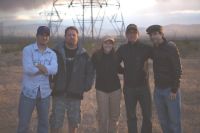
The Electroland film crew, Gabriel London on far right. Credit: Found Object Films/SOS
London, whose previous work has included an expose of rape and sexual abuse in the U.S. juvenile prison system, spoke to IPS this week from his new home in New York City.
IPS: I would think that people who are at all active on the issue of climate change are well aware of the statistics you present. So who is your target audience?
GABRIEL LONDON: A lot of the people entering the debate now are new to the issue. I think we’re all sort of waking up simultaneously to the changes that are going on around us. So the idea was to reach out to people who want to join the debate but who don’t necessarily know where the focus of the debate should be.
You think about how innocuous the gesture is of flipping on a light switch – and we all do it all day long, and we often leave the lights burning all day long. People don’t always see it in the same fashion as when they turn on their car motor, and maybe they should.
IPS: You note that coal is the worst culprit in terms of greenhouse gas emissions – accounting for about 89 percent in the U.S., even though it generates a little less than half of the country’s electricity. But it’s also one of the cheapest options. How can we bring down the cost to consumers of cleaner, sustainable alternatives like solar, wind and biomass?
GL: Economies of scale make a big difference. With wind and solar, the prices have been dropping precipitously for the last decade as more and more countries switch over to renewable sources. Germany and Spain have made lots of investments in solar, in particular, but also wind. What you’re seeing is it’s becoming more diffuse and economies of scale are driving down prices for the high-ticket items – the turbines, the panels, the various techonologies. So there’s hope there.
I was alarmed that only .01 percent of our power comes from solar. Sometimes you feel like there are little PR items that make you feel good, and that we’re making an advancement, but if you’re talking about .01 percent, it starts to make you feel a little discouraged. It’s going to take a long time to build up that infrastructure.
As a society that’s what we need to decide, and we need to encourage our politicians and the various people of industry in saying, we are willing to put down an investment here in our future, it may cost a little more now, but over time it lowers the economic cost. One of the things that’s so crazy about coal and other fossil fuels is there is no economic cost associated with polluting. There isn’t a carbon tax. I’m not advocating for one, but let’s say that the world is going to be economically harmed by global warming and yet there is no penalty for being the culprits that create global warming. Isn’t that weird?
IPS: It’s interesting that you decided against any voice-over narration, although the music does set a certain tone – sounding rather ominous when fossil fuel plants are shown, and upbeat when images of windmills spinning behind a green field appear on the screen. Do you think the film is neutral?
GL: The film is associated with SOS and Live Earth, an advocacy tool for change. [But] I don’t like to lead people too far along in my storytelling. I like them to reach their own conclusions. Coal is still the cheapest power source, and we didn’t hide that fact. But I do feel that through archival footage and that kind of thing, we were able to draw some contrasts. It’s worth noting that archive was in some ways a necessity because there was very limited access available to those sources. People in those industries don’t necessarily want to put a public foot forward. They would like to keep it so you don’t know, when you switch on a light bulb, where that power is coming from.
IPS: What kind of obstacles did you encounter during filming? I see the crew got access to some large hydropower plants, like the Hoover Dam; what did you tell the relevant authorities there and elsewhere? Probably not that you were making a film to mobilise the public on the issue of climate change.
GL: In going into the whole thing, I wanted to give each power source the same aesthetic treatment. I wanted to do these beauty shots, each with their own respective qualities. Coal was going to be fire-breathing, and wind was going to be the motion of the windmills. And I was going to each of the power producers and saying the same thing. And I really hit a brick wall when it came to all of the old-fashioned power sources.
I’ve gotten into prisons to film on numerous occasions. I’ve gotten judges to allow me to film in the child welfare system in California. And I had the hardest time ever trying to get access to [fossil fuel and nuclear power plants], it was just a blanket “no, go talk to the Homeland Security Department”. So it really left me with a sense of, what am I going to do? And thankfully there is something called the U.S. Archive, and I went there and trolled for good stuff, and I found some amazing footage that allowed the coal industry to present itself, and the nuclear industry to present itself, and oil and gas. But those worlds were closed to me.
IPS: Tell us a little about the Live Earth project.
GL: Live Earth has a very ambitious agenda of not only doing seven concerts simultaneously in six different continents on 7/7/07, but they also wanted to add this film component. From what I understand, in the past they’ve done Live Aid, Live 8, and the idea here is to have films that are lasting past the day of the concerts. Something that can be used for educational purposes, that can be used to stimulate debate wherever in the world, post- and pre-concert, so that we have something we can use in classrooms, and use for activism and various other purposes.
The goal, when they commissioned these 60 films, was to get diverse voices from all over the world, so I’m part of a group of filmmakers that comes from all sorts of different traditions of filmmaking – narrative filmmaking, commercial, music videos. I think at this early stage of the debate about how to move forward, it’s a good thing to pick all these diverse voices and see which strategies work.
>From my perspective, I think we have to start with information. And they say [SOS Live Earth] should reach a global population of over a billion.
 Print
|
Print
|