
Tuesday, September 22, 2026



News and Views from the Global South
POLITICS-MALAYSIA: ‘Mass Rally Wake Up Call to Gov’t’
Baradan Kuppusamy
- The biggest public protest in a decade that saw over 30,000 people braving riot police and tear gas on the weekend demanding fraud-free elections was no less than a public cry for real democratic change, say observers.
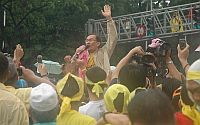
Opposition leader Anwar Ibrahim calls for the king's intervention at Sunday's pro-democracy rally Credit: Seng Keat Tan
“The protest has clearly shaken the government,” he told IPS. “Instead of listening to the voice of the people the authorities want to start criminal prosecution against the organisers, against parents and students who took part and against journalists who reported the protest.”
“Such a reaction will only harden the resolve of democracy activists to press for genuine reforms,” Wong said.
The Nov. 11 protest was widely reported by the global media. But at home it was played down and even misreported by the government controlled media which showed concern for traffic jams and loss in profits caused by traders pulling down the shutters for a few hours.
Significantly, the rally came on the heels of another protest by 2,000 lawyers led by the Malaysian Bar on Sep. 26. They marched several kilometres from the Palace of Justice to Prime Minister Abdullah Badawi’s office in the administrative capital of Putra Jaya to demand a corruption-free judiciary.
The lawyers’ ‘Walk for Justice’ was the second such protest in 50 years as an independent nation.
The authorities did their best to stop Sunday’s rally that was organised by four main opposition political parties led by de-facto leader Anwar Ibrahim and a coalition of 67 civil rights non-governmental organisations gathered under a coalition called ‘Bersih’.
The protestors marched about five km from the city centre to the palace to submit a memorandum to the king, urging him to intervene and ensure the upcoming 12th general elections, widely expected before March 2008, are fraud-free and played out on a level playing field.
Specifically Bersih wants the Election Commission, whose independence is strenuously questioned by the political opposition, to remove phantom voters from the electoral rolls, use indelible ink to prevent illegal and multiple voting, ensure equal access to media for all political parties and abolish postal voting which, opposition lawmakers say, the government frequently abuses.
Instead of allowing the protest to go on as advised by both domestic and international civil rights activists, the authorities did their best to frighten people into not attending. Badawi, who saw the rally as a challenge to his authority, personally weighed in warning people to stay home.
“I don’t like being challenged, don’t challenge me,” Badawi said on the eve of the protest and was dutifully given wide coverage by the mainstream media. Police cordoned off Dataran Merdeka (independence square), put up roadblocks on all main roads leading into the city and at one stage even stopped trains. But nothing stopped people from turning up.
“This is a historic occasion. Despite everything thrown at us the rally is an unqualified success,” Ibrahim said when contacted later.
Political analysts widely see the turnout out as a face-off between Ibrahim and Badawi with the Prime Minister blinking first.
Although the government is publicly rattling the sabre and throwing ‘extremist’ labels at Bersih, privately, senior officials said, the government is shaken by the scale of protest and the deep grievances it has exposed.
Not since the sacking of Ibrahim as deputy prime minister in 1998 has the country seen public anger on this scale. At that time the anger was directed at former prime minister Mahathir Mohamad and the brutal way he used the police, judiciary and local media against Ibrahim, then his deputy.
This time the focus is Badawi, who earlier enjoyed an image as the ‘gentle father of the nation’, but is increasingly under attack for failing to deliver on his many promises to reform society.
“It is significant that many of the protestors this time were young, working class Malays, compared to the English-educated elite who took to the streets for Anwar (Ibrahim) a decade ago,” said a political science lecturer at the National University of Malaysia who declined to be named for fear of reprisals.
Many of the protestors were poor, urban Malays who, despite Badawi’s promises, have difficulties making ends meet, with private sector wages stagnant and the cost of living escalating.
“They hold low-paying jobs and live in cramped, cheap flats outside the city and stare at a bleak future,” he told IPS.
“These are the people the NEP (New Economic Policy) has left behind,” he said referring to affirmative action policy designed to help Malays advance, but according to Ibrahim and others, has been “hijacked” by the ruling Malay elite for their own enrichment.
A host of pent up grievances are behind the show of public defiance last week, civil rights activists say.
“People are angry over the extreme racism, the religious intolerance, judicial corruption and lack of governance, transparency and accountability,” said human rights lawyer Haris Ibrahim. “People are worried where the country is heading…who is in charge, really?”
Beth Yahp, a Malaysian author, wrote a blisteringly critical open letter to Badawi urging him to “fully and fairly endorse and practice democracy…that is, democracy for everyone, not just a powerful few.’’
The European Commission’s envoy to Malaysia, Thierry Rommel, who ended his four-year tour of duty this week, told Reuters, “…this country still lives under emergency. ”
“It is not a secret that elections are not fair,” he said. “There’s a significant part of the population that feels their voice is not really heard because of the way elections are managed,” he added. “They feel locked out.”
With Badawi likely to call elections soon political experts expect more protests – and tougher police reaction – as the government hardens its stance in the face of the opposition’s demands for greater democracy.
 Print
|
Print
|




