
Friday, October 23, 2026



News and Views from the Global South
DEVELOPMENT-MALAYSIA: Civil Society Stalls Eight Billion Dollar Project
Anil Netto
- Civil society groups here are mulling their next move after having stalled a massive, private project to build close to 40 high-rise towers on a precious green lung on this land-scarce Malaysian island.
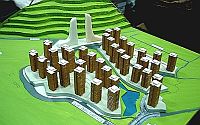
Model of the 8-billion-dollar mega-project stalled by civil society groups Credit: Penang Heritage Trust
The blueprint for the Penang Global City Centre (PGCC) project, to be sited on land presently used as a racecourse operated by the Penang Turf Club, was launched last September with much fanfare by Prime Minister Abdullah Badawi.
It was to have been developed by the private firm Abad Naluri, one of whose directors is Patrick Lim. Lim has been referred to as "Patrick Badawi" by former premier Mahathir Mohamad because of the businessman's perceived closed ties with Abdullah.
The government had regarded the PGCC as a "high-impact" project under the Northern Corridor Economic Region, one of several initiatives to spur economic growth in the various regions of the country.
Newspapers carried images of the PGCC model, which featured "iconic" twin towers that its developer said would become a new landmark for Penang. Promoters touted the "zero carbon" features of the project and hoped to see a deluge of interested buyers and financiers, including those from abroad.
But the project quickly ran into controversy when concerned Penang residents and activists discovered there would be more than just two high-rise towers. Architectural plans submitted for approval showed close to 40 high-rise towers.
Activists from a string of the prominent civil society groups, calling themselves the PGCC Campaign Groups, launched a campaign against what they saw as deception. But they were countered by the developer, which put up a slick public relations campaign, highlighting the project's supposedly ''zero-carbon'' goal.
For their part, the PGCC Campaign Group successfully mobilised the public to write petitions, display anti-PGCC car stickers, wear campaign T-shirts, and write post cards to the Penang Chief Minister Koh Tsu Koon.
It also helped that a whiff of a general election is now in the air, with polls widely expected to be held in March. Penang is expected to see a closely fought battle – for seats in the federal parliament and the state assembly – between the ruling coalition led by Badawi and an opposition front helmed by former deputy premier Anwar Ibrahim. Both Abdullah and Anwar are from Penang.
The government suspended elections to town councils in the 1960s; since then, town councillors have been appointed by the ruling parties in each state. Critics say the absence of local democracy accounts for the lack of accountability and responsiveness to the public at the local level.
In the end, it took 2,500 postcards, emails and letters and a concerted civil society campaign to convince Penang Chief Minister Koh Tsu Koon that it would be politically costly for the ruling coalition to allow the project to proceed.
The groundswell prompted Koh to announce last week that he had issued a directive to the Penang Island Municipal Council to return the application to the developer so that the plans could be revised. ''This is to enable them to address the concerns raised from the feedback we have received,'' he said.
Koh said the project density had to be reduced and the developer also had to comply with a 30 per cent quota for affordable housing. The developer had planned to build almost 7,000 luxury homes and develop 1.3 million square feet of commercial space on site as well as construct some affordable housing – but only in a highly congested low-income neighbouring site.
Abad Naluri had acquired the 104-hectare horse race-course land on Penang Island at 43 ringgit per square foot in 2002. Its purchase from the Penang Turf Club would be partially paid in kind by building a new race-course in Batu Kawan on mainland Penang.
Also in 2002, the state government initiated a move to rezone the land from recreational use to mixed development. The eventual conversion resulted in the property value soaring five to six times, landing the developer an unrealised revaluation profit of a couple of billion ringgit – even before the first bulldozer could rumble in.
Critics said that profit could have gone to the state had it acquired the property for itself before rezoning the land. Others argued that the Turf Club site should be preserved as an open green space as a legacy for future residents of Penang while alternative 'brownfield' sites could be found for the developer.
Activists say the process of revising and resubmitting the plans for approval could take at least a year.
Lim, who is also executive chairman of Equine Capital, which has a 25 per cent stake in Abad Naluri, is determined to press ahead while complying with local government requirements. "There are good international solutions for the issues raised so far, and we will embark on them shortly," he was reported as saying, adding that he welcomed public views. "We always align ourselves with the best thinkers in the world, so one can expect good solutions to arise."
For their part, the campaigners opposing the project are not letting down their guard.
''Let us not be naïve, the announcement by the Chief Minister on the PGCC and Patrick Lim’s response is all an election gimmick!'' warned one heritage conservationist. ''After the elections (if the ruling coalition wins), then it will be back to (all those) towers. I have seen this happen over and over again, so don’t get taken up by all these announcements.''
The stalling of the project is only a small but significant tactical victory, admits Ahmad Chik, one of the coordinators of the PGCC Campaign Group. ''But the fight continues: I fully expect Patrick Lim to come back with another proposal that may be even more difficult to beat, seeing that it will be after the election, the biggest factor in our favour this round.''
All the same, there was an important lesson for the public. ''This victory will, I hope, show to the doubters and fence-sitters that we can make a difference, if we speak out together with a loud voice,'' he added. ''Perhaps with a supportive, empowered and emboldened public a tough fight will be less difficult.''
With the stalling of the project, activists are reassessing their strategy. Will they accept a scaled-down 'green' version of the building project or insist that the site be preserved as a public green on land-scarce Penang Island?
For now though, the Campaign Group is insisting on a local plan not only for the Penang Turf Club site and surrounding areas but also for Batu Kawan, where the new racecourse is to be built. These local plans, they say, should be prepared transparently and with full public participation.
And once these local plans are approved, the Group wants the government to insist on detailed independent Environmental Impact Assessments and traffic studies – undertaken by competent and independent consultants – before approving any major projects.
 Print
|
Print
|




