
Monday, September 28, 2026



News and Views from the Global South

Criticisms Multiply Against Binational Dam
- Ecologists in Argentina and Brazil are sounding the alarm against the potential harm to the Uruguay River, shared by three countries, that could result from the planned Garabí dam.
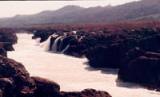
Estreito do Uruguai, between Rio Grande do Sul and Santa Catarina, covered by water from the Itá dam. - Fundación Proteger
“While they talk about building the Garabí, the Salto Grande (Argentina-Uruguay) dam on the same river barely functions due to lack of water,” Jorge Cappato, of the Argentine environmental foundation Proteger, told Tierramérica.
“Between the dams that already exist and the planned ones, in a few years the Uruguay River will have become a series of ponds. Wetlands and forests will be flooded, diminishing biodiversity and water quality,” he predicts.
In periods of drought or scant rainfall the reservoirs will accumulate what little water there is and there will be extremely little outflow. “We are going to walk across riverbeds,” said Cappato, coordinator of the Argentine committee of the World Conservation Union (IUCN).
In late February, Argentina's President Cristina Fernández and Brazil's President Luiz Inácio Lula da Silva ratified the decision to relaunch work on the binational Garabí dam, first planned in 1972. A technical commission was created to oversee the preliminary work and construction is slated to begin in 2011.
The first Argentine-Brazilian dam would have an energy-generating potential of 2,800 megawatts and would mean flooding 33,000 hectares of inhabited land on both sides of the river. Its location would be on the stretch between the far northeastern Argentine province of Corrientes and the southern Brazilian state of Rio Grande do Sul.
Also planned are two more Argentine-Brazilian dams along the same river: San Pedro and Roncador.
The “Uruguai” river (as it is spelled in Portuguese) begins in Brazil and flows into the River Plate (Río de la Plata). Its course forms the border between Brazil and Argentina, and, farther downriver, between Argentina and Uruguay. In its initial stretch there are four hydroelectric dams (Itá, Machadinho, Passo Fundo and Barra Grande), and below is the Salto Grande dam, shared by Argentina and Uruguay.
“We need a common water resource management policy for Argentina, Brazil and Uruguay. We warned about this when the Iguaçu Falls ran dry in June 2006,” Cappato said.
Brazil had closed the sluice gates on several hydroelectric dams on the Iguaçu River and the decline in the flow revealed the basalt walls of the otherwise imposing waterfalls shared with Argentina.
A demonstration of what can happen when there is a shortage of rainfall can be found today at Salto Grande. According to its technical commission, in mid-November the energy it supplied was more than 42,000 megawatt hours (MWh) and in December it had fallen to 8,975 MWh.
“Argentina and Uruguay agreed for now to use very little energy from the dam, so just three of the 14 turbines are operating,” engineer Enrique Topolansky, president of the Uruguayan delegation to the Salto Grande technical commission, told Tierramérica.
“The idea is to store water until after (Roman Catholic) Holy Week, so downriver there is almost no flow,” he admitted. But Topolansky said it would be a positive thing to build the Garabí dam, because its reservoir would provide more water resources to the overall water system in times of drought and would help regulate the resource and prevent overflow in periods of heavy rains.
It is true that the “resource is very scarce, but even more scarce is energy, and the countries have to function with what they have,” he said.
“Garabí is a project of Argentina and Brazil. It would be irrational for Argentina to undermine the operation of another dam that it has with Uruguay, like Salto Grande. The operations will need a closer coordination than what it has been if all sides are to come out ahead,” he said.
But environmentalists believe that such coordination is a mere idea, and insist that the big dams have irreversible social, economic and environmental costs that have been seen across the region.
A communiqué that environmental and citizen groups released Mar. 14 in Buenos Aires and in Porto Alegre, Brazil, states that the Garabí dam would cause a loss of biodiversity, alter the local microclimate, destroy fisheries and increase poverty.
The Saltos del Moconá, a heavy cascade more than three kilometers long, could be drowned by the reservoir. That already happened with the Sete Quedas (seven cascades) that disappeared as a result of the Itaipú dam on the Paraná River, said Cappato.
Something similar occurred with Itá, which left the falls of the Estreito do Uruguai underwater.
“Garabí will be a final blow to the Uruguay River basin,” according to attorney Jorge Daneri, of the Fundación Mbiguá, in the inter-river city of Paraná.
“We are taking action so that the Garabí will not be built,” Elisángela Soldatelli Paim, projects coordinator for Friends of the Earth Brazil, told Tierramérica. The dam “would aggravate damage in the basin,” which already has to withstand large hydroelectric dams and has other in preparatory phases, she said.
According to Topolansky, the Garabí, Salto Grande and the other dams upriver do not have large reservoirs. “They are small in relation to the power they produce,” he said.
One of the project's prior studies indicates that 7,000 families would have to be relocated, including family farming cooperatives and artisanal fishing villages, said Soldatelli Paim. “There was not even any debate in the community to know why and for whom a large hydroelectric dam is needed,” she said.
In her opinion it is likely that the energy is destined for high-energy-use industries, like aluminum and cellulose. “But for such things there are alternative energies, like wind and thermoelectric, which they have ignored.”
 Print
|
Print
|




