
Saturday, September 19, 2026



News and Views from the Global South
BANGLADESH: Amnesty for Tainted Tycoons as Economy Flags
Farid Ahmed
- Bangladesh’s military-backed interim government hopes that a ‘truth commission’ it plans to set up will give tainted businessmen an opportunity to revive their businesses and help put a badly flagging economy back on the rails.
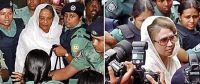
File pictures of ex-PMs Sheikh Hasina Wajed (left) and Khaleda Zia (right) being arrested and led away. Credit: Focus Bangla
Under the scheme, business people who have been detained, or who are on the run after being named as graft suspects, can expect to be pardoned, Anisul Huq, one of the authors of the draft law, told IPS.
"The government will set up the truth commission as soon as possible in a bid to spur economic activities which have slowed down after the authorities launched their crackdown," said Huq, a senior Supreme Court lawyer.
While the government believes the truth commission will ease the pressure on the country's economy, the independent Anti-corruption Commission (ACC) fears that the move may jeopardise the spirit of the anti-graft drive.
The ACC’s chairman Hasan Mashhud Chowdhury, a former army chief, said earlier this month that while he was not opposed to the plan, he felt no one should be given special privileges.
The Berlin-based corruption watchdog, Transparency International, has listed Bangladesh among the most corrupt countries and economists say graft levels are high enough to have seriously eroded the country's GDP.
But Huq said corruption was all-pervasive in Bangladesh and that there were people who were unwillingly drawn into it. "The move will lessen the burden of the courts dealing with corruption cases," he said.
One of the main reasons for instituting the truth commission was to provide an avenue for businessmen to get back to work and which could stimulate the economy and stem the rise in prices. "The idea is to offer an amnesty to top businessmen. Their absence has led to the collapse of their enterprises and dragged the whole economy down," said Huq.
With some 30 leading corporate houses, whose owners are either in jail on corruption charges or have gone underground to avoid the anti-corruption dragnet, uncertainty has been cast on an estimated 300,000 jobs.
The average production capacity of some of these business houses has decreased by 20 – 50 percent over the past few months. Some units have already announced layoffs, resulting in the loss of several thousand jobs, while employees at others have not been paid wages for three to seven months.
The country's apex trade body, the Federation of Bangladesh Chambers of Commerce and Industry, has complained that the drive has caused a ‘climate of fear’ that has dampened the economy.
This is the first time that Bangladesh's interim government has acknowledged that the sweeping reforms, launched in February 2007 and aimed at cleaning up a notoriously corrupt political and economic system, have had an adverse effect on the economy.
The government launched the crackdown a month after it took power following the imposition of a state of emergency and the cancellation of scheduled general elections in the face of violent street unrest.
Fast-track courts have since sentenced more than a dozen former ministers, lawmakers and their family members to between five and 20 years in jail.
Fakhruddin Ahmed, a former World Bank official who heads the interim government, has said that Khaleda Zia and Sheikh Hasina were not eligible to appear before the proposed truth commission for pardon as they have already been arraigned on corruption charges and are facing trial in the courts.
Huq explained to IPS that the objectives of the proposed commission are to promote voluntary disclosure of corrupt practices for lenient dealing and in a spirit of encouragement that may lead to expeditious disposal of cases.
The commission, he said, may refuse to accept a voluntary disclosure when it feels that it has not been honest or that the disclosed corruption is grave in nature affecting the national interest or economy.
A person who has made voluntary disclosure before the commission shall be disqualified from holding any public or elected office under the constitution, namely membership of Parliament, and other local body polls for a period not exceeding five years.
Prof. Ataur Rahman at the political science department of Dhaka University told IPS that it was important that the anti-corruption drive, an ongoing process, ‘’should not be hurried and that the process should remain sustainable".
 Print
|
Print
|




