Thursday, August 27, 2026



News and Views from the Global South
RIGHTS-SPAIN: Demolishing Memory
José Antonio Gurriarán
- The wrecking balls have begun to smash into the walls of the notorious Carabanchel prison, built by the dictatorship of Francisco Franco (1939-1975) to hold its opponents.
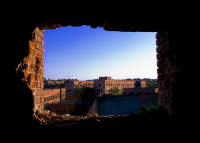
Carabanchel Credit: Alekspression (creative commons)
An umbrella group linking neighbourhood associations, communists, socialists, anarchists, trade unionists, politicians along the ideological spectrum, liberals and progressive Christians who were once held in the prison’s infamous third and fifth galleries has been holding protests against the demolition.
The administration of the Spanish Socialist Workers Party (PSOE) and the government of Madrid, ruled by a moderate faction of the right-wing Popular Party (PP), agreed to tear down the prison, which was built after the 1936-1939 civil war fought between the Loyalist or Republican forces of the democratically elected leftist government of the time and the Nationalist or fascist forces led by Franco.
The agreement was reached by the Interior Ministry of the government of socialist Prime Minister José Luís Rodríguez Zapatero and Madrid Mayor José María Ruiz Gallardón of the PP.
The mayor is the son of José María Ruíz Gallardón, a university professor, politician and lawyer who defended political prisoners during the dictatorship and was arrested after participating in a student congress that condemned the Franco regime in 1956.
The pact establishes that 50,000 square metres of the 200,000 comprising the grounds of the abandoned prison will be used for the construction of 650 low-income housing units, a hospital, a public square with a monument to the prisoners of Carabanchel, and a centre that will carry out research into the human rights abuses committed during the civil war and subsequent dictatorship.
But the Platform for a Centre for Peace and Memory, which groups those opposed to the demolition, disagrees with the plans.
"What they’re doing is a disgrace," said Julián Rebollo, the head of the Aluche Neighbourhood Association, which forms part of the umbrella group.
"No one even considered destroying the Nazi concentration camps of Auschwitz (in Poland) and Mauthausen (in Austria), tearing them down and putting new buildings in their place. They were left as a reminder of the horrors that occurred there," the former Communist city councilor of Madrid told IPS.
Rebollo was not held prisoner in Carabanchel, but he did spend time in the basement of the Dirección General de Seguridad, the central police station, in downtown Madrid.
He knows by memory, however, the names of all of the political prisoners who spent years of their lives in the regime’s most notorious prison.
"What we want is for them to leave the main section standing, with its prison yard and guard towers, or one of the two galleries where the dictatorship’s prisoners suffered so much," said Rebollo.
"How will our children and grandchildren know what happened there if we eliminate every trace of it? It would be an outrage," he said.
Luís Solana, an economist who specialises in security questions and was a close associate of the government of former socialist prime minister Felipe González (1982-1996), concurs.
In a letter to Prime Minister Zapatero, Solana said: "José Luis, if you authorise the demolition, a past history of struggle and sacrifice for the freedom that we now have will be wiped out.
"I was prisoner there for a year…If they (the right) have the Valle de los Caídos (Franco’s tomb and a monument to the fascist fighters who died in the civil war), many of us would like to have the Carabanchel prison. Stop the demolition, leave the building standing."
Spain’s national ombudsman Enrique Múgica, who served as minister of justice under González, was another of those captured in the 1956 round-up of student activists, along with Ruíz Gallardón, Communist leader Ramón Tamales, Dionisio Ridruejo, a liberal, and Gabriel Elorriaga, who belongs today to the PP.
After meeting with the members of the Platform, Múgica expressed his support for their request in an open letter to Interior Minister Alfredo Pérez Rubalcaba.
"I make this request my own, as ombudsman and as someone who was imprisoned in Carabanchel because of my political views and commitment," says the letter.
He added that "the Carabanchel prison is an especially significant place, as a symbol of political repression. There is still time to make the plans for the lot compatible with what we are asking for: memory and homage."
The prison, which began to be built in 1939 by Republican political prisoners sentenced to forced labour, opened in 1944. It was closed in 1998.
Others who suffered there for years were Marcelino Camacho, the charismatic founder and leader of the Comisiones Obreras central trade union, and Simón Sánchez Montero, a close associate of Santiago Carrillo in the modernisation of the Spanish Communist Party (PCE).
Camacho and Sánchez were convicted on charges of "illegal association," an offence that did not exist in any criminal code in Europe.
A worse fate was suffered by Julián Grimau, a member of the PCE Central Committee during the civil war, who went into exile in the Dominican Republic and then France when Franco’s forces defeated the Republicans.
After slipping back into Spain, he was captured, taken to Carabanchel, tortured and thrown out of a window in an attempt to kill him. But he survived, and was sentenced to death for "rebellion against the regime."
Despite requests for clemency by European leaders and Pope John XXIII (1881-1963), as well as huge demonstrations held as far away as Latin America to call for a pardon, Grimau was executed by firing squad in the wee hours of the morning on Apr. 20, 1963 in Carabanchel.
Legendary Chilean singer/songwriter Violeta Parra dedicated a song to him: "¿Qué dirá el santo Padre?" (What Would the Holy Father Say?)
The same fate met three members of the Revolutionary Anti-Fascist and Patriotic Front (FRAP) and two members of the ETA Basque separatist group, who spent their last hours in Carabanchel before they were shot by a firing squad in an army garrison on the outskirts of Madrid, while Franco was dying.
It was Sept. 27, 1975, and they were the last political prisoners executed by the dictatorship.
In response to the pressure to preserve part of the structure, the head of the prison service, Mercedes Gallizo, has presented reports by architects who say the structure is so badly deteriorated that it cannot be salvaged.
Gallizo told IPS that the prison "has been abandoned for 10 years, and it has become a filthy place that poses a risk to local residents."
She also reiterated her commitment to include in the area "a space dedicated to those who unjustly served time" in the prison.
Meanwhile, former prisoners and others, aware of what the prison meant in 30 years of struggle for democracy, have been approaching the demolition site and taking home pieces of brick and tile. Like the Berlin Wall, Carabanchel is a symbol of democracy.
 Print
|
Print
|