
Monday, September 21, 2026



News and Views from the Global South

Personal Crusades for Nature
- Environmental misfortune moved these four people so much that they embraced protection of the natural world as their own personal crusades. Tierramérica shares their stories.
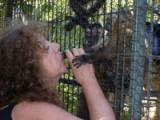
Elba Muñoz pours her heart into saving monkeys. - Daniela Estrada/IPS.
“Some people see me as a hero and others see me as a madwoman,” Elba Muñoz, 58 and a midwife, tells Tierramérica. She founded the Peñaflor Center for Primate Rescue and Rehabilitation, 40 kilometers west of the Chilean capital.
Sixty percent of the 6,000 dollars the center spends monthly comes from Elba and her family. The rest is donated by more than 240 “sponsors”. The center today is home to 145 monkeys of 10 different species. Most were seized from illegal trafficking deals, and most arrive sick and injured.
The story began on Dec. 8, 1994, when someone showed up at her door to sell her Cristóbal, a small woolly monkey (Lagothrix lagotheicha).
Muñoz bought him and cared for the monkey as a son, never imagining that more and more trafficked or abandoned primates would follow. In 1996 she created the center, which has taken in monkeys from circuses, zoos and even from a university laboratory.
She has studied primates, visited wildlife sanctuaries, written a book, collaborated in academic publications and given presentations at seminars. Today she is seeking sponsorship from the government in order to obtain private financing, says this mother of four.
The center holds the only colony of woolly monkeys that has reproduced in captivity in Latin America. Muñoz believes that her effort has helped raise awareness about animal mistreatment. Trafficking of monkeys has been greatly diminished, she says.
But, paradoxically, the goal of the center is to disappear when the animals die of old age. “All monkeys in captivity are unhappy. The center is a prison. It's the best in Chile, but in the end it's still a prison,” she says with sadness.
There are people in this world who can make life emerge from what seems to be the epicenter of destruction. In Peru, Trinidad Vela is one such person. She was born 72 years ago in the Amazonian village of Juanjuí, along the Huallaga River, which in the 1980s became a cemetery for victims of Peru's internal armed conflict, cornered by drug traffickers and deforestation.
There, in a degraded area of pasture in the eastern region of San Martín, this daughter of farmers, who never finished primary school, planted a forest 14 years ago that revived the flow of a dry riverbed. In 2005, that water saved her farming neighbors from the worst drought in this part of the Amazon.
“At first, everybody thought I was crazy because I didn't want to burn off or cut down the weeds, and I began to plant species to recover the flow of our stream. They said 'she is wasting the land and she's not working the soil',” Vela tells Tierramérica.
While others planted coca or orange trees, she planted mahogany and cedar to attract the birds, mammals and insects back to their original habitat. She built her dream accompanied by her daughter, Karina, with perseverance and few resources, turning into the only recorded success in restoring the landscape in a pasture ecosystem. Today it is the first private conservation area in the region and bears the name of the recovered stream: Pacunucho.
“After those days without water, the people began to comprehend the importance of the forests, which are necessary for our lives,” says Vela.
In Argentina, Rubén Pablos,aged 46, has led a reforestation project since 1996 in the native forest of the southwestern city of San Carlos de Bariloche. Fires, which in the 1990s decimated 10,000 hectares a year in Nahuel Huapí National Park, were his wake-up call.
Pablos was born in the suburbs of Buenos Aires. In 1982 he fought in the war against Britain over the Malvinas/Falkland Islands, and in 1990, with no job or profession, he want to work as an artisan in Bariloche. “I've always been interested in nature, but in Bariloche I was very worried about how the forest was being degraded,” he tells Tierramérica.
At first he channeled his concerns by serving as a volunteer fire fighter in the forests. That experience revealed to him that no entity was working to recover what the fires destroyed. That is how the Native Andean Patagonian Forest Restoration Project was born.
The initiative includes the Bariloche Forest Nursery, which produces 50,000 seedlings of various species to be planted in reforestation efforts.
“We hold workshops in schools about the functions of the forest, and we take 2,000 kids per year out to plant seedlings in areas affected by the fires,” says Pablos, who describes himself as “self-taught” and now heads the Asociación Civil Sembrar (sembrar means “to sow” in Spanish).
In 2004 he was able to establish Native Forest Day. Since then, by city ordinance, on the second Sunday of May a reforestation campaign is held in Bariloche. The initiative has been copied by other Patagonian towns. Now the Argentine Parliament is considering a bill to make it a national Native Forest Day.
In Cuba, meanwhile, Angela Corvea, 59, is cultivating public awareness.
A retired marine biologist with two decades of experience in environmental education, Corvea divides her time between seminars and workshops in schools and other locations, coordinating the international “Clean Up the World” (A Limpiar el Mundo) campaign in her town, and Acualina, her pioneering project begun in 2003.
All of this without neglecting her daughter Elisa, 24, who continues to suffer the effects of infant cerebral palsy.
Her message is aimed at children. “They are like sponges; they take in everything that one plants in their brains. My intention is to alert them and make them concerned, but also keep them busy,” she tells Tierramérica.
With Acualina, a cartoon character made known on the government-run educational television channels, her ideas have spread across the entire country. The character is a girl, a child philosopher dressed like the ancient Greeks and with the colors of the Cuban flag. She teaches and counsels about what should be done to protect the environment.
Acualina's likeness can also be found on posters, matchboxes, calendars, prepaid phone cards, a web page and two books, “Acualina 1” and “Acualina 2”. These days, Corvea is working on the budget to send her “Acualina 3” to be printed, while some friends are redesigning the Internet site.
It is not a quantifiable effort, and it does not boost her retirement pension. But Corvea believes that the most important thing is to continue raising awareness and multiplying efforts, because tomorrow could be too late.
 Print
|
Print
|




