
Saturday, September 19, 2026



News and Views from the Global South

Geothermal Debate Simmers in El Tatio
- El Tatio, the world's third largest geyser field, is in the sights of energy, tourism and conservation interests.
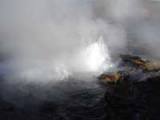
El Tatio Geyser field in northern Chile. - Public Domain
“For us, the geysers are the fountain of life,” Julio Ramos, president of the Council of Lickanantay-Atacameño Peoples, an umbrella group of 25 communities, told this reporter.
El Tatio is the largest geyser field in the southern hemisphere and the third largest in the world, with more than 100 springs erupting at an altitude of more than 4,000 meters in the Andes Mountains.
Chile is rich in thermal energy due to its location on the Pacific Ring of Fire. Geothermal heat is used to produce some 9,000 megawatts worldwide, with the United States, Philippines and Mexico leading the way. Various measurements indicate Chile's potential geothermal energy production at 3,000 megawatts.
El Tatio, located in the community of Calama and owned by the Ministry of National Goods, was declared an area of touristic interest in 2002. But because the territory is claimed by the indigenous communities, in 2006, its administration was handed over to two of them: Toconce and Caspana.
According to Ramos, most of the Atacaman Indians oppose the deep perforations that the Geotérmica del Norte consortium began in July 2008 in the Zoquete Ravine, four kilometers from the geysers.
In fact, the governmental National Indigenous Development Corporation issued a negative report in the process of assessing the project's environmental impacts.
However, Toconce and Caspana leaders reached an agreement with Geotérmica del Norte, controlled by the National Geothermal Company, a consortium itself whose ownership is shared: 51 percent by the Italian state company ENEL and 49 percent by the National Petroleum Company of Chile.
Gilberto Anza, president of Caspana, said in an interview that the project had brought his community a variety of benefits, such as placement of signs in the geyser field. The communities opposed to the project “haven't informed themselves very well,” he said.
Geotérmica del Norte's 18-month plan entails drilling four 2,000 to 2,500 meter perforations to assess the technical and economic feasibility of electrical production. Part of the extracted liquid is reinjected into the earth.
If the feasibility results prove satisfactory, the company will apply for the necessary permits to build a geothermal energy plant. The decision could be made by the end of the year.
“The project, which is already being executed, showed in practice that there was no negative effect on the availability of water or on biodiversity,” a Geotérmica del Norte spokesperson told this reporter.
The company also rules out any future impact on the geysers because “the thermal eruptions on the surface are fed primarily by water coming from rain or snowmelt… and those sources are not affected by the project.”
According to Energy Minister Marcelo Tokman, water scarcity and tourism justify citizen concern about the energy project. The government hired a U.S. consultant to analyze the environmental impact report that Geotérmica del Norte presented.
“What they have told us is that they are carrying out perforations following all imposed restrictions, and that there has not been – as the scientific analyses anticipated – any negative impact on the geysers or water availability,” Tokman said in an interview for this article.
However, the indigenous groups opposed to the project, backed by environmental organizations, local authorities and tourism operators, are convinced that sooner or later the energy project will contaminate surface and underground water sources, threatening the geysers and harming vegetation and animals.
In this High Andean zone of fertile plains and its areas of vegetation, the “llareta” plant grows like a green carpet. This is also habitat for the vicuña, a member of the camelid family, and the vizcacha, a rodent of the chinchilla family.
In a bid to halt the project, the Atacama Council and the Women's Network of El Loa staged street protests and appealed to the Inter-American Commission on Human Rights.
Citizen distrust increased in March, when the Regional Environmental Commission of Antofagasta slapped the company with a fine equivalent to 180,000 dollars for irregularities and non-compliance. The company is refusing to pay.
In 2000, a geothermal concessions law was enacted, and in the context of diversifying the country's energy matrix, the administration of President Michelle Bachelet provided incentives for exploration of this unconventional renewable energy source.
In addition to the Zoquete Ravine, there are other zones with perforation projects. On Jun. 1, international bidding began on 20 areas of exploration, 15 in the Chilean north.
El Tatio's future is also of concern to scientists. Pedro Zamorano and Rubén Araya, of the University of Antofagasta, study the bacteria that survive in the geysers where temperatures reach 80 degrees Celsius. There is great biotechnological potential for these bacteria in industrial processes.
In an interview for this article, the researchers refrained from predicting possible negative effects of the geothermal plant on El Tatio. The see the main problem as being the lack of protection for the country's biological wealth in microorganisms, given that foreign researchers are constantly visiting the zone, they said.
 Print
|
Print
|




