
Tuesday, September 22, 2026



News and Views from the Global South
SOUTH AFRICA: Legal Victory Offers Little Relief For Sex Workers
- More than seven months after the Cape High Court ruled in favour of the Sex Workers Education and Advocacy Taskforce (SWEAT), interdicting the police for harassment and arrests, sex workers are losing the daily battles against police and criminal elements on the streets.
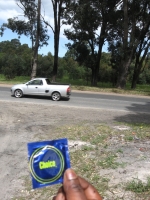
The City of Cape Town's response to an interdict banning arbitrary arrest of sex workers was to establish a vice squad. Credit: Nathalie Rosa Bucher/IPS
Nomsa and Beyonce* are Cape Town sex workers. They get R100 for a “mcembi” (jump in isiXhosa) but admit to being open to lowering their rates. The threat of violence is constant and the women often get hurt by clients who demand rough sex, often beat them up. Some clients drop them off far from their pick up points, robbing or even raping them.
Both women, like many other sex workers, have also repeatedly experienced violence at the hands of police. Nomsa still lives with the trauma of having been raped by a policeman inside the Tygerberg morgue.
“We’re targets for the police, pimps and clients,” explains Valencia*, another sex worker and peer educator. “I was abused in a police cell three years ago.”
Fadeelah*, another peer educator interviewed, was raped by two policemen who stepped into her cell with condoms and their nametags off. “I’m too scared to lay charges,” she says.
Between June and August alone, three sex workers were murdered around Cape Town.
According to “Rights not Rescue”, a report released by the Open Society Institute Public Health Programme in June, the amount of money police take from sex workers constitutes a significant portion of their income.
“The constant extortion of sex workers’ earnings by police further compromises workers’ health and safety by robbing them of the means to take care of their basic well-being,” the report states.
A few minutes’ drive from a T-junction on Old Faure Road, Beyonce* points towards a small grove of eucalyptus trees: "This is where I take my clients," she explains.
All along Old Faure Road, halfway into the picturesque Cape Winelands, 30 minutes from Cape Town, Beyonce and Nomsa*, both sex workers and peer educators for the Sex Worker Education and Advocacy Task Force, spot women standing along the road, waiting for clients, avoiding the police.
"There are sex workers living in those shacks over there," says Nomsa, pointing towards roughly 30 shacks built on sandy uneven terrain, a few metres from the road, near the township of Mfuleni. "That car parked in the bushes – a sex worker."
Beyonce is the only working member of a household of four adults and five children. She has to care for her three young daughters, as well as her three siblings and their offspring who all share a house in a township 40 kilometres outside Cape Town.
"I want my children to finish school, I don’t want them to suffer," she says. "It’s difficult. It’s not nice to be a sex worker," Nomsa adds.
"I’m 30 now. I always thought that when I’m 30 I won’t be a sex worker, life will change," Beyonce says. "It’s a big challenge to take care of kids."
The case was prompted by the fact that most sex workers who are arrested are not detained with any intention of prosecution; they are simply held overnight in holding cells before being released.
In April, the Cape Town High Court ruled in favour of SWEAT’s application, stating that “the members of the South African Police Service in the Cape Metropolitan area and of the Cape Town City Police, are interdicted and restrained from arresting sex workers for a purpose other than to bring the arrestees before a court of law, there to face due prosecution.”
But the interdict has not led to an improvement of their situation, says Beyonce. “It’s a very sad situation.”
Instead, the City of Cape Town has taken a gung-ho approach with a newly established special unit, nick-named “the vice squad” by local media, and has been conducting arrests in several areas where sex workers operate. Fines have been set at $70, doubling, and then tripling for those caught more than once.
“We’re being chased around by SAPS (South African Police Service) and Metro Police, things are getting harder,” Beyonce says.
“I concur with the interdict,” says Jean-Pierre Smith, mayoral committee member for safety and security for the City of Cape Town, and one of the driving forces behind the series of recent arrests. “The habitual arrest and withdrawing of charges is a human rights violation.”
But Smith is determined that sex work will be stamped out in the city. “We’re setting up a special unit, like for the copperheads thieves to take repeat offenders out of the equation. This will save ratepayers money and require the use of smaller staff numbers. The fines will act as a deterrent,” Smith adds.
“We wanted to gather evidence on why these cases were routinely withdrawn. As local government we have a responsibility to manage and fulfil our mandate and adhere to the Streets and Public Places and the Prevention of Noise Nuisance by-laws.”
Regarding wide-spread abuse of sex workers by police, Smith said that if the police have evidence for abuses, they would act.
The main motivation behind the intensification of police activities for Smith is that “the areas where sex workers work, slum very badly.”
Prostitution is still prohibited by South Africa’s Sexual Offences Act, Act No. 23 of 1957 but Vivienne Lalu, SWEAT advocacy programme coordinator, believes that the approach taken denies sex workers proper access to justice.
“We know it’s a crime. This is a 1957 law: selling sex is a crime. Now the law is changing, why doesn’t government change it to allow us to do our work?” Valencia queried.
"The SA Law Reform Commission’s Project 107 Sexual Offences: Adult Prostitution is still on the programme of the SA Law Reform Commission," Denelle Clark, lead researcher in the Secretariat of the SA Law Reform Commission (SALRC) explains.
The process of reviewing the Act, which includes submissions received following a public consultation phase, will most likely only be completed by 2011. Only once the resulting report is approved by the SALRC will it be forwarded to the Minister of Justice and Constitutional Development for consideration regarding a policy decision on the legislative process.
Meanwhile, the city and police continue to target sex work. "There are about 8000 to 9000 arrests made annually in the Western Cape by SAPS under the Sexual Offences Act," states JP Smith, mayoral committee member for safety and security for the City of Cape Town.
"They don’t say you’re stealing or breaking in, they say ‘you’re making Cape Town dirty’ when they arrest us," states Amanda*.
Repeated violence, extortion, and detention by law enforcement officers leave sex workers feeling constantly under threat, found a report by the Open Society Insitute, titled "Rights Not Rescue". "Such abuse severely compromises sex workers’ access to equal protection of the law and creates a climate of impunity that fosters further violence and discrimination against sex workers in the community-at-large".
While 84 sex workers were arrested in just the first week of the new police unit’s formation, Smith admitted that despite the public announcement that sex workers’ clients were also to be targeted, no johns had been arrested during the raids.
“We’re responding to practical complaints. The public is quick to complain about nuisance, cat calls, flashing, fights, damage to property, vehicles and condoms in the area,” Smith underlines. “We want to offer alternatives, offer help, accommodation, we’re speaking to NGOs, and reviewing the (bylaw).”
Asked what she made of the new system with its escalating fines and zero-tolerance approach, Beyonce replies that the police are wasting their time.
“They’ll take me and I’ll have to find extra money to make up for the fine,” she says.
“What are they doing with that money?” Nomsa interjected.“We don’t steal, we work. I vote and I’m on the street committee where I live but I’m not proud of being South African. I never got anything but promises about houses and work but South Africa never did anything for me. I’ve done something for government but we don’t have free education. I still pay school fees and for books,” Beyonce concludes.
*The names of the sex workers interviewed for this story have been changed.
 Print
|
Print
|




