
Thursday, October 15, 2026



News and Views from the Global South
Grassroots Groups Wary of Haiti’s “Attractive” Mining Law
- (Haiti Grassroots Watch) – As the government works on preparing “an attractive law that will entice investors”, Haitian popular organisations are mobilising and forming networks to resist mining in their country.
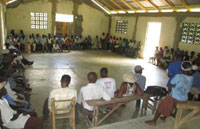
Haitians concerned about the impacts of unchecked mining meet at a sweltering tin-roofed church near Grand Bois on Jul. 5, 2013. Source: HGW/Lafontaine Orvild
Some 2,400 square kilometres have been parceled out to Haitian firms fronting for U.S. and Canadian concerns. Some estimate that Haiti’s mineral wealth – mostly gold, copper, and silver – could be worth as much as 20 billion dollars. The awarding of permits behind closed doors, with no independent or community oversight, has angered many in Haiti, who fear that the government is opening the country up to systematic pillage.
But the head of the government mining agency told Haiti Grassroots Watch (HGW) his concern is to assure that Haiti is made more “attractive” to potential investors.
“We need an attractive mining law,” said Ludner Remarais, head of the Mining and Energy Agency. “A mining law that will entice investors.” The current law is obsolete, according to Remarais.
Haiti’s “gold rush” has been going on for the past five years or so, since the price of gold and other minerals rose. Until last year, the government and the companies cut their deals behind closed doors. After an investigation revealed that 15 percent of the county was under contract, on Feb. 20, 2013 the Haitian Senate adopted a resolution demanding all activities cease in order to allow for a national debate and for analysis of all contracts.
“We are scrupulously respecting the decision,” Remarais said, but he added that the resolution does not annul the rights already acquired.
Peasant, human rights, food sovereignty and environmental organisations are worried about the disastrous effects the mining industry could have on water quality, farmland, and on the affected regions in general and have formed the national Collective Against Mining to assist local associations with information and consciousness-raising sessions.
On Jul. 5, over 200 farmers from the area around the Grand Bois deposit – about 11 kilometres south of Limbé, in the North department – got together to discuss the mining operation and their futures. They spoke of their worries for three hours in sweltering tin-roofed church.
“When someone talks about mining, our history makes us think of slavery, of the takeover of our farmlands,” said Willy Pierre, a social sciences teacher from a nearby school. “We could lose our fertile fields. We will be forced off our land. Where will we live?”
The Grand Bois deposit is rich in gold and copper, according to tests carried out by the Canadian mining company Eurasian Minerals. Eurasian owns the license given by the BME to its Haitian subsidiary, Société Minière Citadelle S.A. During the meeting, many people said they were nervous.
“This mining business should be a lesson for all of us,” warned Jean Vilmé, a farmer from the Bogé region of Grand Bois. “Not only will those of us who live around the mineral deposit perish, the entire country will be swallowed up!”
Two weeks earlier about 50 members of local and national organisations met in Jean Rabel, an impoverished town in the Northwest department with poor roads and no water system or health facilities. Participants watched and debated a video on mining in Haiti and discussed their next steps.
Earlier that month, some 60 representatives of the associations in the collective organised a day-long meeting at Montrouis, northeast of the capital. Of particular concern are the protection of ground water, food sovereignty, agricultural land, biodiversity, health, and land ownership.
 Print
|
Print
|




