
Sunday, October 18, 2026



News and Views from the Global South
Mexico City Marijuana Legalisation Would Challenge Conventional Approach
- If marijuana is legalised in the Mexican capital, as the local government proposes, this country would have to review its adherence to the three international drug control treaties, a trail already blazed by other nations.
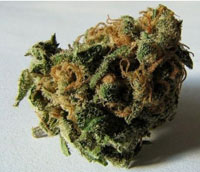
Dried cannabis flowers. Credit: CC BY 2.5
The Mexico City Federal District city council and the leftwing government of Mayor Miguel Mancera announced that debates would begin in September on health, economic and security aspects of marijuana, popularly known here as “mota”, and medical use might by approved by the end of the year.
“Several countries have questioned the drug control treaties for health reasons,” lawyer Fernando Gómez-Mont, former interior minister in the government of conservative president Felipe Calderón (2006-2012), told IPS. “This creates tension for the operation of the U.N. conventions,”
Under the General Health Law, amended in 2009, state governments have the authority to legislate on health issued related to illegal drugs. The law permits possession for personal use of five grams of marijuana, 500 milligrams of cocaine and 50 milligrams of heroin, but bans production, distribution and sale of these substances.
This country of 118 million people is a party to the Single Convention on Narcotic Drugs of 1961, the United Nations Convention Against Illicit Traffic in Narcotic Drugs and Psychotropic Substances of 1988 and the Convention on Psychotropic Substances of 1971.
“In Mexico, intermediate steps (on drug decriminalisation) may be taken without neighbouring countries necessarily having to follow suit. It is far more viable in the capital,” writer Jorge Castañeda, former foreign minister in the conservative government of Vicente Fox (2000-2006), told IPS.
“For example, in the United States some states have taken decisions of this kind,” said Castañeda, who has become a staunch advocate of decriminalisation.
Marijuana is the illegal drug that is most widely consumed in this country, followed by cocaine and inhalants, according to the 2011 National Addiction Survey published by the health ministry. Production of marijuana is concentrated in western and southern states.
Mexico is in urgent need of new approaches to illicit substances because of the humanitarian crisis unleashed by the repressive anti-drug strategy applied by Calderón throughout his presidency, which resulted in a high death toll and the spread of drug trafficking and drug use.
In 2012 there were 26,037 recorded homicides, a slight decline from the previous year, when there were 27,213. However, this remains one of the highest murder rates in Latin America, according to the National Institute of Statistics and Geography.
President Enrique Peña Nieto has rejected decriminalisation as a means of combating drug trafficking and is in favour of what he calls “a security strategy based on intelligence” – not very different from the policy enforced by his predecessor.
But changes in the global vision of the fight against drugs that are still illegal, especially marijuana, are exerting pressure for a shift towards policies based on prevention rather than repression and law enforcement. “We will be very responsible in this debate,” Manuel Granados, chair of the city council Governance Committee, told IPS.
“In Mexico City we agree on replacing criminal policies with health policies. We are ready to hold this debate and, at the right time, to legislate,” said the city council member, who belongs to the leftist Party of the Democratic Revolution (PRD) which governs the capital. The Federal District of Mexico City has been in the vanguard of decriminalising abortion and legalising same-sex marriage.
 Print
|
Print
|




