
Saturday, October 17, 2026



News and Views from the Global South
Conditions In Zimbabwe Worsen From El Niño Drought
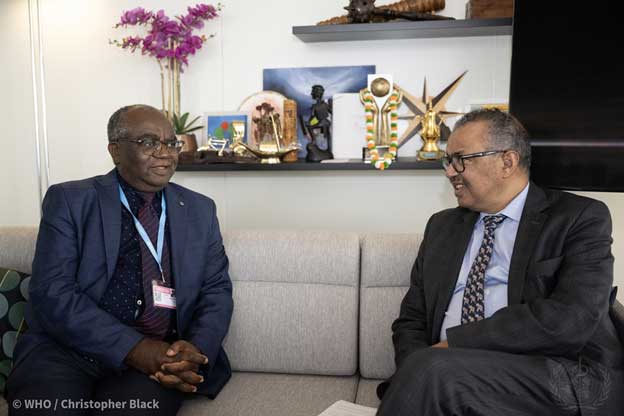
Director-General of the World Health Organization (WHO) Dr. Tedros Adhanom Ghebreyesus meets with Dr Wenceslas Nyamayaro, Acting Chief Director for Public Health of Zimbabwe to discuss the current issues dealing with health, wellbeing, and economy. Credit: Christopher Black/WHO Photo Library
- Half of Zimbabwe’s crops were destroyed and about 7.6 million people are at risk of acute hunger as a result of the El Niño weather phenomenon.
El Niño is a climate pattern that results from the unusual warming of surface waters in the eastern equatorial Pacific Ocean. El Niño is declared when sea temperatures in the tropical eastern Pacific rise 0.5°C above the long-term average. It’s impact varies, bringing droughts, floods and other disasters.
“More than half of the harvest was destroyed, and some 7.6 million people are now at risk of acute hunger,” Deputy Spokesperson for the Secretary-General Farhan Haq told a press briefing on August 7.
More than 5.9 million people are expected to face severe food insecurity early next year as the peak-hunger period approaches, he added.
In April 2024, the Zimbabwean president, Emmerson Mnangagwa, declared a nationwide state of disaster.
The UN Resident Coordinator in Zimbabwe, Edward Kallon, states, “This crisis has far-reaching consequences across sectors such as food and nutrition security, health, water resources, education and livelihoods.”
The El Niño drought resulted in several environmental issues in Zimbabwe, including reduced rainfall, increased temperatures, depleted rivers, and compromised air quality.
This is particularly troubling as Zimbabwe is heavily reliant on rainfall, which determines the success of crop production and livestock health. The efficacy of their agricultural system is crucial for the nation, as more than half of the population relies on it as a source of income. Additionally, agriculture accounts for roughly 15 percent of the nation’s gross domestic product.
As a result of decimating crop yields, roughly 42 percent of the population is faced with extreme poverty. This has led to young children being pulled out of school to join the workforce in an effort to keep their families afloat.
“The drought has strained Zimbabwe’s economy, with more than a fifth of school-aged children now out of school,” Haq said.
The El Niño drought has produced significant economic turmoil in Zimbabwe, putting families in a state of disarray as they struggle to make enough income to support themselves.
According to the UN Office for the Coordination of Humanitarian Affairs (OCHA), “more than 45,067 children dropped out of school, 3,000 more compared to the annual average. Currently, the El Niño-induced drought may result in increased school dropouts as families face increasing poverty levels, thus making it difficult to pay school fees.”
Furthermore, OCHA predicts that there will be higher rates of child marriages, violence against children, child migration, and child abandonment.
In addition to lower rates of education among children, they are the most vulnerable in terms of health. Due to widespread food insecurity and compromised diets, children are at high risk of succumbing to famine, malnutrition, and disease. The World Food Programme (WFP) states that approximately 27 percent of children in Zimbabwe have stunted growth.
Zimbabwean women are also highly vulnerable to socioeconomic issues as a result of the pressures caused by the drought. OCHA there has been an observed increase in sexual violence, domestic violence, and gender-based violence as a result of “heightened family tensions caused by crop damages and income losses.”
OCHA adds that rural communities have been hit the hardest. Rural communities in Zimbabwe account for the majority of the nation’s population, with roughly 62 percent working in agriculture.
Additionally, the drought had a detrimental impact on the nation’s water supply, with many rivers drying up and not expected to recover for years. This greatly limits access to clean water for many rural communities. OCHA states “35 percent of rural households were accessing inadequate water services, while 45 percent of rural households were traveling more than half a kilometer to fetch water”.
The diminishing access to clean water greatly exacerbates levels of poor hygiene and the spread of disease, particularly cholera, which continues to run rampant among poorer communities.
“The humanitarian community in Zimbabwe is also concerned that the scarcity and depletion of safe water resources could lead to an uptick in communicable diseases,” the Secretary-General’s spokesperson, Stéphane Dujarric, told a press briefing in April 2024.
OCHA adds that the risk of contracting infectious and waterborne diseases is significantly raised by the drought. The current cholera outbreak has been aggravated by poor hygiene practices as a result of the dry spells, with 591 deaths being reported between February 2023 and April 2024.
In addition, the drought increases the likelihood of developing malaria and maternity-related complications. Pregnant women are highly vulnerable to stillbirths, infections, miscarriages, and maternal mortality. OCHA adds that this is primarily due to the drought, which greatly limits resources essential for medication and quality of care.
Plans to mitigate the effects of the drought and assist communities in Zimbabwe are underway by the United Nations. “The UN and partners continue to work with the government to support response efforts. However, the USD 429 million flash appeal launched in May, which aims to assist more than 3 million people, is only about 11 percent funded,” Haq said.
IPS UN Bureau

 Print
|
Print
|




