
Wednesday, October 7, 2026



News and Views from the Global South
Opinion
The Americas have the Tools to Eliminate HIV, but Gaps in Access & Coverage remain, says PAHO

PAHO Director calls for expanded access to innovations such as oral and injectable PrEP, rapid testing, and HIV self-testing, while strengthening early diagnosis and timely treatment initiation to advance HIV elimination. Credit: PAHO
- The Region of the Americas has more tools than ever before to prevent, diagnose, and treat HIV, yet many of them are still not reaching everyone who needs them, Pan American Health Organization (PAHO) Director Jarbas Barbosa said during the opening session of the International AIDS Conference (AIDS 2026).
Dr. Barbosa emphasized that expanding access to innovations such as oral pre-exposure prophylaxis (PrEP), long-acting injectable PrEP, rapid testing, and HIV self-testing, together with strengthening early diagnosis and ensuring timely treatment initiation, will be essential to accelerate the elimination of HIV as a public health problem in the Region.
In his remarks, Dr. Barbosa highlighted that the Americas have repeatedly demonstrated that ambitious public health goals can be achieved through cooperation, scientific evidence, and strong health systems. He noted that the Region has eliminated polio and rubella and that several countries have eliminated mother-to-child transmission of HIV, achievements that provide a strong foundation for accelerating progress toward HIV elimination.
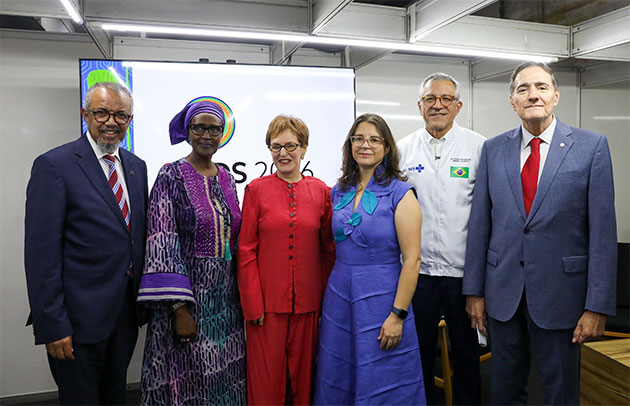
Credit: PAHO
He further stressed that achieving this goal will require combining innovations in prevention, diagnosis, and treatment with political leadership, equity, and close collaboration with communities.
Dr. Barbosa also noted that countries in Latin America and the Caribbean now finance 92% of HIV investments through domestic resources, representing one of the highest levels of domestic funding for HIV programs globally and demonstrating the Region’s sustained commitment to HIV response.
“The question before us is no longer whether we have the tools to end HIV as a public health threat. We do. The question is whether we can ensure that those tools reach everyone who needs them, regardless of where they live, who they are, or the circumstances they face,” said Barbosa. “Innovation only changes lives when people can access it.”
According to the latest available data, AIDS-related deaths in Latin America and the Caribbean declined by 46% between 2010 and 2025. In 2024 alone, access to antiretroviral treatment prevented an estimated 117,000 AIDS-related deaths. Access to PrEP also increased substantially, from 35,000 people in 2020 to more than 326,000 in 2025.
Despite this progress, significant gaps in access and coverage remain. Approximately one in three new HIV diagnoses is still made at a late stage of infection, and nearly 900,000 people living with HIV in Latin America and the Caribbean are not receiving treatment.
Reducing HIV-related mortality and addressing advanced HIV disease will be among PAHO’s key priorities at AIDS 2026. Although tools to prevent and treat HIV have improved substantially, late diagnosis, delays in treatment initiation, and challenges in retaining people in care continue to contribute to preventable deaths and to the burden of co-infections such as tuberculosis, which remains the leading cause of death among people with advanced HIV disease.
Against this backdrop, PAHO unveiled new initiatives aimed at accelerating HIV elimination across the Region.
As part of its agenda at AIDS 2026, PAHO launched the Alliance for HIV Elimination in the Americas, a new regional platform designed to advance progress toward HIV elimination by 2030 through stronger collaboration among governments, communities, international organizations, academia, development partners, and the private sector.
The Alliance is part of PAHO’s Disease Elimination Initiative and seeks to strengthen political leadership, expand equitable access to innovation, and promote sustainable investments to accelerate HIV elimination across the Americas.
PAHO is also advancing the Path to HIV Elimination in the Americas, an evidence-based framework that will help countries measure progress, identify remaining gaps, and demonstrate achievements on the path toward HIV elimination.
“If we maintain political commitment, protect the investments already made, and place equity at the center of every decision, ending HIV as a public health threat will be within our reach,” Barbosa said. “No country will achieve this goal alone.”
The PAHO Director warned that financial pressures, shifting political priorities, and persistent inequalities could jeopardize hard-won gains.
He reiterated that achieving HIV elimination will require strengthening people-centered health systems, expanding access to PrEP and other innovations, integrating HIV services with tuberculosis, viral hepatitis, and sexually transmitted infection services, working alongside communities to reduce stigma and discrimination, and sustaining the domestic investments that have enabled steady progress across the Region.
Throughout AIDS 2026, PAHO will advance these priorities through a series of high-level events focused on HIV elimination, advanced HIV disease, and equitable access to innovations for prevention, diagnosis, and treatment.
IPS UN Bureau


 Print
|
Print
|




