
Saturday, October 10, 2026



News and Views from the Global South
Combating Desertification and Drought
As Mongolia Hosts COP17, Pastoralists Demand Space to Move, Survive and Restore
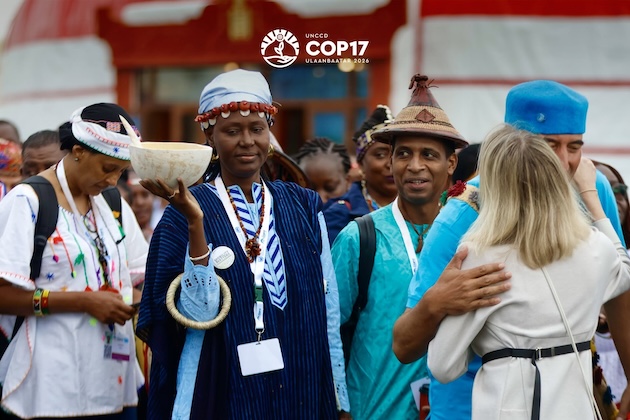
Participants in traditional dress take part in a cultural welcome at the UNCCD COP17 venue in Ulaanbaatar on Aug. 17, 2026, highlighting the cultural diversity of communities whose livelihoods are closely linked to rangelands. Credit: UN photo
- After moving more than 6,000 km across Eurasia, the Silk Road Caravan has reached Mongolia with stories from pastoralists whose livelihoods are increasingly threatened by drought, degraded land and shrinking access to grazing areas.
Since leaving Türkiye in May, the thud of horse hooves has echoed through landscapes in the Russian Federation, Uzbekistan, Kazakhstan, Kyrgyzstan and China. Along the way, its riders met pastoralists adapting to a harsher climate and deteriorating rangelands. Now their experiences have converged in Ulaanbaatar, where the caravan’s final leg coincides with the opening of COP17 of the United Nations Convention to Combat Desertification. Governments, scientists, financial institutions, businesses and civil society have gathered there to address the pressures on the world’s drylands.
The journey has brought an old question into the spotlight: can global efforts to restore rangelands succeed without the knowledge of the people who have managed them for generations?
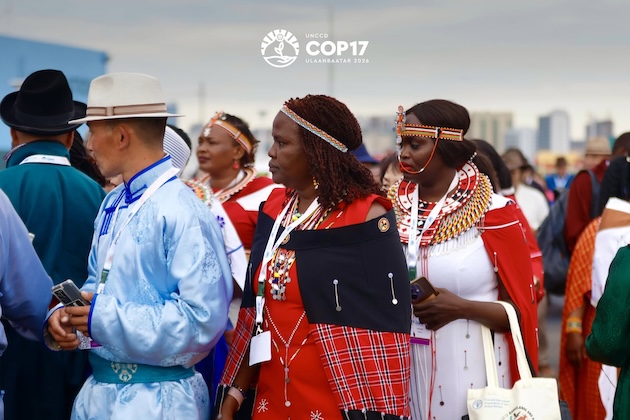
Delegates in traditional attire gather at the UNCCD COP17 venue in Ulaanbaatar, Mongolia, on Aug. 17, 2026, as the conference brings together pastoralists, Indigenous representatives and policymakers to discuss land degradation, drought and rangeland restoration. Credit: UN photo
For centuries, caravans travelling the ancient Silk Road carried goods, ideas and cultures between distant civilisations. This one has carried stories of communities trying to keep up their land productive and their livelihoods intact as drought and degradation spread across drylands from Eurasia to Africa.
Its arrival on the eve of COP17 highlights the conference’s challenge of turning commitments to land restoration into action on the ground.
Land Degradation
Land degradation and drought cost the global economy USD 900 billion annually and affect 40% of the world’s land and 3.2 billion people. Droughts have increased by almost one-third since 2000 and generate at least USD 300 billion in annual losses, according to UN data.
For Tanzania’s pastoralist communities, Neema Seki, an Indigenous women and youth advocate connected to the Pastoralist Women’s Council, urged world leaders in Ulaanbaatar to guarantee land security for pastoral communities.
“The most rapidly changing aspect is access to land. This by implication affects everything else in pastoral livelihoods. Without land tenure security, livestock health is impacted, mobility is affected, and family food security is affected,” she told IPS.
Her warning is central to the COP17 debate as land degradation increasingly threatens pastoralist women’s rights, livelihoods and mobility.
“In a pastoralist setting, women play a significant role that is oftentimes not stated. If livestock health deteriorates, women are mostly responsible for feeding them, bringing water from far distances to water the ailing or weak livestock,” Seki said.
She added that restrictions on pastoral livelihoods can also create a gendered burden that national climate and conservation policies rarely capture.
“Another aspect is a reality that when the pastoral livelihoods are dismantled by restrictions on access to resources, women oftentimes remain in the land to suffer while men are able to go into cities to look for work while women remain with children at home.”
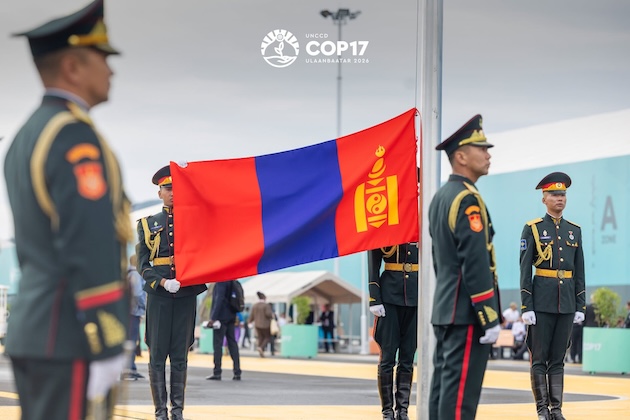
Mongolian ceremonial guards stand beside the national flag during the opening of UNCCD COP17 in Ulaanbaatar on Aug. 17, 2026. The conference is focused on accelerating global action on land restoration and drought resilience. Credit: UN photo
That experience is echoed thousands of kilometres away in Niger, where Abarchi Harouna, a pastoralist leader with the association Nodde Nooto and co-chair of the International Year of Rangelands and Pastoralists for West and Central Africa, argues that mobility itself is an environmental management tool.
“Mobility is essential to pastoralism because it allows livestock keepers to search for water, pasture and salt wherever they are available,” Harouna told IPS.
For nomadic pastoralists such as Tanzania’s Maasai, restricting traditional migration corridors directly affects livelihoods.
“When governments restrict access to traditional routes and water points, nomadic pastoralists are deprived of pasture, water and salt,” he said.
“This can lead to a pastoral crisis, with significant livestock deaths and even conflicts between farmers and herders.”
Relevance in Mongolia
Similar pressures are evident in Mongolia, where pastoralism is key to the economy, yet nearly 77 percent of the country’s land suffers from degradation. Rangelands cover about 70 percent of its territory and support the livelihoods of roughly one-third of the population, leaving pastoral communities exposed to climate shocks.
Rangelands cover 54% of the Earth’s land surface, support about 2 billion people and provide nearly 70% of global livestock feed and one-sixth of the world’s food. Yet up to half are degraded, particularly in dry regions facing mounting climate pressures.
Harouna challenges a persistent narrative that pastoralism itself is responsible for land degradation.
“Livestock keepers are never responsible for land degradation. This narrative is incorrect. Livestock mobility ensures the health of pastures.”
He points instead to the ecological functions performed by mobile herds.
“Animals carry the seeds of grasses and woody plants from one place to another, thereby enriching biological diversity.”
Manure, he said, fertilises soils, while trampling can loosen compacted ground.
“The knowledge of livestock keepers helps governments and all stakeholders restore degraded land and improve resilience to climate change.
For Seki, a similar knowledge system exists in Tanzania but is increasingly undermined by government policies.
“One of the greatest traditional knowledge practices by pastoralists which is being wrongly discouraged by government policies is pastoral mobility,” she said.
The implications extend to a younger generation that, despite the pressures, has not necessarily abandoned pastoralism.
“Young pastoralists still see pastoralism as the best livelihood system. They are, however, daily confronting the ugliness caused by state-restrictive policies and the climate crisis,” Seki said.
The Economics of Waiting
COP17 organisers are seeking to frame restoration not just as an environmental obligation but also as an economic investment.
The conference estimates that about USD 355 billion is needed every year to combat land degradation and drought, compared with the current investment of roughly USD 77 billion. That leaves an annual financing gap of USD 278 billion.
The private sector currently contributes only around six percent of global finance for land restoration and drought resilience.
Closing that gap will be central to the negotiations.
The conference will explore ways of reducing investment risks and encouraging businesses, financial institutions and governments to finance regenerative landscapes. An initiative linked to the COP has recorded commitments of more than USD 9 billion across more than 210 million hectares.
The argument for investment is strengthened by the potential returns: every dollar invested in drought resilience can generate returns of up to USD 10, while some nature-based solutions can generate benefits many times their cost.
UNCCD Executive Secretary Yasmine Fouad has described the challenge bluntly: “The world does not lack solutions; the challenge is taking them to scale.”
From Commitments to Measurable Results
Mongolia’s Prime Minister N. Uchral has called for a shift “from talk to action, from targets to implementation, and from commitments to measurable results”.
The conference comes at a time when multilateral cooperation faces pressure and the world’s environmental crises grow increasingly interconnected. Land degradation affects food production. Drought intensifies water insecurity. Loss of vegetation contributes to biodiversity decline. Livelihood losses can drive migration and deepen competition over scarce resources.
As the first of the three Rio Convention COPs being held in 2026, COP17 offers an opportunity to connect land policy with negotiations on biodiversity and climate change later in the year.
It is also taking place during the International Year of Rangelands and Pastoralists, giving pastoral communities a prominent place in the global policy calendar.
Seki argues that women and young people should be recognised as custodians of knowledge and resources.
“Women and young people play a great role in the pastoral system. This role extends to forest stewardship and resource management.”
Yet, she said, traditional knowledge often gets sidelined.
“Both women and young people are discouraged by state policies and conservation policies from using traditional knowledge for ecology and nature sustainability.”
COP17’s agenda includes a proposed policy framework on rangelands and pastoralists and the launch of a Rangelands Flagship Initiative aimed at attracting long-term investment into sustainable rangeland management and pastoral livelihoods.
For Harouna, restrictions on livestock mobility potentially affect agriculture, pastoral production and the environment. He warns that declining soil fertility could trigger dismal crop yields, while degraded grazing areas could foster invasive pests, consequently affecting livestock and reducing milk and meat supplies.
Exchange of Knowledge
The Silk Road Caravan’s final journey across Mongolia will take participants from the Gobi Desert to the country’s central forests and grasslands. They are expected to meet nomadic herder families, researchers, local authorities and pastoral cooperatives and visit restoration projects.
The challenge for delegates is to ensure the caravan’s lessons continue beyond the conference.
For dryland communities in Tanzania, Niger and Mongolia, restoration can determine whether livestock survive, families remain on their land, food production continues and ecosystems endure.
As the conference opens under the theme “Restoring Land. Restoring Hope”, its success may depend on whether the afflicted communities living on vulnerable landscapes receive the space, resources and recognition they need to restore and manage them.
IPS UN Bureau Report


 Print
|
Print
|




