
Thursday, October 8, 2026



News and Views from the Global South
Opinion
How Mexico’s Search Collectives Claimed a Place at the World Cup
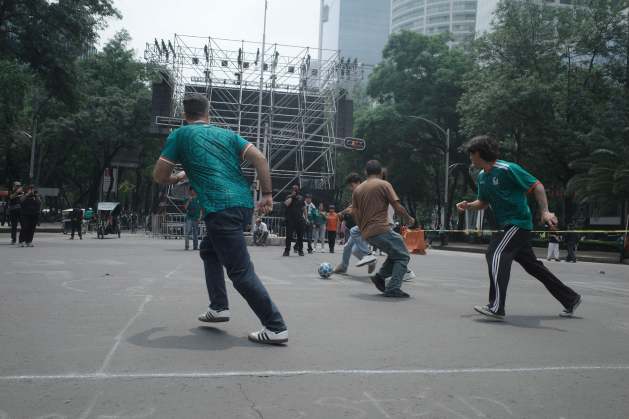
Passersby take part in a pickup football game organized by civilian search collectives on Mexico City's Paseo de la Reforma during the World Cup, July 2026. © 2026 Jorge Peniche/Human Rights Watch
- Weeks have gone by since the World Cup ended. Its aftermath has sparked a broader conversation about who football’s biggest tournament belongs to and how it should look in 2030. One postscript to that conversation comes from Mexico.
In a country with more than 100,000 people registered as disappeared, families searching for their loved ones confronted an unusual question: how do you participate in a national celebration while carrying the grief of a missing loved one?
While fans immersed themselves in 104 matches and the outcome for the teams they were cheering for, the answer by the civilian search collectives, who come together to find missing relatives amid state inaction and often face considerable risks, was disarmingly bold: neither to ignore the tournament nor reject it, but to claim a place in it.
In a country where football pitches can be found from volcanoes to fields of Mexican agave plants, they carved out a pitch of their own in the country’s most emblematic avenue. And then they played football.
Around 9 a.m., the chalk lines for another pitch began to appear on the asphalt of Paseo de la Reforma in Mexico City. It was Mexico’s final day as a World Cup host. Sixteen kilometers north of the Azteca Stadium, the “Glorieta de los Desaparecidos,” a roundabout reclaimed by families as a memorial in 2022, was preparing for another game. These were among the pickup games that collectives organized as spaces of remembrance during the tournament. Pickup games took place the days Mexico was playing.
“Preparations started one year before the initial kick-in,” Jorge Verástegui, one of the initiative’s organizers, told me.
His brother and nephew, Antonio and Antonio de Jesús, disappeared in the northern state of Coahuila in January 2009, when the Zetas cartel dominated much of the region.
“We were coming from a very frustrating year of dialogues with the government, so many of us, searching for our loved ones, asked how to engage with a World Cup taking place in Mexico,” he said, wearing a Mexican national team jersey emblazoned with a large picture of his brother. Organizers distributed over 300 similar jerseys, so families could add photos of their missing loved ones. Search collectives joined from across the country.
For César Contreras, a lawyer at Centro Prodh, a human rights group that has represented families for decades, football became a way “to collectivize joy but also reflect on how we got here.” The interventions wanted to challenge the stigma of disappearances as a “sad topic that nobody wants to hear about.”
When children joined, one father told Contreras he would later explain to his son who he had been playing with.
Supporters created the “Ajolote Buscador” a reworking of the salamander that is the city mascot, that became a regular presence at the pickup games. In Guadalajara, another Ajolote denounced the lack of resources for identification.
Mobilization was not without backlash from government authorities. U.N. experts raised concerns about restrictions faced by families while trying to make their voices heard. And violence against those seeking answers or accountability continued. During the World Cup, two searchers were killed, one in Guanajuato and another in Sinaloa.
Yet, as Andrea Horcasitas, one researcher who has worked alongside search collectives put it, “in a context marked by exclusion from the city and restricted access, collectives sent a message of belonging: this celebration is also ours, and here we are,”
Among the families who joined the pitches were Javier Barajas and María del Tránsito Piña, teachers who were originally from Guanajuato.
Their daughter, Guadalupe, disappeared in Salvatierra in February 2020. Her brother, Francisco Javier, joined the local search commission and helped locate her remains in one of Mexico’s largest mass graves. Three months later, he was killed. Investigations linked both crimes to the same criminal group. Their parents were later displaced from their home state.
Football was a family ritual, their mother told me. Francisco Javier and his mother watched matches together, while Javier and Guadalupe prepared the snacks.
“Now, I can’t watch football. It’s just too painful,” she said.
Yet the couple eventually found their way to the pitches. Barajas played several matches as a tribute to his son and daughter. For his wife, the pickup games offered a distinct space: “I can feel them when I wear that jersey with their photos.”
The resistance to FIFA’s commercialization projects is a reminder that we ultimately cherish these tournaments because of the stories they leave behind. Mexico’s search collectives offer one of them.
For the families, the work continues. Ensuring their security remains an urgent task, particularly in places where lethal violence against them concentrates. So does advancing investigations grounded in local realities and reducing the backlog in forensic identification.
Their message still resounds: this tournament was also theirs, because their stories are part of Mexico.
Jorge Peniche is a senior Americas researcher at Human Rights Watch.
 Print
|
Print
|




