
Thursday, November 12, 2026



News and Views from the Global South

Endangered Young Turtles Take to the Water
- Venezuela has broken a wildlife conservation record: in 15 years it has produced and protected 168,000 South American river turtle hatchlings. Under the supervision of experts, year-old members of this endangered freshwater species each April make their way to their permanent home, the Orinoco River.
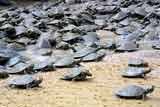
Young South American river turtles make their way to the Orinoco -
When workers from the turtle nursery lifted the net and opened the way to the beach for the young turtles, eight-year-old Priscilla exclaimed, “I'm so excited! The baby turtles are so cute, and we should do everything we can to protect them!”
The program has been under way since 1989, led by the Environment Ministry, producing 168,000 baby turtles in captivity, and later releasing them — fomenting hope that extinction will no longer loom over this species.
Two centuries ago, the South American river turtle, known in Spanish as the 'arrau', was abundant along the banks of the Orinoco and its tributaries.
Around 1800, the German naturalist Alexander Von Humboldt estimated that some two million female arrau laid eggs in the area of the Middle Orinoco, a 700-km stretch of the river (which extends 2,140 km) and 400 meters wide, running 400 km south of Caracas.
The arrau was declared in danger of extinction in the late 1990s. There were some years in which scientists counted fewer than 200 egg-laying females.
“Releasing 54,000 young turtles this year and reaching the total of 168,000 after 15 consecutive years is an historic achievement,” Eddys Solórzano, a biodiversity official from the Environment Ministry, said in a conversation with Tierramérica.
“It is a new record in Latin America,” boasted Environment Minister Ana Elisa Osorio.
The turtles are released along the banks of the Orinoco and its tributaries, and along the Casiquiare branch, which flows into the Negro River, and east to the Amazon. But the species is not exclusive to Venezuela. In Latin America, its habitat extends to Bolivia, Brazil, Colombia, Guyana and Peru.
“We know that in Brazil they are working with the arrau. They raise them and release them in their natural environment. Some releases have also taken place in Peru,” said Solórzano.
Among the predators of these turtles on land and in the water are fish, such as catfish, and, of course, large reptiles like the spectacled caiman (Caiman crocodilus).
“When they are not protected, five percent of the hatchlings are eaten by large birds,” said Marco Falcón, head of the Foundation for Development of the Sciences, another participant in the program.
But humans are the biggest enemy of the arrau. “I once ate 'sancocho de tortuga' (a turtle meat dish), but not anymore. I got involved in the conservation effort two years ago, and now I trade a chicken for the turtle if someone tries to kill one,” said Gustavo Morillo, 54, resident of Capachal, a community on the Orinoco.
“This is an isolated community. We don't have electricity or potable water. But I wouldn't eat turtle and I have never participated in hunting those creatures,” Lilian Rodríguez, from Santa María del Orinoco, told Tierramérica.
A single mother of three, Rodríguez grows beans, vegetables and fruit. Occasionally she receives food from the Environment Ministry or from relatives living in nearby towns.
“We are satisfied with what we have achieved in the communities. Now people turn in the turtles that end up in their nets when they are fishing. We have to keep motivating them,” said Solórzano, who acknowledges that in areas away from the refuges the illegal turtle trade prospers.
“A turtle sells for as much as 100 dollars. In the Upper Orinoco (south), eggs and turtles are sold to the miners,” says Jesús Ramos, director of the National Biological Diversity Office.
An adult arrau can weigh 25 kilos and measure 60 cm long or more. “They are eaten when they are half grown. A turtle that lays 100 eggs per year, for 60 to 80 years, produces 8,000 eggs over a lifetime, on average, but only one young turtle will reach adulthood. Only one will replace the adult,” says Omar Hernández, head of the effort to raise them in captivity and follow their progress after release.
The Environment Ministry and the Sciences Foundation monitor the eggs — up to 100 per nest — and make sure they are not plundered. Upon hatching, the young turtles, measuring five cm long and weighing 15 grams, are collected and transferred to the Amazon Research Station, set on the Orinoco, and their home for one year. They are raised in 100-square-meter tanks and an 80-meter lagoon.
At the nursery, the young turtles are fed concentrated products for fish, “high in protein and low in fat so that they grow quickly,” said Hernández.
A year later, when they measure 10 to 15 cm and weigh around 200 grams, they are released at sites like Playa del Medio “because they are places where the turtles hatch. This is where the arrau lays eggs,” explained Solórzano.
“We expect the situation of the species to improve. This year we have recorded at least 1,200 nests” in the Middle Orinoco zone, said Ramos. The figure is nothing near what Von Humboldt found 200 years ago, but at least it is an improvement over the recent past.
Every April release is witnessed by schoolchildren from the area, like Priscilla. They receive a lesson about the environment — and can never imagine themselves “eating baby turtles.”
 Print
|




